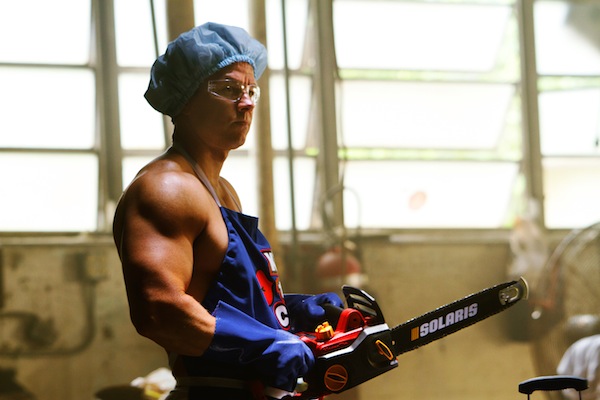
We've come full circle on another band, ladies and gentlemen. One of the earliest posts on this blog was my review for Ruining it For Everybody - the second full length album from avant-garde metalers iwrestledabearonce. It's now my pleasure to once again revisit the band and see what they've been up to in the years between with their latest album Late For Nothing.
As a preamble to the rest of my review, I have to say that there have been some pretty significant changes in the past year-and-a-half. Most notably, Krysta Cameron is no longer with the band having amicably parted ways in order to focus on her baby boy - who, by all photographic evidence, is completely adorable. In her place is Courtney LaPlante, who joined forces with the band to complete their Warped Tour 2012 obligations and ultimately became a permanent fixture in the lineup. Secondly, and much to the chagrin of YouTube commenters everywhere, the music of Late For Nothing is definitely a bit of a departure for the band and strays into some of the most organized and non-wacky sounds of their career. But I'm getting ahead of myself; let's break it down, Camacho!
THE PROS
Any lineup change is a potential risk, especially if the change is drastic. Fortunately for IWABO fans everywhere, Courtney LaPlante is a fantastic fit. In fact, she and Krysta are completely comparable as vocalists. They each have distinguishing strengths and weaknesses of course, but LaPlante's style isn't radically different from Cameron's and that's a good thing. If I had to make a distinction between the two of them, I would say that LaPlante's cleans are stronger than Cameron's by the same margin that Cameron's screams/growls are stronger than LaPlante's. If you're a longtime fan of the band, you'll definitely catch the shift between these two; but casual listeners or newcomers won't likely be as quick to notice the major differences.
As I mentioned before, Late For Nothing marks a considerably less "wacky" release for the band - at least comparably speaking. That's not entirely a bad thing, because IWABO has always had a knack for writing catchy hooks and choruses. The difference here is that there's a lot more "catchy" than "chaos" in this album. To that end, a small handful of the tracks really stick in your head with the first listen-through, and thankfully they're good tracks. "Boat Paddle" and "I'd Buy That For a Dollar" play around with melodies that alternately soar and glide in and around the signature double-bass schizophrenia and guitar work. The legendary Steve Vai even stops by during "Carnage Asada" with the kind of guest-solo face-meltage for which he's renown.
And before all this talk of comparatively tame music gets you down, Late For Nothing still contains IWABO's signature sound. Breakdowns alternate between low-end chugging riffs and high-end dissonant semitones, songs occasionally make a hard left into breezy, laid-back interludes only to explode again with ferocity seconds later, and - my favorite - the "spider riffs." That's a term I made up because of how distinctly visual it sounds to me, but one of the guitars hammers out a palm-muted riff while the other swiftly ascends a cacophonous scale of wicked sounds that flurry together in a kind of menacing web of aggression. Ya know, the delightfully deranged musicality for which this quintet is known.
THE CONS
I'm not going to dwell too much on this, but it bears mentioning: Late For Nothing does not contain the full-on insanity that made their first two albums stand out so noticeably. The album still stands out against your average run-of-the-mill metalcore release, but less so than their previous outings. As I mentioned in my review for Ruining It For Everybody, this is a trend that metalheads the world round just seem intrinsically unable to forgive. Once their favorite heavy band goes too "mainstream," it's time to break out the bad attitudes. Late For Nothing is not a mainstream album by any standard, and still contains some of the most intense moments in their discography. But, as I mentioned before, what endeared me so much to IWABO was how relentlessly hare-brained and truly avant-garde their music is - and I'm not "hating" on the band to say that Late For Nothing isn't really an avant-garde album.
THE VERDICT
Despite the journey into more accessible territory, I still enjoyed the hell outta this CD. Maybe I would be more butthurt by their musical evolution if I didn't see it coming, but before the release of Late For Nothing guitarist Steven Bradley said: "We didn’t want to make another weird IWABO album or whatever people were
expecting. We set out to make something different and better than
anything we’ve ever released. It’s a more evolved version of the band.
We explored new styles and genres as well—especially in terms of the
more spacey, epic, and beautiful parts. It’s got the most melodic
moments of our career as well as the heaviest." Couldn't have said it better myself...says the blogger who spent an entire review trying to anyway.
Going into the album with that in mind, the comparatively restrained approach didn't catch me off guard, so I was able to take it in stride - despite my hunger for a little more of the maniacal and psychotic IWABO. And while it doesn't have any bearing on the music specifically, the liner notes of this CD are a minor riot in themselves to read through. Guitarist John Ganey concludes his brief thank-you's with "PS. I'm Batman.".... Drummer Mikey Montgomery thanks "...God for all the health problems I inherited and the FDA for being sacks of shit and giving me more. Thanks to President Obama for flushing this country further down the shitter. Last but not least, thanks Chipotle. See you later today. Give me all the burritos." And "Ricky" (who I assume is bassist Mike "Rickshaw" Martin) concludes his thanks by saying: "A final 'thank you' goes out to weed, beer, whiskey, cheap bars, sexy women, vapes, PS3, XMEN, and the new girl."
Personally, I took some comfort in knowing that the band's evolution wasn't a move to get "more serious" or somehow shed the deranged image they had initially constructed. So while Late For Nothing isn't nearly as challenging or diverse an album as Ruining It For Everybody or the downright psychologically fractured It's All Happening, it's still far from boring and it's still undeniably iwrestledabearonce.
The moral of the story: go out and buy this album.
Thursday, August 8, 2013
Friday, July 26, 2013
The Wolverine
He's arguably the most popular of the X-Men, or at least Hugh Jackman's portrayal of him is. Logan, or as he's more commonly known "Wolverine," has already had one outing as a lead character in X-Men Origins: Wolverine and it didn't go so well. Despite sufficient commercial success, the film received a great deal of negative press - though Jackman's take on the character remained in the fan's and critics' good graces.
Initially envisioned as a sequel to Origins, The Wolverine went through a minor whirlwind of writers and directors before eventually securing James Mangold behind the camera. Having been at the helm of decidedly non-comic book fare (Walk the Line, Girl, Interrupted, and 3:10 to Yuma most notably) for most of his career, Mangold's involvement implied a more character-driven piece than most comic book films are known for being - though personally I was a little dismayed when Darren Aronofsky dropped off this project.
Emerging from a minor miasma of production delays and setbacks is a film that chronologically follows the events of X-Men: The Last Stand but succeeds as a standalone piece. Logan/Wolverine (Jackman) lives as a kind of mountain-man/hermit on the outskirts of a nondescript Yukon town, plagued by nightmares of Jean Grey (Famke Janssen) and surviving the bombing of Nagasaki long before the events of the first few X-Men films. Early on, he's approached by Yukio (Rila Fukushima), who tells him that a Japanese soldier he saved during the bombing named Yashida (Haruhiko Yamanouchi) is on the verge of death and wishes to thank Logan for saving his life all those years ago. Arriving in Tokyo, Logan discovers a much darker plan behind his being brought to Japan, suddenly pitted against ninjas, yakuza, Viper (played by Svetlana Kodchenkova) and - naturally - his own demons.
THE PROS
Fortunately, there are a lot of good things to say about this movie.
Taking the character completely out of his natural North American habitat is a fantastic setup, and the film makes wonderful use of the contrast. Accustomed to getting in bar-fights and shocking non-mutants with his vicious adamantium claws, Logan undergoes more than just culture shock once the action gets going. But rather than simply being another "white savior" narrative (e.g. The Last Samurai or 47 Ronin - whose trailer practically promises a dud), Logan is unwittingly swept away by the complexities of an epic family feud and the machinations of villains beyond his control. It's not something we've never seen before - the reluctant, cynical hero forced to get involved - but it's something that suits this character perfectly.
On top of that, the film's side characters are actually engaging and fleshed out (to varying extents) individuals with often complex motivations. Yukio acts as something of a companion to the Yashida family, who we discover adopted her at an early age. Despite her appearance - a kind of punk anime school girl - she demonstrates masterful skill with the katana and jokingly refers to herself as Logan's "bodyguard." Mariko Yashida, (Tao Okamoto) the granddaughter of the Yashida that Logan saved at the beginning of the film, becomes something of a love interest for Logan - despite the apparitions of Jean Grey that act as a manifestation of his psychological torment. Hiroyuki Sanada plays Shingen Yashida - Mariko's father, a son jilted out of his inheritance by the dying wish of an old man. So as you can see, the underlying framework of the narrative into which Logan is dropped is complex and engaging enough even before he shows up, thus it gives our hero a good deal to work with story-wise.
And no superhero movie is complete without the fight scenes. Though the first big outbreak of gunfire and Wolverine-rage gets a bit lost in the somewhat shaky-cam shuffle, the rest of the film wisely restrains itself in letting the action flow with a much more choreographed and structured grace. The visual effects are also tastefully deployed for the most part, relying on CGI only when necessary and not bludgeoning the audience with spectacle the way a handful of recent superhero films have seen fit to.
THE CONS
The Wolverine is not without flaw, though I'll say that overall its shortcomings are outweighed by its strengths.
My biggest beef with the film is that the main antagonist, Viper, isn't really the villain I hoped for. Kodchenkova plays the character with all the appropriate vampy beats, but as a character she's not very fleshed out or strong. This isn't always a bad move - especially considering how many characters this film asks you to keep track of - but Wolverine is such a strong character to begin with, he needs an equally strong character pitted against him.
As a number of critics have noted, the film's third act does stumble a bit. It couldn't really be avoided; a film like this has to pay off with a big epic showdown, and in this case it's effectively Wolverine versus Silver Samurai. Story-wise, again, it's the right kind of ending - but the film takes such pain to build a narrative that's more grounded and character-driven that it felt like more of a stretch than usual to suspend disbelief during the climactic conflict.
THE VERDICT
With movies like Man of Steel and Iron Man 3 letting their visual effects take a front seat to some of the more meaty aspects of their story, The Wolverine is a welcome change of pace. It's still a superhero movie, and even an occasionally predictable one, but the finesse with which its crafted and the tasteful presentation of most of the film's visual effects are what set it apart.
There's some real character development here, which is no easy trick considering how well-defined Wolverine already is. While The Wolverine has a very definite place in the sequence of events outlined in previous films, it feels much more like a standalone story than a sequel or a prequel or a whatever-quel. Even with a post-credits stinger that seems to set up the events of the upcoming X-Men: Days of Future Past, this movie exists as a narrative unto itself and doesn't require any pre-existing knowledge or understanding of the X-Men universe to truly appreciate. There are a handful of sight gags and references here and there, but The Wolverine isn't confined to the chronology of another film or series of films and as such explores its own story on its own time by its own rules - much like the title character.
The Wolverine doesn't fully ascend to the heights of the original X-Men, X2, or X-Men: First Class - but it's a vast improvement over Wolverine's Origins title. And Hugh Jackman still spends just enough time shirtless and raging to make it all worth while. So if you're getting tired of some of the excesses of more recent superhero films, The Wolverine is a welcome reprieve and return to form.
Initially envisioned as a sequel to Origins, The Wolverine went through a minor whirlwind of writers and directors before eventually securing James Mangold behind the camera. Having been at the helm of decidedly non-comic book fare (Walk the Line, Girl, Interrupted, and 3:10 to Yuma most notably) for most of his career, Mangold's involvement implied a more character-driven piece than most comic book films are known for being - though personally I was a little dismayed when Darren Aronofsky dropped off this project.
Emerging from a minor miasma of production delays and setbacks is a film that chronologically follows the events of X-Men: The Last Stand but succeeds as a standalone piece. Logan/Wolverine (Jackman) lives as a kind of mountain-man/hermit on the outskirts of a nondescript Yukon town, plagued by nightmares of Jean Grey (Famke Janssen) and surviving the bombing of Nagasaki long before the events of the first few X-Men films. Early on, he's approached by Yukio (Rila Fukushima), who tells him that a Japanese soldier he saved during the bombing named Yashida (Haruhiko Yamanouchi) is on the verge of death and wishes to thank Logan for saving his life all those years ago. Arriving in Tokyo, Logan discovers a much darker plan behind his being brought to Japan, suddenly pitted against ninjas, yakuza, Viper (played by Svetlana Kodchenkova) and - naturally - his own demons.
THE PROS
Fortunately, there are a lot of good things to say about this movie.
Taking the character completely out of his natural North American habitat is a fantastic setup, and the film makes wonderful use of the contrast. Accustomed to getting in bar-fights and shocking non-mutants with his vicious adamantium claws, Logan undergoes more than just culture shock once the action gets going. But rather than simply being another "white savior" narrative (e.g. The Last Samurai or 47 Ronin - whose trailer practically promises a dud), Logan is unwittingly swept away by the complexities of an epic family feud and the machinations of villains beyond his control. It's not something we've never seen before - the reluctant, cynical hero forced to get involved - but it's something that suits this character perfectly.
On top of that, the film's side characters are actually engaging and fleshed out (to varying extents) individuals with often complex motivations. Yukio acts as something of a companion to the Yashida family, who we discover adopted her at an early age. Despite her appearance - a kind of punk anime school girl - she demonstrates masterful skill with the katana and jokingly refers to herself as Logan's "bodyguard." Mariko Yashida, (Tao Okamoto) the granddaughter of the Yashida that Logan saved at the beginning of the film, becomes something of a love interest for Logan - despite the apparitions of Jean Grey that act as a manifestation of his psychological torment. Hiroyuki Sanada plays Shingen Yashida - Mariko's father, a son jilted out of his inheritance by the dying wish of an old man. So as you can see, the underlying framework of the narrative into which Logan is dropped is complex and engaging enough even before he shows up, thus it gives our hero a good deal to work with story-wise.
And no superhero movie is complete without the fight scenes. Though the first big outbreak of gunfire and Wolverine-rage gets a bit lost in the somewhat shaky-cam shuffle, the rest of the film wisely restrains itself in letting the action flow with a much more choreographed and structured grace. The visual effects are also tastefully deployed for the most part, relying on CGI only when necessary and not bludgeoning the audience with spectacle the way a handful of recent superhero films have seen fit to.
THE CONS
The Wolverine is not without flaw, though I'll say that overall its shortcomings are outweighed by its strengths.
My biggest beef with the film is that the main antagonist, Viper, isn't really the villain I hoped for. Kodchenkova plays the character with all the appropriate vampy beats, but as a character she's not very fleshed out or strong. This isn't always a bad move - especially considering how many characters this film asks you to keep track of - but Wolverine is such a strong character to begin with, he needs an equally strong character pitted against him.
As a number of critics have noted, the film's third act does stumble a bit. It couldn't really be avoided; a film like this has to pay off with a big epic showdown, and in this case it's effectively Wolverine versus Silver Samurai. Story-wise, again, it's the right kind of ending - but the film takes such pain to build a narrative that's more grounded and character-driven that it felt like more of a stretch than usual to suspend disbelief during the climactic conflict.
THE VERDICT
With movies like Man of Steel and Iron Man 3 letting their visual effects take a front seat to some of the more meaty aspects of their story, The Wolverine is a welcome change of pace. It's still a superhero movie, and even an occasionally predictable one, but the finesse with which its crafted and the tasteful presentation of most of the film's visual effects are what set it apart.
There's some real character development here, which is no easy trick considering how well-defined Wolverine already is. While The Wolverine has a very definite place in the sequence of events outlined in previous films, it feels much more like a standalone story than a sequel or a prequel or a whatever-quel. Even with a post-credits stinger that seems to set up the events of the upcoming X-Men: Days of Future Past, this movie exists as a narrative unto itself and doesn't require any pre-existing knowledge or understanding of the X-Men universe to truly appreciate. There are a handful of sight gags and references here and there, but The Wolverine isn't confined to the chronology of another film or series of films and as such explores its own story on its own time by its own rules - much like the title character.
The Wolverine doesn't fully ascend to the heights of the original X-Men, X2, or X-Men: First Class - but it's a vast improvement over Wolverine's Origins title. And Hugh Jackman still spends just enough time shirtless and raging to make it all worth while. So if you're getting tired of some of the excesses of more recent superhero films, The Wolverine is a welcome reprieve and return to form.
Friday, July 12, 2013
Pacific Rim
In 1975, Jaws became the first "summer blockbuster" - a high-concept film with numerous product tie-ins and promotions that made a fortune, breaking every box office record up to that point in time and remaining the seventh highest-grossing film adjusting for inflation. Like sharks drawn to blood in the water, studio execs began attempting to repeat the success of the summer blockbuster formula and we as a movie-going audience have come to expect as much ever since.
But the summer blockbuster has a bit of a black-eye for those who seek more substance in their entertainment, and with movies like the Transformers films (which were as monumentally profitable as they were critically panned) becoming standard procedure, it's easy to see how. If audiences just want to see a gigantic visual effects circus on screen for two hours, why agonize over the details of character development and engaging dialogue?
It was with these concerns floating around in my head that I sat down to enjoy Pacific Rim, the latest from Guillermo Del Toro. Pacific Rim has all the earmarks of a big, dumb summer blockbuster; it's effectively Godzilla vs. Transformers. But Del Toro has proven he has the directorial skill to make films that are both visually appealing, exciting, and still possessed of substance. If you've seen Pan's Labyrinth or the Hellboy movies you know what I'm talking about. So how does Pacific Rim fare?
THE PROS
I've mentioned before on this blog that we as an audience are pretty desensitized to visual effects by now. They've become so commonplace in our films that we don't experience the breathtaking moments of films like the original Jurassic Park with the same wide-eyed wonder any more. Del Toro knows this pretty well, and while the quality of the visual effects in Pacific Rim was very much par for the course - it's their presentation that marks them as stand-out. Again, the premise is simple: massive monsters (called kaiju, Japanese word for monster) erupt from a fissure deep at the bottom of the ocean to wreak havoc on the world above. In retaliation, the world creates the Jaeger Program - humanoid robots of equal size controlled by two pilots inside who fight the kaiju and protect humanity. Almost immediately after the movie starts we get a taste of the action as the protagonist (Charlie Hunnam) and his co-pilot battle a beast amidst the icy waves just off the coast of Antarctica. But instead of a camera that hustles in and out of the action, spinning madly around as CGI splashes chaotically everywhere - we get to actually see the fight between the two gargantuan foes. Shots are framed to convey the maximum amount of awesome and the near-complete absence of any "shaky-cam" effect was a welcome sight.
In films like Transformers and even this year's mildly underwhelming Man of Steel - the action is so frenetic and speedy that I often feel completely removed from it; I know that there's some fighting going on, but I can't tell who's winning or what's actually happening in the fight apart from the fact that an entire metropolitan area is being laid to waste. And don't get me wrong, Pacific Rim has real estate reduction to equal or rival those films. But the difference is that there's a definite coordination, a choreography even, to these sky-high slug-fests that makes them a genuine joy to watch. You can tell when one of the kaiju is overwhelming its opponent, and you cringe and curse as you watch it gain the upper hand. On the flipside, you can surmise when one of the jaegers is about to bring the pain with a massive finishing move, and your adrenaline rises just in time to see the heroes seize the moment with a perfect strike.
But all of that can easily be negated without at least a modicum of character development and involvement. Pacific Rim's writing and characters are not without flaw (I'll discuss that in the next section), but there's definitely enough here to latch onto. Being a summer blockbuster of this kind, the movie has a handful of "archetypes" it has to supply. For example, you need a wise and cautious leader who commands respect but isn't just another hard-ass. Idris Elba fills this role as Commanding Officer Pentecost, and while he never says these words, Elba pulls off the role with just enough "I'm-getting-too-old-for-this-sh*t" to make it work. At the lead of these kinds of movies, you often have a young and overly confident soldier. You know the type: the guy who flings the rule book out the window and takes the kinds of damn fool chances that will get us all killed. Charlie Hunnam's Raleigh Becket is that character, and while Hunnam's performance leaves a bit to be desired - the campy beats of his character are what really matter. Opposite him is Mako Mori (Rinko Kikuchi), whose dream of being a jaeger pilot comes to fruition alongside some tastefully restrained sexual tension with Hunnam's character.
Naturally, you need the "scientist" character in a movie like this, and Pacific Rim has two! Charlie Day plays Dr. Newton Geizler, an expert on the kaiju and would-be hero. Geizler is more or less another one of Day's typical characters - a goofy and somewhat neurotic fellow who just barely straddles the line between "too much" and "just enough." Dr. Herman Gottlieb (Burn Gorman) is the more stereotypical "scientist" character of the two, and his thick English accent and pompous disdain for his colleague act as a perfect foil to Geizler's hare-brained notions. Gorman hams up his role perfectly, pretentiously walking on a cane and getting flustered by any challenges to his theories as the mismatch between these two characters provides the film with some appropriate comic relief.
THE CONS
As I mentioned before, I was pretty disappointed by Hunnam's performance. You can see him reaching for the stereotype; trying to be that campy action hero who always has the perfect quip and mouths off to his commanding officers. But Hunnam just doesn't seem to have the acting chops to pull it off and much of the dialogue thrown his way is more or less wasted on him. It's not like he's surrounded by Oscar-winning performances or anything, but for my money Hunnam's misfires keep Pacific Rim from reaching the heights I think it otherwise could have.
Along the same lines, the script isn't terribly sterling either. While Hunnam's performance is still pretty bad, to his credit he doesn't have a whole lot to work with. Even many of the actors falter here or there with some of the lines that border on just too cheesy or overwrought. It's certainly not enough to bring the whole thing down, but a few stray snickers peppered the audience more often than I think Del Toro intended.
THE VERDICT
Considering the two flaws I mentioned above, Pacific Rim had a pretty tall order to fill. But for a movie whose protagonist I disliked so strongly, I found myself willing to overlook its flaws in favor of its other strengths. The big battles between the jaegers and kaiju are pitch perfect in that they start pretty big and get increasingly bigger without sacrificing any of the substance that makes us actually care about the outcome.
Pacific Rim is a movie that defies logic in favor of spectacle, as many blockbusters often do, so if you're one of those movie-goers that just wants to find plot holes you'll find plenty to keep you occupied here. But again, it's the presentation that really matters in a movie like this. For example, during one of the big fight scenes, one of the jaegers seems on the brink of annihilation. We know they're out of all the weapons we've seen them use so far - one of the pilots says something to the effect of "We're out of weapons!" To which the other pilot coolly replies "No, we have one more..." (or something like that, I'm paraphrasing here, you get the picture) and then deploys this massive sword that practically slices the kaiju in half. Well, c'mon guys, if that weapon is as effective as it seems, why not start with that and then break out the missiles or whatever later? Because then we don't get this great "AW YESSSSS!" moment at the eleventh hour when we think our heroes are sure to perish. And, again, the spectacle of these moments is what really sells them. So when that superblade unloads and locks into place Power Rangers-style and you see just how they're going to get out of this scrape, you practically want to leap out of your seat and cheer with excitement despite the obvious tactical oversight.
That's the true spirit of Pacific Rim; just enough substance to get away with being a style-over-substance movie.
And on top of that, said style is still accessible and enjoyable. If you don't find yourself getting pretty pumped at least a few times in this movie ("Is that...? Is that jaeger gonna beat that kaiju to death with a friggin' cargo ship...? AWESOME!"), then perhaps the cynicism induced by movies like Transformers has just gone untreated for too long. Pacific Rim proves that big, dumb blockbusters don't really have to be "big, dumb blockbusters." That certainly doesn't mean you'll be converted if you're not into these kinds of movies from the get-go. But if you're in the mood for good summer blockbuster type movie, Pacific Rim is one of the best we've had this year.
But the summer blockbuster has a bit of a black-eye for those who seek more substance in their entertainment, and with movies like the Transformers films (which were as monumentally profitable as they were critically panned) becoming standard procedure, it's easy to see how. If audiences just want to see a gigantic visual effects circus on screen for two hours, why agonize over the details of character development and engaging dialogue?
It was with these concerns floating around in my head that I sat down to enjoy Pacific Rim, the latest from Guillermo Del Toro. Pacific Rim has all the earmarks of a big, dumb summer blockbuster; it's effectively Godzilla vs. Transformers. But Del Toro has proven he has the directorial skill to make films that are both visually appealing, exciting, and still possessed of substance. If you've seen Pan's Labyrinth or the Hellboy movies you know what I'm talking about. So how does Pacific Rim fare?
THE PROS
I've mentioned before on this blog that we as an audience are pretty desensitized to visual effects by now. They've become so commonplace in our films that we don't experience the breathtaking moments of films like the original Jurassic Park with the same wide-eyed wonder any more. Del Toro knows this pretty well, and while the quality of the visual effects in Pacific Rim was very much par for the course - it's their presentation that marks them as stand-out. Again, the premise is simple: massive monsters (called kaiju, Japanese word for monster) erupt from a fissure deep at the bottom of the ocean to wreak havoc on the world above. In retaliation, the world creates the Jaeger Program - humanoid robots of equal size controlled by two pilots inside who fight the kaiju and protect humanity. Almost immediately after the movie starts we get a taste of the action as the protagonist (Charlie Hunnam) and his co-pilot battle a beast amidst the icy waves just off the coast of Antarctica. But instead of a camera that hustles in and out of the action, spinning madly around as CGI splashes chaotically everywhere - we get to actually see the fight between the two gargantuan foes. Shots are framed to convey the maximum amount of awesome and the near-complete absence of any "shaky-cam" effect was a welcome sight.
In films like Transformers and even this year's mildly underwhelming Man of Steel - the action is so frenetic and speedy that I often feel completely removed from it; I know that there's some fighting going on, but I can't tell who's winning or what's actually happening in the fight apart from the fact that an entire metropolitan area is being laid to waste. And don't get me wrong, Pacific Rim has real estate reduction to equal or rival those films. But the difference is that there's a definite coordination, a choreography even, to these sky-high slug-fests that makes them a genuine joy to watch. You can tell when one of the kaiju is overwhelming its opponent, and you cringe and curse as you watch it gain the upper hand. On the flipside, you can surmise when one of the jaegers is about to bring the pain with a massive finishing move, and your adrenaline rises just in time to see the heroes seize the moment with a perfect strike.
But all of that can easily be negated without at least a modicum of character development and involvement. Pacific Rim's writing and characters are not without flaw (I'll discuss that in the next section), but there's definitely enough here to latch onto. Being a summer blockbuster of this kind, the movie has a handful of "archetypes" it has to supply. For example, you need a wise and cautious leader who commands respect but isn't just another hard-ass. Idris Elba fills this role as Commanding Officer Pentecost, and while he never says these words, Elba pulls off the role with just enough "I'm-getting-too-old-for-this-sh*t" to make it work. At the lead of these kinds of movies, you often have a young and overly confident soldier. You know the type: the guy who flings the rule book out the window and takes the kinds of damn fool chances that will get us all killed. Charlie Hunnam's Raleigh Becket is that character, and while Hunnam's performance leaves a bit to be desired - the campy beats of his character are what really matter. Opposite him is Mako Mori (Rinko Kikuchi), whose dream of being a jaeger pilot comes to fruition alongside some tastefully restrained sexual tension with Hunnam's character.
Naturally, you need the "scientist" character in a movie like this, and Pacific Rim has two! Charlie Day plays Dr. Newton Geizler, an expert on the kaiju and would-be hero. Geizler is more or less another one of Day's typical characters - a goofy and somewhat neurotic fellow who just barely straddles the line between "too much" and "just enough." Dr. Herman Gottlieb (Burn Gorman) is the more stereotypical "scientist" character of the two, and his thick English accent and pompous disdain for his colleague act as a perfect foil to Geizler's hare-brained notions. Gorman hams up his role perfectly, pretentiously walking on a cane and getting flustered by any challenges to his theories as the mismatch between these two characters provides the film with some appropriate comic relief.
THE CONS
As I mentioned before, I was pretty disappointed by Hunnam's performance. You can see him reaching for the stereotype; trying to be that campy action hero who always has the perfect quip and mouths off to his commanding officers. But Hunnam just doesn't seem to have the acting chops to pull it off and much of the dialogue thrown his way is more or less wasted on him. It's not like he's surrounded by Oscar-winning performances or anything, but for my money Hunnam's misfires keep Pacific Rim from reaching the heights I think it otherwise could have.
Along the same lines, the script isn't terribly sterling either. While Hunnam's performance is still pretty bad, to his credit he doesn't have a whole lot to work with. Even many of the actors falter here or there with some of the lines that border on just too cheesy or overwrought. It's certainly not enough to bring the whole thing down, but a few stray snickers peppered the audience more often than I think Del Toro intended.
THE VERDICT
Considering the two flaws I mentioned above, Pacific Rim had a pretty tall order to fill. But for a movie whose protagonist I disliked so strongly, I found myself willing to overlook its flaws in favor of its other strengths. The big battles between the jaegers and kaiju are pitch perfect in that they start pretty big and get increasingly bigger without sacrificing any of the substance that makes us actually care about the outcome.
Pacific Rim is a movie that defies logic in favor of spectacle, as many blockbusters often do, so if you're one of those movie-goers that just wants to find plot holes you'll find plenty to keep you occupied here. But again, it's the presentation that really matters in a movie like this. For example, during one of the big fight scenes, one of the jaegers seems on the brink of annihilation. We know they're out of all the weapons we've seen them use so far - one of the pilots says something to the effect of "We're out of weapons!" To which the other pilot coolly replies "No, we have one more..." (or something like that, I'm paraphrasing here, you get the picture) and then deploys this massive sword that practically slices the kaiju in half. Well, c'mon guys, if that weapon is as effective as it seems, why not start with that and then break out the missiles or whatever later? Because then we don't get this great "AW YESSSSS!" moment at the eleventh hour when we think our heroes are sure to perish. And, again, the spectacle of these moments is what really sells them. So when that superblade unloads and locks into place Power Rangers-style and you see just how they're going to get out of this scrape, you practically want to leap out of your seat and cheer with excitement despite the obvious tactical oversight.
That's the true spirit of Pacific Rim; just enough substance to get away with being a style-over-substance movie.
And on top of that, said style is still accessible and enjoyable. If you don't find yourself getting pretty pumped at least a few times in this movie ("Is that...? Is that jaeger gonna beat that kaiju to death with a friggin' cargo ship...? AWESOME!"), then perhaps the cynicism induced by movies like Transformers has just gone untreated for too long. Pacific Rim proves that big, dumb blockbusters don't really have to be "big, dumb blockbusters." That certainly doesn't mean you'll be converted if you're not into these kinds of movies from the get-go. But if you're in the mood for good summer blockbuster type movie, Pacific Rim is one of the best we've had this year.
Friday, May 3, 2013
Iron Man 3
This film needs little introduction.
Marvel has been whistling a happy tune all the way to the bank now for the better part of five years; basically since the first Iron Man movie was a smash hit at the box office and opened the floodgates for the series leading up to The Avengers. The Iron Man series has been my favorite thus far, and that's largely due to Robert Downey Jr.'s perfect portrayal of the inimitable Tony Stark.
Iron Man 3 opens on a Tony Stark who is suffering from what appears to be some mild PTSD after the events of The Avengers. He can't sleep, he's beginning to experience panic attacks, he spends even more time than usual "tinkering," and his relationship with Pepper Potts (Gwyneth Paltrow) is visibly shaky. And right as Stark is battling his own personal crisis, the world once again falls victim to the chaos of another supervillain: The Mandarin (Ben Kingsley). It's a familiar setup with familiar faces and familiar visual effects; so how does it stack up both as its own movie and part of a larger series?
THE PROS
Again, Downey's performance is perfection. In the same way Tony Stark "owns" the fact that he is Iron Man, so too does Robert Downey Jr. own the fact that he is Tony Stark. It's as if he doesn't even really act the part, because he is the part. His dialogue here is as caustic and humorous as it's ever been, and even amidst some of the more crippling crises in the film he brings the usual aplomb. All of the returning cast (Gwyneth Paltrow, Jon Favreau, Don Cheadle, the voice of Paul Bettany) does a marvelous job with their roles, as can be expected. Newcomers to the franchise include Guy Pearce as Aldrich Killian and, as mentioned before, Ben Kingsley. Both of them supply performances worthy of the franchise, and not in ways you might necessarily expect. Without giving anything away, there's a small twist in Iron Man 3 that requires both these actors to approach their characters differently before film's end - and they handle the transition flawlessly.
During a temporary setback in the course of the film's events, Stark finds himself stranded in a small town in Tennessee where he finds something of a sidekick in a kid named Harley (Ty Simpkins, of Insidious notoriety). The banter between these two provides some of the film's (maybe even the entire franchise's) most memorable moments, as Simpkins and Downey evince an easy chemistry.
What's an Iron Man film without lots of fun explosions and visual effects-laden action sequences, right? Iron Man 3 delivers the goods in that department with the usual craftsmanship we've come to expect from this genre. We've entered an era in visual effects where they're both so recurrent across genres and so well polished that we don't even really notice them any more. By that I mean I caught myself not even really inspecting the visual effects the way I often do because they fit right in with everything else going on in the film. Not a huge surprise there, to be honest, but still worth noting.
A number of subtle but appropriate references to the previous films (including The Avengers) help Iron Man 3 fit into the growing mythology of this series, but the film still has an identity independent of the other entries. That identity, however, still isn't quite what it once was...
THE CONS
Remember the rock-n-roll swagger of the first film? To me, that's what sets the Iron Man movies apart from the other Avengers flicks, and I was sad to see it largely cast aside. There's no AC/DC in the soundtrack, the iconic Black Sabbath ballad isn't musically mentioned, and Brian Tyler's soundtrack barely resembles the aggressive confidence of Ramin Djawadi's - and to a lesser extent, John Debney's. This isn't a true flaw, to be fair. But it was something that I missed not having this go 'round.
Another element that isn't an actual flaw but just something I was disappointed to experience was the tone of the film. The trailers and ad campaigns surrounding the release of Iron Man 3 have billed it - directly and indirectly - as a sort of "dark chapter" in the series. You've seen the commercials; Stark's home destroyed by helicopters, Stark - broken but undefeated - dragging his suit through a lonely snowfall, shots of Pepper Potts in seemingly impossible situations of danger, the works. I went into this expecting something like an Empire Strikes Back moment - where the plight of our heroes is more grim than ever before. But, for better or worse, that doesn't really describe the film at all. True, all of the events shown in the trailer happen in the film, but they're tied together by an almost comical whimsy. This isn't a bad thing, don't get me wrong; I laughed along with the rest of the theater time and time again because Iron Man 3 is probably the funniest of the trilogy. But I expected something a little more dark and gritty. Yes the Hollywood rhetoric surrounding those buzzwords has rendered them almost meaningless, but I was still a bit disappointed.
THE VERDICT
Don't let my personal disappointments with the film dissuade you, because Iron Man 3 is still a worthy installment to the franchise and a solid film in its own right. While I wish I could have had a different set of expectations going into it, I still enjoyed the hell out of this movie.
In a lot of ways it works better as a post-Avengers film than a true Iron Man sequel, which makes complete sense given the direction Marvel is going with their entire brand right now. All the right Marvel touches appear, including Stan Lee's cameo and a brief post-credits scene. But with that territory comes the loss of a few things that really endeared me to Iron Man as its own franchise when this whole thing began. They're minor complaints, I know, but ones I left the theater unable to shake.
Still, the heart of this franchise is Robert Downey, Jr.'s singular portrayal of the title character, and that heart is preserved true to form. During an interview on the Daily Show, Downey indicated that his initial contract for three films is up and he is currently renegotiating. Here's hoping the head honchos at Marvel know better than to let him slip away.
Marvel has been whistling a happy tune all the way to the bank now for the better part of five years; basically since the first Iron Man movie was a smash hit at the box office and opened the floodgates for the series leading up to The Avengers. The Iron Man series has been my favorite thus far, and that's largely due to Robert Downey Jr.'s perfect portrayal of the inimitable Tony Stark.
Iron Man 3 opens on a Tony Stark who is suffering from what appears to be some mild PTSD after the events of The Avengers. He can't sleep, he's beginning to experience panic attacks, he spends even more time than usual "tinkering," and his relationship with Pepper Potts (Gwyneth Paltrow) is visibly shaky. And right as Stark is battling his own personal crisis, the world once again falls victim to the chaos of another supervillain: The Mandarin (Ben Kingsley). It's a familiar setup with familiar faces and familiar visual effects; so how does it stack up both as its own movie and part of a larger series?
THE PROS
Again, Downey's performance is perfection. In the same way Tony Stark "owns" the fact that he is Iron Man, so too does Robert Downey Jr. own the fact that he is Tony Stark. It's as if he doesn't even really act the part, because he is the part. His dialogue here is as caustic and humorous as it's ever been, and even amidst some of the more crippling crises in the film he brings the usual aplomb. All of the returning cast (Gwyneth Paltrow, Jon Favreau, Don Cheadle, the voice of Paul Bettany) does a marvelous job with their roles, as can be expected. Newcomers to the franchise include Guy Pearce as Aldrich Killian and, as mentioned before, Ben Kingsley. Both of them supply performances worthy of the franchise, and not in ways you might necessarily expect. Without giving anything away, there's a small twist in Iron Man 3 that requires both these actors to approach their characters differently before film's end - and they handle the transition flawlessly.
During a temporary setback in the course of the film's events, Stark finds himself stranded in a small town in Tennessee where he finds something of a sidekick in a kid named Harley (Ty Simpkins, of Insidious notoriety). The banter between these two provides some of the film's (maybe even the entire franchise's) most memorable moments, as Simpkins and Downey evince an easy chemistry.
What's an Iron Man film without lots of fun explosions and visual effects-laden action sequences, right? Iron Man 3 delivers the goods in that department with the usual craftsmanship we've come to expect from this genre. We've entered an era in visual effects where they're both so recurrent across genres and so well polished that we don't even really notice them any more. By that I mean I caught myself not even really inspecting the visual effects the way I often do because they fit right in with everything else going on in the film. Not a huge surprise there, to be honest, but still worth noting.
A number of subtle but appropriate references to the previous films (including The Avengers) help Iron Man 3 fit into the growing mythology of this series, but the film still has an identity independent of the other entries. That identity, however, still isn't quite what it once was...
THE CONS
Remember the rock-n-roll swagger of the first film? To me, that's what sets the Iron Man movies apart from the other Avengers flicks, and I was sad to see it largely cast aside. There's no AC/DC in the soundtrack, the iconic Black Sabbath ballad isn't musically mentioned, and Brian Tyler's soundtrack barely resembles the aggressive confidence of Ramin Djawadi's - and to a lesser extent, John Debney's. This isn't a true flaw, to be fair. But it was something that I missed not having this go 'round.
Another element that isn't an actual flaw but just something I was disappointed to experience was the tone of the film. The trailers and ad campaigns surrounding the release of Iron Man 3 have billed it - directly and indirectly - as a sort of "dark chapter" in the series. You've seen the commercials; Stark's home destroyed by helicopters, Stark - broken but undefeated - dragging his suit through a lonely snowfall, shots of Pepper Potts in seemingly impossible situations of danger, the works. I went into this expecting something like an Empire Strikes Back moment - where the plight of our heroes is more grim than ever before. But, for better or worse, that doesn't really describe the film at all. True, all of the events shown in the trailer happen in the film, but they're tied together by an almost comical whimsy. This isn't a bad thing, don't get me wrong; I laughed along with the rest of the theater time and time again because Iron Man 3 is probably the funniest of the trilogy. But I expected something a little more dark and gritty. Yes the Hollywood rhetoric surrounding those buzzwords has rendered them almost meaningless, but I was still a bit disappointed.
THE VERDICT
Don't let my personal disappointments with the film dissuade you, because Iron Man 3 is still a worthy installment to the franchise and a solid film in its own right. While I wish I could have had a different set of expectations going into it, I still enjoyed the hell out of this movie.
In a lot of ways it works better as a post-Avengers film than a true Iron Man sequel, which makes complete sense given the direction Marvel is going with their entire brand right now. All the right Marvel touches appear, including Stan Lee's cameo and a brief post-credits scene. But with that territory comes the loss of a few things that really endeared me to Iron Man as its own franchise when this whole thing began. They're minor complaints, I know, but ones I left the theater unable to shake.
Still, the heart of this franchise is Robert Downey, Jr.'s singular portrayal of the title character, and that heart is preserved true to form. During an interview on the Daily Show, Downey indicated that his initial contract for three films is up and he is currently renegotiating. Here's hoping the head honchos at Marvel know better than to let him slip away.
Thursday, May 2, 2013
Pain, Gain, and the Case for (and Against) Michael Bay
Pain and Gain took the #1 spot at the box office last weekend, and once again the relentless march of Michael Bay hatred (Bay-tred!) spread through the internet like a pretentious plague. Countless keyboard colonels took to their Rotten Tomatoes profiles and Facebook statuses and Twitter feeds to find ever-predictable ways to turn the title of the film into some snarky pun:
"Michael Bay = More pain than gain." Cried James Verniere, of the Boston Herald.
"Pain and Gain brings the pain, but it's difficult to see the gain." Opined Tom Long of the Detroit News.
But cynicism wasn't the only thing offered in response to Bay's latest film. Amidst the predictable displeasure, there was also a smattering of positive comments - not the least of which came from Richard Roeper:
"Kudos to Bay and his screenwriters for making sure we're laughing at (the characters), and not with them."
He went on to give the film a 'B,' and is among a relatively substantial group of critics - professional and otherwise - who weren't completely underwhelmed by the effort. In fact, it seems the response to Bay's film runs right down the middle with about half giving it a negative review and everyone else giving it the proverbial thumbs up.
Now, what I want to do with this post is both review Pain and Gain as well as address all the Bay-tred floating around these days. It's not that I think he's undeserving of much of the criticism leveled against him, because he is. But there's a lot more to him than the Transformers movies and, more importantly, there's a lot less to most of his detractors than they seem to realize. Plus, at the end of the day...
First things first, let's do a quick roll call. If you are a professional film critic, studied film in college, and/or have seen a minimum of 5 non-English-language films in your life time - you are excused.
Everyone else, if you do not fall into one of the categories mentioned above and have contributed to Bay-tred, come on in. Take a seat, prop your feet up, and release your clammy grip on condescension long enough to appreciate a change of perspective because Pain and Gain is the perfect Michael Bay movie. What I mean by that is it's a film that brilliantly outlines exactly for what Bay should and shouldn't be vilified. It's perfect in places, and a total wreck in others - resulting in a film that's largely a mixed bag, just like its director. But Michael Bay isn't treated like a mixed bag, he's treated like, well...
And attempting the same experiment on other film makers - even those with worse track records at the box office and in critic's corners - doesn't yield nearly as vitriolic a reaction. Take Tyler Perry for example...
He's more prolific than Bay and even has roughly the same average RT rating across his filmography (Perry's average, 31%; Bay's average 33%). But Perry doesn't make the same kinds of movies Michael Bay does so...how about Roland Emmerich? The man behind box office-bomb-and-blockbuster-alike (Independence Day, The Day After Tomorrow, Stargate, Godzilla) still fairs better than Bay; the worst Google auto-complete suggestion being "...is the worst director ever." Let's broaden the scope a bit and conduct the same experiment on the ever controversial and polarizing Quentin Tarantino. Opinions regarding his body of work (both for and against) are arguably just as vehement as those regarding Bay's, yet even Google's first four suggestions include both "...is a hack" and "...is a genius." And make no mistake; I don't mean to equate the content of Bay's work with Tarantino's; Sir Quentin is in a league all his own. What I'm trying to do is build a case for the fact that Bay's punishment does not match his crime and that Bay-tred is just another godawful trend.
Remember this movie?
Almost every Bay-basher I have encountered seems to have forgotten it. And, upon its recollection - namely how absolutely badass it is - found their Bay-tred thwarted, by however small a margin. Apart from being just a fun film, The Rock features a laundry list of "good movie" qualities; a sympathetic and multi-dimensional villain, memorable characters with concrete motivations, an engaging plot, and Sean Connery. It's currently the only Michael Bay film to have a "Certified Fresh" rating on Rotten Tomatoes (holding at 67%), so clearly this man is capable of making a film that's critically and commercially successful. That's got to count for something, right? Which brings me to my next point...
Rotten Tomatoes isn't a scientifically accurate endeavor by any means; but as an aggregate of professional and amateur opinions alike, it's a good way to generally judge a film's reception and in many cases - by extension - its quality. And after the initial flurry of reviews, that average becomes a fairly solid statistic - a few stray positive or negative reviews here and there don't impact its overall rating. Because in order to significantly change the rating of a film like, say, Transformers after its rating was thus solidified - it would take a great deal of extremely negative ratings to drag the average down. Well when it came out, the first Transformers film earned a rating of 65%; the second film initially achieved a 25% rating. In the years after their release, these two films saw a plummet - to 57% and 20%, respectively - that can really only be explained by users either going back and changing their existing rating or a whole new batch of fingers pounding out negative reviews ex post facto. (For the record, the third film's rating hasn't changed from the 36% it achieved during opening weekend).
So then we can surmise that Bay-tred has a retroactive effect, which is just patently unfair. Going back to further deride a work in the past based purely on your at-zero-and-falling opinion of the director in the present is both mean-spirited and illogical. If anything, usually the passage of time nets the opposite results; we tend to forget how bad things actually were as their memory fades a little. And what do we usually remember from the Transformers films? Mostly the explosions, the colossal spectacles of CGI, and Megan Fox objectified in every possible cinematic way.
Far greater cinematic sin has been committed time and time again (I refer you to the previously mentioned ouevre of Monsieurs Perry and Emmerich) but without nearly the same level of backlash; their RT scores haven't budged at all in recent memory. Michael Bay has been maligned I tell ya!
Alright, getting back to Pain and Gain...
The film follows the mostly true story (a fact that's used almost as a bludgeoning tool during its 2-hour + run time) of Danny Lugo (Mark Wahlberg), a body builder and fitness freak in Miami during the 90s. He hatches a scheme with his cohorts (played by Anthony Mackie and Dwayne "The Rock" Johnson) to kidnap and extort money from Victor Kershaw (Tony Shalhoub), a foul-mouthed and all-around scumbag gym client of Lugo's. The logic of the main characters and (partially, at least) the film is that Kershaw deserves what's coming to him because he's such a sleazy dude. One count of attempted murder, two counts of "accidental" manslaughter, assault, theft, swooping Dutch angles, and only two explosions later - the film reaches its conclusion with a lead character who essentially learns nothing from his crimes or the death penalty he received for them.
It seemed like a mostly pointless endeavor with no perspective or message to be gleaned, but then I took note of the song rolling over the credits: Coolio's "Gangsta's Paradise." For those of you in the audience who have Weird Al's lyrics to "Amish Paradise" overriding any recollection of the original lyrics (and I am among you), there are a number of lines in that song that speak directly to the goings on of the film. Cruise through these lyrics for reference - and I freely admit I turned to Google to get them:
As I walk through the valley of the shadow of death
I take a look at my life and realize there's nothin' left
Cause I've been blasting and laughing so long,
That even my mama thinks that my mind is gone
But I ain't never crossed a man that didn't deserve it
Me be treated like a punk you know that's unheard of
You better watch how you're talking and where you're walking
Or you and your homies might be lined in chalk
I really hate to trip but I gotta loc
As they croak, I see myself in the pistol smoke, fool
I'm the kinda G the little homies wanna be like
On my knees in the night saying prayers in the streetlight
As mentioned before, a big part of the film's logic revolves around the idea that Lugo "never crossed a man that didn't deserve it" and when "treated like a punk" more than one person ends up "lined in chalk."
Look at the situation they got me facin'
I can't live a normal life, I was raised by the streets
So I gotta be down with the hood team
Too much television watching got me chasing dreams
I'm an educated fool with money on my mind
Got my 10 in my hand and a gleam in my eye
I'm a loc'd out gangsta set trippin' banger
And my homies is down so don't arouse my anger, fool
Death ain't nothing but a heartbeat away,
I'm living life, do or die, what can I say
I'm 23 now, but will I live to see 24
The way things are going I don't know
This verse almost reads like it was pulled from the script. A handful of times Lugo mentions how he saw something "in a movie" or "on tv" that gives him the motivation and instruction on how to proceed, and a minor subplot involves his idolization of a scam artist/motivational speaker (Ken Jeong) who teaches his followers to be "doers." Before the end of the film, "I'm a do'er!" is practically Lugo's mantra.
But the song has an almost evangelical edge, as the refrain "Tell me why are we so blind to see? That the ones we hurt are you and me..." reminds the listener that the idea of a "Gangsta's Paradise" isn't something being here glorified. Pain and Gain shares this in common with its de facto theme song, because despite the undeniable energy present in the film - the actions of the main characters aren't really glorified. If anything they're cast in an almost condescending satire; even the film's tagline "Their American dream is bigger than yours" echoes this self-deprecating sentiment. Ultimately both the song and the film are nihilistic endeavors, though Coolio's iconic ballad is clearly the greater of the two. Still, it was in this moment that I saw Bay tying everything together thematically. The movie is still a mess, but it's a mess that messes up less than many a mess can confess.
So how does all of this calculate into the Bay-tred discussion?
Well like it or not, Michael Bay is no idiot. Quite the contrary, he's completely self-aware. Rather famously he once quipped: "I make movies for teenage boys. Oh dear, what a crime." That's not Uwe Boll challenging his critics to a boxing match, or Tom Cruise overreacting to basically any attack on Scientology; that's Michael Bay's artistic integrity.
Yes, I said it. Michael Bay has a singular vision for each of his films that usually includes almost pornographic levels of explosions and visual effects, and he's unwilling to compromise that vision in order to please the hordes of bloggers and vloggers and loggers (I assume lumberjacks dislike him, I don't have any hard data on that) who continually rip on his movies. That's called artistic integrity; not sophisticated artistic integrity, but integrity nonetheless, and Pain and Gain is practically bursting at the seams with this middle-finger attitude.
I didn't think Pain and Gain was that great of a movie. It gets some things completely right: Bay is wise to treat the camera like the limitless tool it can be and slings handheld camerawork, steadicam moments, snorricam shots, Dutch angles, swooping passes, and every conceivable camera trick at the audience like promotional frisbees. It's also excessive in the right ways - humor here is not in subtlety or nuance of dialogue but in the sheer quantity of outrageous events and moments that continue to keep coming down the pike, one after another.
What it doesn't get right are things usually regarded as more important...like character development, and the fact that the film gives you cause to sympathize with criminals responsible for some pretty heinous acts. Still, the movie itself has a presentation and style all its own and edges its way towards the grindhouse aesthetic with sufficient confidence.
Pain and Gain is an intentionally thought-provoking film, though there's no denying it's still the poor man's Fargo.
And as for the man behind the film, it's high-time to give him his due. Being a bankable director in this day and age isn't half as easy most of the Macbook-and-beard-combo-at-Starbucks crowd would have you believe. Bay has carved a niche for himself as a blockbuster director with a singular, if predictable, vision. And just because that vision involves extravagant budgets and basically all the special effects doesn't make it illegitimate. What makes it illegitimate are things like paper-thin characters, egregious plot holes, and subpar writing. But if you're going to take his movies to task for these offenses you've got to do so everywhere you find them, and there's not always a big sign that says "Hey! This movie was made by someone you once heard was a hack! Sweeping generalizations within!"
So if you dislike Michael Bay's films, fine. As a general rule, I'm not crazy about them myself. But don't fuel the Bay-tred just because it makes you sound cynically intellectual or because that's what's popular. There are plenty of reasons to deride his movies; they're often racially insensitive, they relentlessly objectify women, and they're rarely - if ever - intellectually stimulating. But if finding fault with Michael Bay and his movies is just another way you pass the time, that's just plain-ol'-lame-ol'-Bay-tred.
Here, put yourself to this test:
1. If you're about to say something bad about Michael Bay but can't at least name a film by Federico Fellini, Frank Capra, Francois Truffaut, Andrei Tarkovsky, etc...that's Bay-tred.
2. If your blood is curdled by the fact that Transformers: Dark of the Moon is the 5th highest-grossing movie of all-time, but you haven't paid money to see an art house film within the past year...that's Bay-tred.
3. If you've ever said something mean about Michael Bay, but don't even know what he looks like...that's Bay-tred.
Here, I'll even give you a hand with that last one.
Michael Bay just wants to make movies that he thinks are fun. Those movies make a lot of money, so at the end of the day he's just livin' the dream. If you don't like it, go get your own.
And just say no to Bay-tred.
"Michael Bay = More pain than gain." Cried James Verniere, of the Boston Herald.
"Pain and Gain brings the pain, but it's difficult to see the gain." Opined Tom Long of the Detroit News.
But cynicism wasn't the only thing offered in response to Bay's latest film. Amidst the predictable displeasure, there was also a smattering of positive comments - not the least of which came from Richard Roeper:
"Kudos to Bay and his screenwriters for making sure we're laughing at (the characters), and not with them."
He went on to give the film a 'B,' and is among a relatively substantial group of critics - professional and otherwise - who weren't completely underwhelmed by the effort. In fact, it seems the response to Bay's film runs right down the middle with about half giving it a negative review and everyone else giving it the proverbial thumbs up.
Now, what I want to do with this post is both review Pain and Gain as well as address all the Bay-tred floating around these days. It's not that I think he's undeserving of much of the criticism leveled against him, because he is. But there's a lot more to him than the Transformers movies and, more importantly, there's a lot less to most of his detractors than they seem to realize. Plus, at the end of the day...
![]() |
|
♫That’s
what blogs are foooor!♫
|
First things first, let's do a quick roll call. If you are a professional film critic, studied film in college, and/or have seen a minimum of 5 non-English-language films in your life time - you are excused.
Everyone else, if you do not fall into one of the categories mentioned above and have contributed to Bay-tred, come on in. Take a seat, prop your feet up, and release your clammy grip on condescension long enough to appreciate a change of perspective because Pain and Gain is the perfect Michael Bay movie. What I mean by that is it's a film that brilliantly outlines exactly for what Bay should and shouldn't be vilified. It's perfect in places, and a total wreck in others - resulting in a film that's largely a mixed bag, just like its director. But Michael Bay isn't treated like a mixed bag, he's treated like, well...
![]() |
| Bay-bashers once again proving they apparently don't know what subtlety is either. |
And attempting the same experiment on other film makers - even those with worse track records at the box office and in critic's corners - doesn't yield nearly as vitriolic a reaction. Take Tyler Perry for example...
![]() |
| Tyler Perry Island: Literally No One's Vacation Destination |
He's more prolific than Bay and even has roughly the same average RT rating across his filmography (Perry's average, 31%; Bay's average 33%). But Perry doesn't make the same kinds of movies Michael Bay does so...how about Roland Emmerich? The man behind box office-bomb-and-blockbuster-alike (Independence Day, The Day After Tomorrow, Stargate, Godzilla) still fairs better than Bay; the worst Google auto-complete suggestion being "...is the worst director ever." Let's broaden the scope a bit and conduct the same experiment on the ever controversial and polarizing Quentin Tarantino. Opinions regarding his body of work (both for and against) are arguably just as vehement as those regarding Bay's, yet even Google's first four suggestions include both "...is a hack" and "...is a genius." And make no mistake; I don't mean to equate the content of Bay's work with Tarantino's; Sir Quentin is in a league all his own. What I'm trying to do is build a case for the fact that Bay's punishment does not match his crime and that Bay-tred is just another godawful trend.
Remember this movie?
![]() |
| Special thanks to Dwayne Johnson for making every conversation about this movie an Abbot and Costello routine |
Almost every Bay-basher I have encountered seems to have forgotten it. And, upon its recollection - namely how absolutely badass it is - found their Bay-tred thwarted, by however small a margin. Apart from being just a fun film, The Rock features a laundry list of "good movie" qualities; a sympathetic and multi-dimensional villain, memorable characters with concrete motivations, an engaging plot, and Sean Connery. It's currently the only Michael Bay film to have a "Certified Fresh" rating on Rotten Tomatoes (holding at 67%), so clearly this man is capable of making a film that's critically and commercially successful. That's got to count for something, right? Which brings me to my next point...
Rotten Tomatoes isn't a scientifically accurate endeavor by any means; but as an aggregate of professional and amateur opinions alike, it's a good way to generally judge a film's reception and in many cases - by extension - its quality. And after the initial flurry of reviews, that average becomes a fairly solid statistic - a few stray positive or negative reviews here and there don't impact its overall rating. Because in order to significantly change the rating of a film like, say, Transformers after its rating was thus solidified - it would take a great deal of extremely negative ratings to drag the average down. Well when it came out, the first Transformers film earned a rating of 65%; the second film initially achieved a 25% rating. In the years after their release, these two films saw a plummet - to 57% and 20%, respectively - that can really only be explained by users either going back and changing their existing rating or a whole new batch of fingers pounding out negative reviews ex post facto. (For the record, the third film's rating hasn't changed from the 36% it achieved during opening weekend).
So then we can surmise that Bay-tred has a retroactive effect, which is just patently unfair. Going back to further deride a work in the past based purely on your at-zero-and-falling opinion of the director in the present is both mean-spirited and illogical. If anything, usually the passage of time nets the opposite results; we tend to forget how bad things actually were as their memory fades a little. And what do we usually remember from the Transformers films? Mostly the explosions, the colossal spectacles of CGI, and Megan Fox objectified in every possible cinematic way.
![]() |
| PICTURED: Not the worst thing to happen to her career. |
Far greater cinematic sin has been committed time and time again (I refer you to the previously mentioned ouevre of Monsieurs Perry and Emmerich) but without nearly the same level of backlash; their RT scores haven't budged at all in recent memory. Michael Bay has been maligned I tell ya!
Alright, getting back to Pain and Gain...
The film follows the mostly true story (a fact that's used almost as a bludgeoning tool during its 2-hour + run time) of Danny Lugo (Mark Wahlberg), a body builder and fitness freak in Miami during the 90s. He hatches a scheme with his cohorts (played by Anthony Mackie and Dwayne "The Rock" Johnson) to kidnap and extort money from Victor Kershaw (Tony Shalhoub), a foul-mouthed and all-around scumbag gym client of Lugo's. The logic of the main characters and (partially, at least) the film is that Kershaw deserves what's coming to him because he's such a sleazy dude. One count of attempted murder, two counts of "accidental" manslaughter, assault, theft, swooping Dutch angles, and only two explosions later - the film reaches its conclusion with a lead character who essentially learns nothing from his crimes or the death penalty he received for them.
It seemed like a mostly pointless endeavor with no perspective or message to be gleaned, but then I took note of the song rolling over the credits: Coolio's "Gangsta's Paradise." For those of you in the audience who have Weird Al's lyrics to "Amish Paradise" overriding any recollection of the original lyrics (and I am among you), there are a number of lines in that song that speak directly to the goings on of the film. Cruise through these lyrics for reference - and I freely admit I turned to Google to get them:
As I walk through the valley of the shadow of death
I take a look at my life and realize there's nothin' left
Cause I've been blasting and laughing so long,
That even my mama thinks that my mind is gone
But I ain't never crossed a man that didn't deserve it
Me be treated like a punk you know that's unheard of
You better watch how you're talking and where you're walking
Or you and your homies might be lined in chalk
I really hate to trip but I gotta loc
As they croak, I see myself in the pistol smoke, fool
I'm the kinda G the little homies wanna be like
On my knees in the night saying prayers in the streetlight
As mentioned before, a big part of the film's logic revolves around the idea that Lugo "never crossed a man that didn't deserve it" and when "treated like a punk" more than one person ends up "lined in chalk."
Look at the situation they got me facin'
I can't live a normal life, I was raised by the streets
So I gotta be down with the hood team
Too much television watching got me chasing dreams
I'm an educated fool with money on my mind
Got my 10 in my hand and a gleam in my eye
I'm a loc'd out gangsta set trippin' banger
And my homies is down so don't arouse my anger, fool
Death ain't nothing but a heartbeat away,
I'm living life, do or die, what can I say
I'm 23 now, but will I live to see 24
The way things are going I don't know
This verse almost reads like it was pulled from the script. A handful of times Lugo mentions how he saw something "in a movie" or "on tv" that gives him the motivation and instruction on how to proceed, and a minor subplot involves his idolization of a scam artist/motivational speaker (Ken Jeong) who teaches his followers to be "doers." Before the end of the film, "I'm a do'er!" is practically Lugo's mantra.
| See? |
But the song has an almost evangelical edge, as the refrain "Tell me why are we so blind to see? That the ones we hurt are you and me..." reminds the listener that the idea of a "Gangsta's Paradise" isn't something being here glorified. Pain and Gain shares this in common with its de facto theme song, because despite the undeniable energy present in the film - the actions of the main characters aren't really glorified. If anything they're cast in an almost condescending satire; even the film's tagline "Their American dream is bigger than yours" echoes this self-deprecating sentiment. Ultimately both the song and the film are nihilistic endeavors, though Coolio's iconic ballad is clearly the greater of the two. Still, it was in this moment that I saw Bay tying everything together thematically. The movie is still a mess, but it's a mess that messes up less than many a mess can confess.
So how does all of this calculate into the Bay-tred discussion?
Well like it or not, Michael Bay is no idiot. Quite the contrary, he's completely self-aware. Rather famously he once quipped: "I make movies for teenage boys. Oh dear, what a crime." That's not Uwe Boll challenging his critics to a boxing match, or Tom Cruise overreacting to basically any attack on Scientology; that's Michael Bay's artistic integrity.
Yes, I said it. Michael Bay has a singular vision for each of his films that usually includes almost pornographic levels of explosions and visual effects, and he's unwilling to compromise that vision in order to please the hordes of bloggers and vloggers and loggers (I assume lumberjacks dislike him, I don't have any hard data on that) who continually rip on his movies. That's called artistic integrity; not sophisticated artistic integrity, but integrity nonetheless, and Pain and Gain is practically bursting at the seams with this middle-finger attitude.
I didn't think Pain and Gain was that great of a movie. It gets some things completely right: Bay is wise to treat the camera like the limitless tool it can be and slings handheld camerawork, steadicam moments, snorricam shots, Dutch angles, swooping passes, and every conceivable camera trick at the audience like promotional frisbees. It's also excessive in the right ways - humor here is not in subtlety or nuance of dialogue but in the sheer quantity of outrageous events and moments that continue to keep coming down the pike, one after another.
What it doesn't get right are things usually regarded as more important...like character development, and the fact that the film gives you cause to sympathize with criminals responsible for some pretty heinous acts. Still, the movie itself has a presentation and style all its own and edges its way towards the grindhouse aesthetic with sufficient confidence.
Pain and Gain is an intentionally thought-provoking film, though there's no denying it's still the poor man's Fargo.
And as for the man behind the film, it's high-time to give him his due. Being a bankable director in this day and age isn't half as easy most of the Macbook-and-beard-combo-at-Starbucks crowd would have you believe. Bay has carved a niche for himself as a blockbuster director with a singular, if predictable, vision. And just because that vision involves extravagant budgets and basically all the special effects doesn't make it illegitimate. What makes it illegitimate are things like paper-thin characters, egregious plot holes, and subpar writing. But if you're going to take his movies to task for these offenses you've got to do so everywhere you find them, and there's not always a big sign that says "Hey! This movie was made by someone you once heard was a hack! Sweeping generalizations within!"
So if you dislike Michael Bay's films, fine. As a general rule, I'm not crazy about them myself. But don't fuel the Bay-tred just because it makes you sound cynically intellectual or because that's what's popular. There are plenty of reasons to deride his movies; they're often racially insensitive, they relentlessly objectify women, and they're rarely - if ever - intellectually stimulating. But if finding fault with Michael Bay and his movies is just another way you pass the time, that's just plain-ol'-lame-ol'-Bay-tred.
Here, put yourself to this test:
1. If you're about to say something bad about Michael Bay but can't at least name a film by Federico Fellini, Frank Capra, Francois Truffaut, Andrei Tarkovsky, etc...that's Bay-tred.
2. If your blood is curdled by the fact that Transformers: Dark of the Moon is the 5th highest-grossing movie of all-time, but you haven't paid money to see an art house film within the past year...that's Bay-tred.
3. If you've ever said something mean about Michael Bay, but don't even know what he looks like...that's Bay-tred.
Here, I'll even give you a hand with that last one.
![]() |
| "...and tomorrow they're putting in something called HERO squad." |
Michael Bay just wants to make movies that he thinks are fun. Those movies make a lot of money, so at the end of the day he's just livin' the dream. If you don't like it, go get your own.
And just say no to Bay-tred.
Monday, April 8, 2013
Evil Dead (2013)
Hollywood these days is obsessed with remakes and reboots. You've probably seen the depressing info-graphics charting the decline of original work over the course of the past two decades or so, and I'm certainly not one to occasionally bemoan the lack of originality coming out of our film industry. Having said that, I enjoy a good remake when they come along. It takes a different kind of creativity to successfully update and reproduce an older work, especially when the original has already made a name for itself.
So when news broke that Evil Dead - Sam Raimi's 1981 horror classic - was getting the reboot treatment I was fairly ambivalent. But as I heard more about the project, specifically that Raimi and Bruce Campbell (who played the iconic lead character, Ash, of the original Evil Dead trilogy) had both signed off on the project and given it their official blessing, my interest was piqued. Their direct involvement with the project only further fueled my excitement to see the film and after all the mounting hype I was downright thrilled to sit down and finally see it this past weekend.
The setup should be familiar even to those who haven't seen the original: a group of teenagers go off to an isolated cabin in the woods (the original Evil Dead essentially began the whole "cabin in the woods" horror subgenre) and find themselves under attack from demonic forces. One by one, each of the characters meets a grisly end until only one of them is left. That about sums up the plot of both films....plus gallons and gallons of fake blood and gore. But we'll get to that...
THE PROS
As a fan of the original films (Evil Dead, Evil Dead 2: Dead by Dawn, and Army of Darkness) I was keen to discern where the remake would decide to adhere to the original and where it would diverge. I'm happy to say that both categories - the things that stayed the same and the things that changed - mostly work in the film's favor, which is no easy trick.
To begin with, the character setup is a bit different. There's still the 3-girls-and-2-guys lineup, though the character's names are changed. On top of this, the motivations behind the individual characters serve to flesh out details absent from the original. For example, in the original - our leads make the trek up to their lonely cabin with the intent of spending their Spring Break there. It's a totally plausible premise, but there's no underlying conflict within - a difference where I think the remake is a bit stronger. In the remake, the youths are gathered at the cabin to help their friend Mia (Jane Levy) kick her drug habit. As part of this, her brother David has decided to join, though we find out through expositional dialogue that the death of their mentally unstable mother has left them estranged. In their mother's final days, David abandoned the family and left Mia to tend her. I personally thought this was a much stronger subplot for a couple of reasons. First, it underscores the events of the film with some narrative tension right off the bat. Secondly, once things start veering into more horror movie territory, it was much more plausible for Mia's friends and her brother to wave off her ramblings about "something in the woods" as symptoms of her withdrawal...as opposed to saying she was just attacked by an animal.
Most of the acting in this film was fairly subpar, which made Jane Levy's fantastic performance a saving grace. Her transformation from estranged sister, to tweaking junkie, to full-on possessed by demons and vomiting blood or self-mutilating was fantastically convincing. Evil Dead owes a great deal of its success to the strength of her performance, given how relatively underwhelming - even for a horror film - the rest of the performances were.
On the flip side, a number of details from the original were kept almost exactly the same. The layout of the cabin and the woodshed nearby is almost a carbon copy, which lent the project a kind of welcome nostalgia amidst the bloodshed. A handful of events from the original film(s) also see a reappearance, with minor changes. For example, one of the more memorable moments from Evil Dead 2 saw Bruce Campbell's hand possessed, which forced him to remove the appendage himself with his trusty chainsaw. In this Evil Dead, a similar hand-possession scene occurs that forces Natalie (Elizabeth Blackmore) to remove her hand with an oscillating electric kitchen knife. Already gory, the film offers up one of its more grisly morsels when the power to the cabin suddenly goes out, leaving Natalie's arm dangling from a few remaining unsevered strands of flesh.
Which brings me to my next point: the gore. Evil Dead is touting itself as "one of the most terrifying films you'll ever experience." While it isn't that so much, it's definitely one of more gory films you'll ever experience. If you're into the gratuitous violence and excessive gore of genres such as this (like me!), Evil Dead will most definitely satisfy in that department. I've been unable to officially confirm or disconfirm the rumor that this film exceeded the record set for most gallons of fake blood used in a film (previously held by Peter Jackson's zombie gorefest Dead Alive), but it's seems like a reasonable claim - though it does so through a bit of a loophole.
THE CONS
Where Evil Dead falters is in the problems intrinsic to the genre. In 1981, audiences weren't quite as widely wise to the rules of horror movies and as such, Raimi could get away with characters doing some of the "stupid" things we as the audience have come to know as dangerous behavior. In 2013, while it's necessary for the story to carry forward, there was a collective groan in the theater when Eric (Lou Taylor Pucci) flips through the Book of the Dead and reads aloud an incantation from it - despite numerous admonitions scrawled in the pages against doing so. Or another classic horror movie moment finds Eric (again, gah!) dramatically opening a door that clearly should not be opened, his hand trembling in the foreground as he inevitably brings something terrible upon himself for "going to investigate." Elsewhere, David assumes one of the demon-possessed bodies of his friends is dead, though he clearly has no reason to do so. Seriously, has no one in this movie heard of the double-tap!?!?
Sometimes these late-breaking reversals of fate work in a film's favor; other times they simply feel like forced attempts at a twist ending. Evil Dead skirts the line between these two just too close for comfort one too many times, and the major turning point late in the third act of the film left me feeling a little underwhelmed, but...
THE VERDICT
...I still enjoyed the hell outta this movie, despite its flaws. Gone is the black comedy and campy humor that defined the original series, but in its place is a just-as-gleeful reveling in the over-the-top-ness of the whole affair. I felt like young Tim in Jurassic Park, watching the T-Rex devour a gallimimus from the safety of the large log with my mouth agape..."Look at how much blood..."
Again, Evil Dead wasn't that terrifying to me - though perhaps it's just because I'm desensitized to these kinds of films by now. It was gruesome and grisly, undoubtedly, but it never engendered the same kinds of terror that movies such as Alien, The Shining, or even the original Evil Dead still can to this day. I was more than happy, however, to forego a feeling of genuine dread to just relish the intensity of moments like Jane Levy standing in a downpour of blood-rain and silhouetted against a fire in the background as she rams a chainsaw into the face of a demon, spraying ever-increasing amounts of the vermillion fluid all over literally everything in frame.
I'm generally turned off by ad campaigns that promise a "new vision" of this film or that franchise, because such wording is usually code for "We're trying to cash in on an old favorite by hiring one of our interns to rewrite this film so that it will be hip and fresh! Youth catchphrases!" But Evil Dead is truly a new vision; almost like a second draft of the original script with a few things reworked and retooled. That goes for the actual production too, which - true to the precedent set by the original - opted to perform almost all of the visual effects practically and in-camera. And in spite of its handful of hangups, Evil Dead delivered exactly what I expected. If the rumors of a sequel to this entry - as well as a potential Army of Darkness 2 - are true, my hope is that they can continue this solid blend of fan service and new material.
Evil Dead is far from the perfect movie; but it's a near-perfect remake.
So when news broke that Evil Dead - Sam Raimi's 1981 horror classic - was getting the reboot treatment I was fairly ambivalent. But as I heard more about the project, specifically that Raimi and Bruce Campbell (who played the iconic lead character, Ash, of the original Evil Dead trilogy) had both signed off on the project and given it their official blessing, my interest was piqued. Their direct involvement with the project only further fueled my excitement to see the film and after all the mounting hype I was downright thrilled to sit down and finally see it this past weekend.
The setup should be familiar even to those who haven't seen the original: a group of teenagers go off to an isolated cabin in the woods (the original Evil Dead essentially began the whole "cabin in the woods" horror subgenre) and find themselves under attack from demonic forces. One by one, each of the characters meets a grisly end until only one of them is left. That about sums up the plot of both films....plus gallons and gallons of fake blood and gore. But we'll get to that...
THE PROS
As a fan of the original films (Evil Dead, Evil Dead 2: Dead by Dawn, and Army of Darkness) I was keen to discern where the remake would decide to adhere to the original and where it would diverge. I'm happy to say that both categories - the things that stayed the same and the things that changed - mostly work in the film's favor, which is no easy trick.
To begin with, the character setup is a bit different. There's still the 3-girls-and-2-guys lineup, though the character's names are changed. On top of this, the motivations behind the individual characters serve to flesh out details absent from the original. For example, in the original - our leads make the trek up to their lonely cabin with the intent of spending their Spring Break there. It's a totally plausible premise, but there's no underlying conflict within - a difference where I think the remake is a bit stronger. In the remake, the youths are gathered at the cabin to help their friend Mia (Jane Levy) kick her drug habit. As part of this, her brother David has decided to join, though we find out through expositional dialogue that the death of their mentally unstable mother has left them estranged. In their mother's final days, David abandoned the family and left Mia to tend her. I personally thought this was a much stronger subplot for a couple of reasons. First, it underscores the events of the film with some narrative tension right off the bat. Secondly, once things start veering into more horror movie territory, it was much more plausible for Mia's friends and her brother to wave off her ramblings about "something in the woods" as symptoms of her withdrawal...as opposed to saying she was just attacked by an animal.
Most of the acting in this film was fairly subpar, which made Jane Levy's fantastic performance a saving grace. Her transformation from estranged sister, to tweaking junkie, to full-on possessed by demons and vomiting blood or self-mutilating was fantastically convincing. Evil Dead owes a great deal of its success to the strength of her performance, given how relatively underwhelming - even for a horror film - the rest of the performances were.
On the flip side, a number of details from the original were kept almost exactly the same. The layout of the cabin and the woodshed nearby is almost a carbon copy, which lent the project a kind of welcome nostalgia amidst the bloodshed. A handful of events from the original film(s) also see a reappearance, with minor changes. For example, one of the more memorable moments from Evil Dead 2 saw Bruce Campbell's hand possessed, which forced him to remove the appendage himself with his trusty chainsaw. In this Evil Dead, a similar hand-possession scene occurs that forces Natalie (Elizabeth Blackmore) to remove her hand with an oscillating electric kitchen knife. Already gory, the film offers up one of its more grisly morsels when the power to the cabin suddenly goes out, leaving Natalie's arm dangling from a few remaining unsevered strands of flesh.
Which brings me to my next point: the gore. Evil Dead is touting itself as "one of the most terrifying films you'll ever experience." While it isn't that so much, it's definitely one of more gory films you'll ever experience. If you're into the gratuitous violence and excessive gore of genres such as this (like me!), Evil Dead will most definitely satisfy in that department. I've been unable to officially confirm or disconfirm the rumor that this film exceeded the record set for most gallons of fake blood used in a film (previously held by Peter Jackson's zombie gorefest Dead Alive), but it's seems like a reasonable claim - though it does so through a bit of a loophole.
THE CONS
Where Evil Dead falters is in the problems intrinsic to the genre. In 1981, audiences weren't quite as widely wise to the rules of horror movies and as such, Raimi could get away with characters doing some of the "stupid" things we as the audience have come to know as dangerous behavior. In 2013, while it's necessary for the story to carry forward, there was a collective groan in the theater when Eric (Lou Taylor Pucci) flips through the Book of the Dead and reads aloud an incantation from it - despite numerous admonitions scrawled in the pages against doing so. Or another classic horror movie moment finds Eric (again, gah!) dramatically opening a door that clearly should not be opened, his hand trembling in the foreground as he inevitably brings something terrible upon himself for "going to investigate." Elsewhere, David assumes one of the demon-possessed bodies of his friends is dead, though he clearly has no reason to do so. Seriously, has no one in this movie heard of the double-tap!?!?
Sometimes these late-breaking reversals of fate work in a film's favor; other times they simply feel like forced attempts at a twist ending. Evil Dead skirts the line between these two just too close for comfort one too many times, and the major turning point late in the third act of the film left me feeling a little underwhelmed, but...
THE VERDICT
...I still enjoyed the hell outta this movie, despite its flaws. Gone is the black comedy and campy humor that defined the original series, but in its place is a just-as-gleeful reveling in the over-the-top-ness of the whole affair. I felt like young Tim in Jurassic Park, watching the T-Rex devour a gallimimus from the safety of the large log with my mouth agape..."Look at how much blood..."
Again, Evil Dead wasn't that terrifying to me - though perhaps it's just because I'm desensitized to these kinds of films by now. It was gruesome and grisly, undoubtedly, but it never engendered the same kinds of terror that movies such as Alien, The Shining, or even the original Evil Dead still can to this day. I was more than happy, however, to forego a feeling of genuine dread to just relish the intensity of moments like Jane Levy standing in a downpour of blood-rain and silhouetted against a fire in the background as she rams a chainsaw into the face of a demon, spraying ever-increasing amounts of the vermillion fluid all over literally everything in frame.
I'm generally turned off by ad campaigns that promise a "new vision" of this film or that franchise, because such wording is usually code for "We're trying to cash in on an old favorite by hiring one of our interns to rewrite this film so that it will be hip and fresh! Youth catchphrases!" But Evil Dead is truly a new vision; almost like a second draft of the original script with a few things reworked and retooled. That goes for the actual production too, which - true to the precedent set by the original - opted to perform almost all of the visual effects practically and in-camera. And in spite of its handful of hangups, Evil Dead delivered exactly what I expected. If the rumors of a sequel to this entry - as well as a potential Army of Darkness 2 - are true, my hope is that they can continue this solid blend of fan service and new material.
Evil Dead is far from the perfect movie; but it's a near-perfect remake.
Tuesday, February 19, 2013
Oscar Predictions 2013
The Oscars are my Superbowl.
In the weeks leading up to the ceremonies, my mind is filled with buzz and excitement. I try to see as many of the nominees as possible and evaluate their position relative to other nominees, I daydream about sitting down to the ceremony with a group of dear friends - of one day attending the ceremonies myself - I practice my own acceptance speech(es)...though to be fair I do a lot of that basically every day.
This year I really buckled down and committed to seeing all the Best Picture, Best Foreign Language Feature, and Best Documentary Feature nominees before the actual ceremony. I'm proud to say that with the exception of one documentary nod (The Gatekeepers, which I can't find anywhere at the moment), I finally completed my lengthy quest. And now that some of the potential indicators of Oscar success (the Golden Globes, the BAFTAs, miscellaneous Guild awards) have passed, I've collected my own predictions in the blog post below.
I'm only commenting on 10 categories; the major awards and a few minor ones, for sake of efficiency and interest. As Oscar politics dictate who gets awards as much as personal preference or quality of work, I've divided each nominee pool into two categores: "Prediction" and "Favorite." Predictions indicate which nominee I think is mostly likely to actually get the award, and Favorites are the ones I personally hope will win. In many cases the two overlap, and will be noted as such. Enjoy!
BEST ACTOR IN A LEADING ROLE
PREDICTION: Daniel Day-Lewis (Lincoln)
This one is practically a no-brainer. Before Lincoln, he'd been nominated 4 times and won twice. And as Lincoln has made the rounds at various awards ceremonies, my suspicions have been confirmed. So even if his performance had been subpar, all indicators point to him taking home the Oscar. But this is Daniel Day-Lewis, so it should go without saying that his performance as America's 16th President is yet another piece of master craftsmanship. It's practically a foregone conclusion that he'll win it this year.
FAVORITE: Daniel "Duh" Day-Lewis
BEST ACTRESS IN A LEADING ROLE
PREDICTION: Emmanuelle Riva (Amour)
Here we come to the first troublesome nominee category; for me personally and for Oscar predictors world 'round. I'm going to get to my beef with Amour a bit later on in this post, but for the purposes of this particular entry I have nothing against Emmanuelle Riva as an actress. I hadn't heard much about her until I saw Amour, but her performance was exemplary. Not, in my opinion, the best of the year - but still quite good. It's a close race, but here are my two main reasons for this prediction: 1) She took home the BAFTA for Best Actress already, which was something of a surprise all the same. BAFTAs aren't a perfect predictor for the Oscars, but as many of the same people vote on their outcome they can be very helpful. 2) At 86 years old, she would be the oldest person in history to win an Academy Award - breaking Christopher Plummer's record for Beginners last year at 82 years old. I really tossed and turned with this one, but I think her age is a deciding factor for both Oscar prestige and the fact that, at that age, her next appearance to the ceremonies could very well be via the In Memoriam montage.
FAVORITE: Jennifer Lawrence (Silver Linings Playbook)
Before the BAFTAs, all sights were set on the lovely Jennifer Lawrence. She took home the SAG Award and the Golden Globe in this category, so her odds were strong. But, unlike her chief competition, we have every reason to believe that her career is only just beginning and that she'll be a familiar face at these ceremonies for years to come. With that in mind, I can see why her chances at winning have dropped, but I'm not happy about it. She turned in an absolutely stellar performance in an absolutely stellar film, though to be fair no one is denying that. And anyone who can take a Robert De Niro character to task and not only get away with it but bring him around to her way of seeing things...needless to say I'm on the J-Law bandwagon for life.
BEST ACTOR IN A SUPPORTING ROLE
PREDICTION: Christoph Waltz (Django Unchained)
He's won every Oscar for which he's been nominated thus far. True, he's only been nominated for an Oscar once before this, but a perfect record is a perfect record. As a huge fan of Django Unchained, I'm optimistic that it will take home a few awards - though the bigger ones I'm less optimistic about...more on that later. Christoph has done well with the other awards ceremonies, taking home the Golden Globe and BAFTA for this category. The only major award he didn't win was the SAG award, which went to Tommy Lee Jones. All due respect to Mr. Jones, that isn't likely going to threaten Christoph's chances much given his other award momentum and the strength of his performance once again under the brilliant direction of Quentin Tarantino.
FAVORITE: Yup. Christoph Waltz. That's a bingo!
BEST ACTRESS IN A SUPPORTING ROLE
PREDICTION: Anne Hathaway (Les Miserables)
We've all seen the clip, we've all heard the buzz, this one looks to be about as foregone a conclusion as Day-Lewis. Hathaway's entire performance was completely shattering in Les Miserables, to say nothing of her show-stopping-one-take-with-a-runny-nose rendition of "I Dreamed a Dream." During her Golden Globes acceptance speech, she even went so far as to mention that director Tom Hooper was similarly in tears during the shooting of that scene. When the people behind the camera can't hold it together, you know you've done your job in front of the camera. And on top of that, she won the SAG, the BAFTA, and the aforementioned Golden Globe already. So an upset in this category is about as unlikely as Russell Crowe being cast in a musical ever again.
FAVORITE: Anne Hathaway...though this version comes in a close second.
BEST ANIMATED FEATURE
PREDICTION: Brave
As we all know, Pixar has a pretty indisputable track record with quality. And that quality has given them a pretty consistent track record among the various awards ceremonies - notable exceptions being the underwhelming Cars 2 and...that's basically it. Brave is a technical masterpiece that continued to push the bounds of animated production design and art direction. It certainly didn't reach the emotional heights - for me, anyway - of most of their previous work; but it wasn't a disappointment either. The fact that it's won the BAFTA and Golden Globe as well only adds to its certainty.
FAVORITE: Wreck-It Ralph
I don't think Wreck-It Ralph was leagues better than Brave, but I definitely think it was better. What this film has going for it are some fantastic characterizations, a brilliant cast, and art direction as equally charming and creative as any on the list. Unfortunately, there some things the Academy just traditionally seems to frown on and video-game related content is still squarely within that region. But I'm not terribly heartbroken about this category, as both were fantastic films in their own right.
BEST FOREIGN LANGUAGE FILM
PREDICTION: Amour
It's nominated for Best Foreign Language Film and Best Picture of the Year; that fact alone would be practically all you would need to make this prediction, and frankly award precedent is the only thing I'm basing my prediction on. I hated Amour. I honestly can not see why everyone has their lips firmly planted against Amour's wrinkly cheeks. Even as a "depressing foreign film," I thought Amour was incredibly underwhelming; and this is coming from someone whose favorite films are Tree of Life, Solaris (Tarkovsky's version), Umberto D. and a plethora of similar pieces - so it's not like I don't know how to enjoy a good art film. It took home the Golden Globe and the BAFTA in this category, and again it's nominated in the most prestigious category the Academy administers - so it's more than just an educated guess that it will win here. But I can't shake the notion that the critical acclaim surrounding Amour is some elaborate emperor's-new-clothes prank. Some things just don't translate well to film, and I think the unfathomable misery of watching a spouse slip into dementia (and all the humiliating things it entails) is one of them.
FAVORITE: En Kongelig Affære (A Royal Affair)
I don't know a whole lot about the history of the Danish royal family, so this film was both educational and entertaining. Following the story of physician Johann Struensee (Mads Mikkelsen), A Royal Affair illustrates the events surrounding his arrival in court, his friendship with the mentally ill King Christian VII (Mikkel Følsgaard), and his subsequent affair with Queen Caroline Mathilde (Alicia Vikander). It's a lush costume-drama/period piece, replete with elaborate royal set pieces and political intrigue. After some moderate research into the film's subject matter (read: "a few minutes on Wikipedia"), I was pleased to find out that much of the overall story is based on actual history. As with any piece of this nature, many details are embellished or completely fabricated, like a brilliant scene where Struensee and Christian have a Shakespeare "quote-off." I really enjoyed this movie; it's exactly what an epic-costume-period-drama-romance should be.
BEST DOCUMENTARY FEATURE
PREDICTION: Searching for Sugar Man
This category isn't always the easiest to predict, but more often than not a good indicator is how "big" of a movie the documentary is. Documentaries aren't known for garnering a lot of commercial attention, so the Oscar usually goes to the one that everyone has actually seen. I made a small experiment of trying to find the nominees at a local Target, and the only one I could find available was Searching for Sugar Man. But I'm not just cynically rolling the dice on this entry, as the film also won the DGA in its category as well as the BAFTA. The only thing really not in its favor is that it's not a stereotypical "Oscar-bait" documentary - like the others in its category. The movie chronicles the story of an enigmatic folk musician in the 70s, as opposed to covering topics like the Israeli-Palestinian conflict (5 Broken Cameras, The Gatekeepers), the early days of the American AIDS epidemic in the 1980s (How to Survive a Plague) or rape in the military (The Invisible War). Don't get me wrong, I think Searching... is a fantastic film and I really enjoyed it. But traditionally speaking, Best Documentary goes to films with "heavy" thematic material. Still, this unassuming film about a guy who was basically the original true hipster (his album was so obscure, he couldn't even find a copy to purchase himself) has the award momentum behind it, so it stands a very good chance of the winning the Oscar.
FAVORITE: Searching for Sugar Man - just take a listen to some of his music.
BEST WRITING - ADAPTED SCREENPLAY
PREDICTION: Argo - Chris Terrio
Argo has been the subject of a great deal of pre-Oscar buzz for several reasons, but it's been very difficult for me to pin down exactly where it will and won't come down with a win. In this particular category, there are two things underpinning the conflict: the fact that it won the WGA award, and the fact it lost the BAFTA (to Silver Linings Playbook). Traditionally, the WGA has been the stronger indicator, but since the Golden Globes only has one category for screenplay (which Tarantino won this year, I'm happy to say) makes it all the more difficult to call. Intercontinental drama between the BAFTAs and the Oscars adds one more layer of intrigue to the whole affair, so I'm not 100% with this prediction. But on that note...
FAVORITE: Silver Linings Playbook - David O. Russell
I'm almost 100% confident that one of these two will take home the Oscar on February 24th. It just so happened that Silver Linings Playbook was my backup for this nomination even before the BAFTAs, so while the WGA difference gives me pause, I was already down to these two titles anyway. All of the nominees in this category are strong contenders, to be sure. But a win for either of these movies will be both historically and personally acceptable.
BEST WRITING - ORIGINAL SCREENPLAY
PREDICTION: Zero Dark Thirty - Mark Boal
I bet the last category on WGA precedence, so for the sake of consistency I'm going to do it again here for a few reasons. Original Screenplay Oscar winners tend to run fairly close to WGA winners, for one. On top of that, Golden Globes and BAFTA nominations are fairly diffuse and not the strongest of indicators. Again, all of the contenders in this category are strong, but I don't think Zero Dark Thirty will be winning any other major awards this year - so it's possible that this will be the consolation prize, per se. That's not to disparage the film; it's brilliant and every bit deserving of the critical acclaim it's received thus far. But like the previous category, I'm torn between this one and my Favorite...
FAVORITE: Django Unchained - Quentin Tarantino
As I've mentioned before, Django Unchained is just a favorite of mine - regardless of awards season. The inconsistency with which the Golden Globes and/or the BAFTAs (both of which Tarantino has already secured) coincide with this category makes it a really, really hard to decide. But, as fate would have it, my prediction would be a repeat of the 82nd Academy Awards. That year Boal took the award for The Hurt Locker over Tarantino's Inglourious Basterds; a win that coincided with Boal's win in the WGA as well. Furthering the coincidence is the fact that Waltz won for Best Supporting Actor that year for a Tarantino movie - which he is poised to do again this year. Though the major difference between this year and that is that Boal won the BAFTA for The Hurt Locker in 2010 - and Tarantino nabbed it for Django this year. But for that one difference, these two separate years will be identical if Zero Dark Thirty gets the Oscar, so it's almost impossible to judge with certainty.
BEST DIRECTOR
PREDICTION: Ang Lee (Life of Pi)
The Academy has made it extremely difficult to predict this category this year on the simple fact that they snubbed Ben Affleck. His directorial skill aside, he's won every other notable award for Argo - the BAFTA, the Director's Guild, the Golden Globe, etc. Failing that, looking back through Oscar history to try to put together some pattern for directors who won without a Best Picture doesn't really give us any firm statistical ground to stand on. So what do we have? Well, we have the fact that Life of Pi is brilliantly directed, without question. The majority of the film's principle action takes place on a lifeboat in the middle of the ocean with an Indian boy and a tiger. The fact that it's not boring is accomplishment enough, but it's even thoroughly engaging and visually pleasing to boot. Beyond that, we have one simple and probably completely unrelated fact: Ang Lee is the only director in the nominee list to beat Spielberg. Granted, he's the only nominee to have even been in the running against Spielberg before, but it's all I've got. It's a long shot, and it's not one I'm completely confident about. But with no real metrics upon which to base this decision, I just had to make an arbitrary call.
FAVORITE: Steven Spielberg (Lincoln)
The margin of difference between these two (for me) is razor thin. I'm fairly confident that one or the other will take home the award (though David O. Russell is a worthy wild card), but it's really hard to say. For what it's worth though, Spielberg is one of my all-time favorite film makers and something of a personal hero. On top of that, Lincoln is a truly brilliant film and superbly directed. So I would be quite happy to see my Prediction confounded in favor of my Favorite.
BEST PICTURE
PREDICTION: Argo
I don't think it's the best film of the year. I really enjoyed it, I thought it was great - but I don't think it's the best movie I've seen this year. Having said that, it has an almost unbeatable list of wins behind it already: Director's Guild, Best Director from the BAFTAs and the Golden Globes, Best Editing at the BAFTAs, Best Picture at the BAFTAs, and Best Picture (Drama) at the Golden Globes. Regardless of your opinions of the film or of Ben Affleck, it's got the most momentum behind it. And I think a big part of that is due to its subject matter; it's a movie about a movie. Not only that, it's a movie about how the movie industry was employed to save the lives of American citizens. The Academy rarely passes up an opportunity to pat itself on the back, and Argo provides it with a whole slew of ways it can do that. If it does win, it will be on a very small list of films to win without a Best Director nomination as well - the only other one since the 1930s being Driving Miss Daisy. So it's going to be an upset of some kind or another; whether it's a Best Picture win without a Best Director nomination or a loss despite significant recognition from other awards ceremonies. As with any prediction, it's hard to be 100% sure - and only in a handful of the mentioned categories am I even close to absolute certainty. But while it wouldn't totally surprise me to see Best Picture go to another film, especially considering the films in question (minus Amour...blech), I'm more than marginally confident that Argo will take home the Best Picture win at the end of the night.
FAVORITE: Django Unchained
It's wishful thinking, I know. But given how much Quentin Tarantino has contributed to film - both the industry and the art - I can't help but hope for a dark horse win here. His entire oeuvre is overflowing with an almost childlike love of movies, and he's the kind of director whose signature is readily apparent. Moreover, his films are the kind of works that truly stand out; they cause controversy, they inspire academic scrutiny, they make money, and they're undeniably unique in their presentation. So while I know that Oscar tradition - for whatever reason - frowns upon the ilk of Tarantino securing the coveted prize, I will continue to lobby for his works in whatever small way I can. Because it's high time he took home a Best Picture win considering how often he appears on Movie-of-the-Year lists.
That's a wrap! See you February 24th!
In the weeks leading up to the ceremonies, my mind is filled with buzz and excitement. I try to see as many of the nominees as possible and evaluate their position relative to other nominees, I daydream about sitting down to the ceremony with a group of dear friends - of one day attending the ceremonies myself - I practice my own acceptance speech(es)...though to be fair I do a lot of that basically every day.
This year I really buckled down and committed to seeing all the Best Picture, Best Foreign Language Feature, and Best Documentary Feature nominees before the actual ceremony. I'm proud to say that with the exception of one documentary nod (The Gatekeepers, which I can't find anywhere at the moment), I finally completed my lengthy quest. And now that some of the potential indicators of Oscar success (the Golden Globes, the BAFTAs, miscellaneous Guild awards) have passed, I've collected my own predictions in the blog post below.
I'm only commenting on 10 categories; the major awards and a few minor ones, for sake of efficiency and interest. As Oscar politics dictate who gets awards as much as personal preference or quality of work, I've divided each nominee pool into two categores: "Prediction" and "Favorite." Predictions indicate which nominee I think is mostly likely to actually get the award, and Favorites are the ones I personally hope will win. In many cases the two overlap, and will be noted as such. Enjoy!
BEST ACTOR IN A LEADING ROLE
PREDICTION: Daniel Day-Lewis (Lincoln)
This one is practically a no-brainer. Before Lincoln, he'd been nominated 4 times and won twice. And as Lincoln has made the rounds at various awards ceremonies, my suspicions have been confirmed. So even if his performance had been subpar, all indicators point to him taking home the Oscar. But this is Daniel Day-Lewis, so it should go without saying that his performance as America's 16th President is yet another piece of master craftsmanship. It's practically a foregone conclusion that he'll win it this year.
FAVORITE: Daniel "Duh" Day-Lewis
BEST ACTRESS IN A LEADING ROLE
PREDICTION: Emmanuelle Riva (Amour)
Here we come to the first troublesome nominee category; for me personally and for Oscar predictors world 'round. I'm going to get to my beef with Amour a bit later on in this post, but for the purposes of this particular entry I have nothing against Emmanuelle Riva as an actress. I hadn't heard much about her until I saw Amour, but her performance was exemplary. Not, in my opinion, the best of the year - but still quite good. It's a close race, but here are my two main reasons for this prediction: 1) She took home the BAFTA for Best Actress already, which was something of a surprise all the same. BAFTAs aren't a perfect predictor for the Oscars, but as many of the same people vote on their outcome they can be very helpful. 2) At 86 years old, she would be the oldest person in history to win an Academy Award - breaking Christopher Plummer's record for Beginners last year at 82 years old. I really tossed and turned with this one, but I think her age is a deciding factor for both Oscar prestige and the fact that, at that age, her next appearance to the ceremonies could very well be via the In Memoriam montage.
FAVORITE: Jennifer Lawrence (Silver Linings Playbook)
Before the BAFTAs, all sights were set on the lovely Jennifer Lawrence. She took home the SAG Award and the Golden Globe in this category, so her odds were strong. But, unlike her chief competition, we have every reason to believe that her career is only just beginning and that she'll be a familiar face at these ceremonies for years to come. With that in mind, I can see why her chances at winning have dropped, but I'm not happy about it. She turned in an absolutely stellar performance in an absolutely stellar film, though to be fair no one is denying that. And anyone who can take a Robert De Niro character to task and not only get away with it but bring him around to her way of seeing things...needless to say I'm on the J-Law bandwagon for life.
BEST ACTOR IN A SUPPORTING ROLE
PREDICTION: Christoph Waltz (Django Unchained)
He's won every Oscar for which he's been nominated thus far. True, he's only been nominated for an Oscar once before this, but a perfect record is a perfect record. As a huge fan of Django Unchained, I'm optimistic that it will take home a few awards - though the bigger ones I'm less optimistic about...more on that later. Christoph has done well with the other awards ceremonies, taking home the Golden Globe and BAFTA for this category. The only major award he didn't win was the SAG award, which went to Tommy Lee Jones. All due respect to Mr. Jones, that isn't likely going to threaten Christoph's chances much given his other award momentum and the strength of his performance once again under the brilliant direction of Quentin Tarantino.
FAVORITE: Yup. Christoph Waltz. That's a bingo!
BEST ACTRESS IN A SUPPORTING ROLE
PREDICTION: Anne Hathaway (Les Miserables)
We've all seen the clip, we've all heard the buzz, this one looks to be about as foregone a conclusion as Day-Lewis. Hathaway's entire performance was completely shattering in Les Miserables, to say nothing of her show-stopping-one-take-with-a-runny-nose rendition of "I Dreamed a Dream." During her Golden Globes acceptance speech, she even went so far as to mention that director Tom Hooper was similarly in tears during the shooting of that scene. When the people behind the camera can't hold it together, you know you've done your job in front of the camera. And on top of that, she won the SAG, the BAFTA, and the aforementioned Golden Globe already. So an upset in this category is about as unlikely as Russell Crowe being cast in a musical ever again.
FAVORITE: Anne Hathaway...though this version comes in a close second.
BEST ANIMATED FEATURE
PREDICTION: Brave
As we all know, Pixar has a pretty indisputable track record with quality. And that quality has given them a pretty consistent track record among the various awards ceremonies - notable exceptions being the underwhelming Cars 2 and...that's basically it. Brave is a technical masterpiece that continued to push the bounds of animated production design and art direction. It certainly didn't reach the emotional heights - for me, anyway - of most of their previous work; but it wasn't a disappointment either. The fact that it's won the BAFTA and Golden Globe as well only adds to its certainty.
FAVORITE: Wreck-It Ralph
I don't think Wreck-It Ralph was leagues better than Brave, but I definitely think it was better. What this film has going for it are some fantastic characterizations, a brilliant cast, and art direction as equally charming and creative as any on the list. Unfortunately, there some things the Academy just traditionally seems to frown on and video-game related content is still squarely within that region. But I'm not terribly heartbroken about this category, as both were fantastic films in their own right.
BEST FOREIGN LANGUAGE FILM
PREDICTION: Amour
It's nominated for Best Foreign Language Film and Best Picture of the Year; that fact alone would be practically all you would need to make this prediction, and frankly award precedent is the only thing I'm basing my prediction on. I hated Amour. I honestly can not see why everyone has their lips firmly planted against Amour's wrinkly cheeks. Even as a "depressing foreign film," I thought Amour was incredibly underwhelming; and this is coming from someone whose favorite films are Tree of Life, Solaris (Tarkovsky's version), Umberto D. and a plethora of similar pieces - so it's not like I don't know how to enjoy a good art film. It took home the Golden Globe and the BAFTA in this category, and again it's nominated in the most prestigious category the Academy administers - so it's more than just an educated guess that it will win here. But I can't shake the notion that the critical acclaim surrounding Amour is some elaborate emperor's-new-clothes prank. Some things just don't translate well to film, and I think the unfathomable misery of watching a spouse slip into dementia (and all the humiliating things it entails) is one of them.
FAVORITE: En Kongelig Affære (A Royal Affair)
I don't know a whole lot about the history of the Danish royal family, so this film was both educational and entertaining. Following the story of physician Johann Struensee (Mads Mikkelsen), A Royal Affair illustrates the events surrounding his arrival in court, his friendship with the mentally ill King Christian VII (Mikkel Følsgaard), and his subsequent affair with Queen Caroline Mathilde (Alicia Vikander). It's a lush costume-drama/period piece, replete with elaborate royal set pieces and political intrigue. After some moderate research into the film's subject matter (read: "a few minutes on Wikipedia"), I was pleased to find out that much of the overall story is based on actual history. As with any piece of this nature, many details are embellished or completely fabricated, like a brilliant scene where Struensee and Christian have a Shakespeare "quote-off." I really enjoyed this movie; it's exactly what an epic-costume-period-drama-romance should be.
BEST DOCUMENTARY FEATURE
PREDICTION: Searching for Sugar Man
This category isn't always the easiest to predict, but more often than not a good indicator is how "big" of a movie the documentary is. Documentaries aren't known for garnering a lot of commercial attention, so the Oscar usually goes to the one that everyone has actually seen. I made a small experiment of trying to find the nominees at a local Target, and the only one I could find available was Searching for Sugar Man. But I'm not just cynically rolling the dice on this entry, as the film also won the DGA in its category as well as the BAFTA. The only thing really not in its favor is that it's not a stereotypical "Oscar-bait" documentary - like the others in its category. The movie chronicles the story of an enigmatic folk musician in the 70s, as opposed to covering topics like the Israeli-Palestinian conflict (5 Broken Cameras, The Gatekeepers), the early days of the American AIDS epidemic in the 1980s (How to Survive a Plague) or rape in the military (The Invisible War). Don't get me wrong, I think Searching... is a fantastic film and I really enjoyed it. But traditionally speaking, Best Documentary goes to films with "heavy" thematic material. Still, this unassuming film about a guy who was basically the original true hipster (his album was so obscure, he couldn't even find a copy to purchase himself) has the award momentum behind it, so it stands a very good chance of the winning the Oscar.
FAVORITE: Searching for Sugar Man - just take a listen to some of his music.
BEST WRITING - ADAPTED SCREENPLAY
PREDICTION: Argo - Chris Terrio
Argo has been the subject of a great deal of pre-Oscar buzz for several reasons, but it's been very difficult for me to pin down exactly where it will and won't come down with a win. In this particular category, there are two things underpinning the conflict: the fact that it won the WGA award, and the fact it lost the BAFTA (to Silver Linings Playbook). Traditionally, the WGA has been the stronger indicator, but since the Golden Globes only has one category for screenplay (which Tarantino won this year, I'm happy to say) makes it all the more difficult to call. Intercontinental drama between the BAFTAs and the Oscars adds one more layer of intrigue to the whole affair, so I'm not 100% with this prediction. But on that note...
FAVORITE: Silver Linings Playbook - David O. Russell
I'm almost 100% confident that one of these two will take home the Oscar on February 24th. It just so happened that Silver Linings Playbook was my backup for this nomination even before the BAFTAs, so while the WGA difference gives me pause, I was already down to these two titles anyway. All of the nominees in this category are strong contenders, to be sure. But a win for either of these movies will be both historically and personally acceptable.
BEST WRITING - ORIGINAL SCREENPLAY
PREDICTION: Zero Dark Thirty - Mark Boal
I bet the last category on WGA precedence, so for the sake of consistency I'm going to do it again here for a few reasons. Original Screenplay Oscar winners tend to run fairly close to WGA winners, for one. On top of that, Golden Globes and BAFTA nominations are fairly diffuse and not the strongest of indicators. Again, all of the contenders in this category are strong, but I don't think Zero Dark Thirty will be winning any other major awards this year - so it's possible that this will be the consolation prize, per se. That's not to disparage the film; it's brilliant and every bit deserving of the critical acclaim it's received thus far. But like the previous category, I'm torn between this one and my Favorite...
FAVORITE: Django Unchained - Quentin Tarantino
As I've mentioned before, Django Unchained is just a favorite of mine - regardless of awards season. The inconsistency with which the Golden Globes and/or the BAFTAs (both of which Tarantino has already secured) coincide with this category makes it a really, really hard to decide. But, as fate would have it, my prediction would be a repeat of the 82nd Academy Awards. That year Boal took the award for The Hurt Locker over Tarantino's Inglourious Basterds; a win that coincided with Boal's win in the WGA as well. Furthering the coincidence is the fact that Waltz won for Best Supporting Actor that year for a Tarantino movie - which he is poised to do again this year. Though the major difference between this year and that is that Boal won the BAFTA for The Hurt Locker in 2010 - and Tarantino nabbed it for Django this year. But for that one difference, these two separate years will be identical if Zero Dark Thirty gets the Oscar, so it's almost impossible to judge with certainty.
BEST DIRECTOR
PREDICTION: Ang Lee (Life of Pi)
The Academy has made it extremely difficult to predict this category this year on the simple fact that they snubbed Ben Affleck. His directorial skill aside, he's won every other notable award for Argo - the BAFTA, the Director's Guild, the Golden Globe, etc. Failing that, looking back through Oscar history to try to put together some pattern for directors who won without a Best Picture doesn't really give us any firm statistical ground to stand on. So what do we have? Well, we have the fact that Life of Pi is brilliantly directed, without question. The majority of the film's principle action takes place on a lifeboat in the middle of the ocean with an Indian boy and a tiger. The fact that it's not boring is accomplishment enough, but it's even thoroughly engaging and visually pleasing to boot. Beyond that, we have one simple and probably completely unrelated fact: Ang Lee is the only director in the nominee list to beat Spielberg. Granted, he's the only nominee to have even been in the running against Spielberg before, but it's all I've got. It's a long shot, and it's not one I'm completely confident about. But with no real metrics upon which to base this decision, I just had to make an arbitrary call.
FAVORITE: Steven Spielberg (Lincoln)
The margin of difference between these two (for me) is razor thin. I'm fairly confident that one or the other will take home the award (though David O. Russell is a worthy wild card), but it's really hard to say. For what it's worth though, Spielberg is one of my all-time favorite film makers and something of a personal hero. On top of that, Lincoln is a truly brilliant film and superbly directed. So I would be quite happy to see my Prediction confounded in favor of my Favorite.
BEST PICTURE
PREDICTION: Argo
I don't think it's the best film of the year. I really enjoyed it, I thought it was great - but I don't think it's the best movie I've seen this year. Having said that, it has an almost unbeatable list of wins behind it already: Director's Guild, Best Director from the BAFTAs and the Golden Globes, Best Editing at the BAFTAs, Best Picture at the BAFTAs, and Best Picture (Drama) at the Golden Globes. Regardless of your opinions of the film or of Ben Affleck, it's got the most momentum behind it. And I think a big part of that is due to its subject matter; it's a movie about a movie. Not only that, it's a movie about how the movie industry was employed to save the lives of American citizens. The Academy rarely passes up an opportunity to pat itself on the back, and Argo provides it with a whole slew of ways it can do that. If it does win, it will be on a very small list of films to win without a Best Director nomination as well - the only other one since the 1930s being Driving Miss Daisy. So it's going to be an upset of some kind or another; whether it's a Best Picture win without a Best Director nomination or a loss despite significant recognition from other awards ceremonies. As with any prediction, it's hard to be 100% sure - and only in a handful of the mentioned categories am I even close to absolute certainty. But while it wouldn't totally surprise me to see Best Picture go to another film, especially considering the films in question (minus Amour...blech), I'm more than marginally confident that Argo will take home the Best Picture win at the end of the night.
FAVORITE: Django Unchained
It's wishful thinking, I know. But given how much Quentin Tarantino has contributed to film - both the industry and the art - I can't help but hope for a dark horse win here. His entire oeuvre is overflowing with an almost childlike love of movies, and he's the kind of director whose signature is readily apparent. Moreover, his films are the kind of works that truly stand out; they cause controversy, they inspire academic scrutiny, they make money, and they're undeniably unique in their presentation. So while I know that Oscar tradition - for whatever reason - frowns upon the ilk of Tarantino securing the coveted prize, I will continue to lobby for his works in whatever small way I can. Because it's high time he took home a Best Picture win considering how often he appears on Movie-of-the-Year lists.
That's a wrap! See you February 24th!
Subscribe to:
Posts (Atom)