Let's go ahead and get the obvious out of the way: it's a little early for a Spider Man reboot. It's only been 10 years since Tobey Maguire first swung into action with a Nickelback-featuring-Josey-Scott theme song to help with marketing, and that movie was actually pretty good. The second film in director Sam Raimi's Spider Man trilogy was even better. And then the third movie happened, apparently. I'm legally obligated to acknowledge its existence but I really don't want to. So when I heard that The Amazing Spider Man was in the works I was admittedly unmoved; it felt like too much too soon. But a few friends recommended I see it, despite my misgivings.
The plot veers almost too close to our previous outings, as we open on a series of vignettes establishing Peter Parker (Andrew Garfield) as the school's nerdy loner kid. From there it's more predictable leaps from encounter with love interest Gwen Stacy (Emma Stone), to introduction of pseudo-mentor figure who will become the villain (Rhys Ifans), to Parker getting bitten by the infamous spider that derails his rather ho-hum existence. And I won't lie to you, the rest of the film unfolds about as predictably as you might imagine. But despite its cliche and apparently lack of a need to exist, The Amazing Spider Man actually...well, amazes.
THE PROS
First off, the characterizations in this adaptation are much stronger than I anticipated - and much stronger than those of Sam Raimi's adaptation. For one, Garfield is much more convincing as the skinny nerd than Tobey Maguire. Tobey came off as kinda goofy and hopelessly lovelorn, where his successor naturally evinces a more reserved but still awkward vibe. There's also an almost imperceptible bitterness about Garfield's portrayal, which stems from Parker's parents leaving him at a very early age without any explanation. Rhys Ifans is the stereotypical aloof scientist, a part he plays with visible ease. His subtle transformation into the Lizard is quite convincing, and tactfully subtle for a film about spider bites that lead to acrobatics. Then there's good ol' Emma Stone, who is always a joy to watch. Long-time webcrawler fans will note that Gwen Stacy was technically Parker's 'first love' from a chronological standpoint.
Which brings me to my next point: The Amazing Spider Man is truer to the original source material than Sam Raimi's trilogy. There's the aforementioned Gwen Stacy aspect, as well as the fact that Spidey's original iconic webshooters weren't part of his mutation, but rather came from wrist-mounted devices he engineered specifically for the task. The costume design also calls to mind the original designs a little more accurately than Sam Raimi's as well.
The cinematography is also worth noting, specifically during the action sequences. Rather than a hundred quick cuts back and forth with a shaky-cam for effect, the camera moves almost like Spider Man himself; weaving in and out of the chaos fluidly and precisely. Thus a single shot might last a comparably long time for an action sequence, but the camera is so smoothly kinetic that the effect is much more enjoyable. Moreover, such an approach mirrors Spider Man's movements as well so the audience feels as if they are right in on the action. And the visual effects accompanying the action sequences are spectacular. I did a little reading up and confirmed my suspicions that there's a lot more live action stunt work than I initially expected. That definitely looks like what's going on, and I was further impressed at how well the CGI and live-action elements blended in the finished product.
THE CONS
I'm a nerd in the negative sense of the term about a few things. By that I mean I get all flustered and bent out of shape over things that the average person doesn't even notice, let alone care about. Movie soundtracks are such a topic for me, and the soundtrack to The Amazing Spider Man would have been great...if it hadn't been ripped straight from the repertoire of the composer himself. There were a few times during the film I thought "That sounds like such-n-such track from A Beautiful Mind. I sincerely hope James Horner isn't ripping himself off again..." But alas, James Horner (who scored The Amazing Spider Man and A Beautiful Mind...and Titanic, and Braveheart, and Land Before Time...and a bunch of other movies it's ok to be a guy and cry during) was indeed ripping himself off again. So when I saw his name in the credits, my heart plummeted. I'm a huge fan of the man's music, but I've noticed he tends to lift motifs and passages directly from his other scores quite often. If you think I'm overreacting or just want to see how red in the face I can get about this, feel free to message me and I'd be happy to show you song by song what I'm talking about. I gots the proof.
Now as I said, I love Emma Stone - but she makes the least compelling blonde I've ever seen. (NOTE: See comments section for correction) I know Gwen Stacy is the blonde, and Mary Jane is the redhead. I get it, I understand why Emma's hair color was altered for the film. But it just looks...wrong. Almost like a cheesy special effect that you can't suspend disbelief over. But somehow redheads keep getting cast as Gwen Stacy (looking at you, Bryce Dallas Howard) and the makeup department has to pick up the slack. Minor annoyance, but one I just couldn't get over.
THE VERDICT
The Amazing Spider Man had a lot to make up for on my end personally. I didn't think it needed to exist given that Spider Man was only ten years old. I don't particularly care for Andrew Garfield, and I knew from the trailers that the whole Emma Stone-as-a-blonde thing would bug me; pun totally intended. But despite all of that, The Amazing Spider Man managed to be quite an enjoyable outing. It's the kind of superhero movie that doesn't really dawdle in exposition; it assumes you're familiar enough with the material to not hold your hand. I liked that approach - too much exposition would have weighed down what already was rather burdened by over-familiarity.
Growing up, Lizard was always one of my favorite Spider Man villains too, and I was glad to see him get screen time worthy of his reputation in my memory. Plus, this one has my favorite Stan Lee cameos of the Marvel films thus far; right in front of him getting mistaken for Hugh Hefner then Larry King in Iron Man and Iron Man 2, respectively.
And now that I've seen it, I understand why Marvel has decided to reboot the franchise this early. With the Avengers movies that have been steadily hitting movie theaters for the past 4 years or so, Marvel Studios has really hit a stride with their own cinematic style. In a sense, they're rebuilding their brand with these films; but that shift came a few years after Sam Raimi's adaptations and consequently those films don't fit in as neatly with the others. The Amazing Spider Man definitely works as a better tie-in to other Marvel movies - specifically the unconfirmed rumors of Spider Man's potential rendezvous with the Avengers in the near future. So while it felt like a bit of an unnecessary exercise at first, when seeing the forest for the trees it not only makes sense, but it actually works. With that in mind, it's much easier to see Raimi's body of work as totally separate from the other Marvel pieces currently in circulation and gives The Amazing Spider Man sufficient justification to both exist, and be as awesome as it turns out to be.
Monday, July 9, 2012
Friday, July 6, 2012
Periphery - "Periphery II: This Time It's Personal"
In a previous post, I touched on the whole "djent" debate. I don't really care what Randy Blythe said (though I love his band), I think djent is a legitimate genre because I like genre labels. Your thoughts on the genre aside, if you've heard *anything* about the djent discussion, you've probably heard Periphery mentioned. Periphery is the band that everyone loves to hate, in my estimation. They have a solid fanbase - one I'm a proud part of - but for some reason most of the keyboard warriors of the internet love to rip on Periphery.
Is it because they lack musicianship? Hardly. Guitarists Misha Mansoor and Jake Bowen are among the best on the scene right now, to say nothing of newly-added talent Mark Holcomb and "Nolly" Netgood. Likewise Matt Halpern is as precise and skilled a drummer as you'd be likely to find, and lead vocalist Spencer Sotelo has an incredible range.
Is it perhaps because they're not "heavy" enough? Maybe. But that's a pretty subjective position to take; especially considering there's plenty of musical ferocity in their repertoire and, more importantly, they've never made any bones about being inclined towards more melodic progressive metal in the first place.
Why all the Periphery hate, then? Check out the answer for "How many licks does it take to get to the Tootsie-roll center of a Tootsie pop?" But Periphery as a band is well-aware of the fact that they have as many haters as fans, and with "Periphery II: This Time It's Personal" they proudly continue their tradition of searching their pockets, unable to find a rats-ass to give.
THE PROS
Like I said, I'm personally a huge fan. Their self-titled debut album is among the most listened-to items in my iTunes library. When I start listening to "Periphery", I can't abide one listen-through. I have to go over and over it over the course of several days and weeks because it's just so metalicious to me. And (spoiler alert), "Periphery II" is well on its way to getting the same treatment.
If you're a fan of Periphery, I can tell you that this album is just another round of what you've come to love in varying doses. There's a beautiful mix of intense chugging and polymetric djent-y riffs. The spaced out M83-like interludes and outros are still here, as spaced out and M83-like as ever before. It's aggressive and ferocious in places, melodic and laid back in others, aggressive and melodic in others...they rounded up the usual suspects.
Where they've improved on their formula is most notably in Spencer's vocal capabilities. Spencer's voice was famously described in a humorous spoken-word interlude on their debut album as being one that "goes up like an angel, and down like a wounded ox." The same is totally true on "Periphery II," but even more so. I don't know if he took voice lessons, or just practiced more, or leveled up in some interdimensional vocalist RPG - but he is on fire here, folks. There are a few times his voices soars...it just *soars.* He pulls from a much broader range of vocal traditions, occasionally even nodding towards soul and jazz. And his screaming has gone from vaguely emo to a full on Corey Taylor-like yell.
To pull a few favorites out of the track listing, the first one that comes to mind is "Scarlet" which isn't the most progressive or experimental of their tracks; its roots are pretty firmly planted in a metalcore tradition. But it's high energy, goes from pissed off to peaced out with total ease, and only leaves you wanting more. "Make Total Destroy" is on the progressive and chaotic end of Periphery's spectrum. It's a more screaming/less singing type of outing, and the guitar work is frantic and infused with pure adrenaline. "Mile Zero" is also another favorite; a track that lyrically tackles the loss of a loved one, and musically runs a great Periphery-gamut. And as always, this album has a decent dose of those catchy grooves that make Periphery a band I can't stop listening to.
- AND -
It clocks in at 69 minutes, making it shorter than "Periphery" by a mere 3 minutes-and-change and long enough to satisfy my hankering for more than just a half hour's worth of yummy tunes.
THE CONS
Whatever it was that gave Spencer his new lease on life vocally might have imbued him with just a smidge of spare hubris. Once or twice he veers into an almost boy-band like pronunciation of a word (like "MEH-EH-HAY" for "me"), but fortunately it's only once or twice.
It's not *quite* as groove-oriented as their debut album. That's not a total drawback, but when it comes to djent I like my groove like I like my gravy: thick. There are plenty of grooves and hooks in the music, just not quite as ubiquitous as previous material.
THE VERDICT
It's a home run from where I'm standing. Periphery's blend of polyrhythmic metal and electronic ambience is gorgeous in its complexity and strength. When listening to a lot of music, you get the feeling that an instrumental version of the track you're currently enjoying would be kinda boring; as if the music is just buoying up the vocal track. With Periphery's music, you get the opposite impression; that the music itself would make phenomenal instrumental tracks. But instead of getting in the way of the arrangement and orchestration, the vocal track adds another degree of precision and complexity. Poetry in motion, I tell ya.
Some listeners might find this release a bit too "radio friendly" in places. There are a handful of tracks that feature minimal screaming (or none at all) and subsequently give "Periphery II" an overall feeling of less-than-heavy. But taken with how much heavier the heavy parts actually are - thanks in part to Spencer's-Slipknot-Stylings - I think it makes for a nice balance. I'm biased, of course, because I'm a huge fan of Periphery's material. But objectively, this release continues the musical traditions and precedents outlined by previous material and acts as a really satisfying follow up to "Periphery." So if you liked that album, I'm pretty sure you'll like this one as well.
And if you're all hung up on whether or not Periphery is truly a djent band, or if djent is a legitimate genre label, or just whatever the hell it is that these comment wars get started over, then "Periphery II" should give you plenty more ammunition for your little crusade.
Because it's pure Periphery, through and through.
Monday, June 25, 2012
Brave
Excellence can be a dangerous endeavor; potentially fatal when attained. Whenever a studio or band or artist of any kind achieves true excellence and can demonstrate the ability to persist in that excellence, they by extension raise the bar by which they're measured. Persist in excellence long enough and the bar may exceed even their own abilities. That's certainly not to disparage the pursuit of excellence; quite the contrary.
Pixar is a perfect example of this, in my estimation. Time after the time that studio has released animated films so spectacular it seemed impossible they could top themselves with their next title. And time and time again they did...until Cars 2, that is. So where does Brave, the latest release from the aforementioned animation powerhouse, fall in relation to Pixar's unique reputation?
The story follows a fiery-headed - both figuratively and literally - Scottish princess named Merida (voiced by Kelly MacDonald). The beginning of the film is almost unbearably familiar thematically: princess has to conform to tradition and choose a suitor, princess is too independent and strong-willed to submit to precedent, princess rebels while secondary characters gasp in shock and disgust. It's basically everything the trailers make it out to be for the first 30 minutes or so. But then, the film takes a clever and surprisingly innovative turn when Merida encounters a witch. After soliciting a potion from the witch to "change her fate," Merida finds the consequences of her actions may lead to a more disastrous end than she could have possibly imagined - setting in motion the rest of the film's adventure.
THE PROS
Scotland's countryside is world-renown for its beauty and grandeur. Conventional wisdom says that set pieces and scenery aren't nearly as important in an animated film as the characters themselves, and Pixar takes their usual revisionist approach to said conventional wisdom. The Scotland of Brave is breathtakingly beautiful. Having never personally visited and only seen glimpses in film and photograph, I found myself actively scanning the landscape around the characters out of sheer wonder. The animation team behind Brave must have spent countless hours researching Scotland's topography and the result is nothing short of stunning; vivid greens in the forest, stones visibly and beautifully weathered by time, vast expanses of crystal clear lakes and rivers.
Pixar's reputation with subtlety also remains delightfully intact, as the characters of the film exude changes in emotion that are almost barely visible onscreen - but powerfully resonant emotionally. And, also true to form, Pixar casts voice actors like it ain't no thang. Billy Connolly as the powerful but jovial King Fergus is as genuine as he is humorous, and Emma Thompson's turn as the perpetually formal Queen Elinor is equally appropriate. Kelly MacDonald imbues each of Merida's lines with a kind of brash sincerity that reflects everything about the character through her voice alone; never mind the pitch-perfect Pixar animation.
As I touched on before, I had some initial reservations about Brave. I have nothing against strong female characters or displays of independence and youthful rebellion. But if we've seen that once, we've seen that a million times and I feared that Pixar was hedging their bets with more tried-and-true plot devices rather risking further innovation. I'm glad to say my suspicions were largely unfounded and that while Brave certainly has a few notes of those cliches woven into the narrative, it ultimately transcends those rather tiresome plot devices in favor of a heartfelt story about the importance of strong familial bonds - namely between a mother and daughter.
THE CONS
Brave is a good movie, a really good movie. But not a great movie, in the sense that Monsters, Inc., Toy Story (and its sequels), and Up, are great movies. Perhaps this is merely my own cynicism talking, but Pixar has hollowed out a reputation for itself that almost defies the possible. And to give credit where credit is due, Pixar's track record is so littered with awards and truly timeless films that if they shut down operation now and never made another film they would still be - in my estimation - arguably the greatest film studio of all time. So when I say Brave is a good movie but not a great one, that's largely because of just how monumentally spectacular Pixar is as a studio. Their films have jaded me. So Brave felt like a worthy contender from a rival animation studio, rather than a continuance of the pitch-perfectionism that preceded it; Cars 2 notwithstanding.
Some of the action scenes and moments felt a little...manic. I realize it's meant to be a kids movie with lots of slapstick and silliness, and that didn't bother me too much. But every once in awhile it felt like the silliness of the action veered into the uncomfortably absurd; character bouncing up and down a little too wildly as they ran away, hyper-fast cuts between punches and strikes, wild-eyed hysteria rampant in a brawl that lasted just a bit too long. What might one day be dubbed in academia the "Pop-Tart Commercial Effect" or "Post Looney Tunes Syndrome." Not a true deterrent, just a minor gripe.
THE VERDICT
As I said before, Brave is a really really good movie, if not a Pixar-great movie. There's a measure of magic that's gone into previous Pixar films that I just felt was missing here. That's not to say the story doesn't involve magic (it does), but walking out of most Pixar films I've often felt transformed in a sense. And as I write this, I can hear the cascade of dissenting comments. "Your expectations are too high!" shouts the nameless disagree-er in my head. Fair enough, inner monologue. But I've come to have my expectations met and exceeded so often from Pixar films that I've lost my ability to not have incredibly high expectations for Pixar films.
Brave is still head and shoulders above your average Dreamworks Animation title, no question. And I was truly delighted to see that they didn't just opt to do a Scottish version of The Little Mermaid. But it's more decidedly a kids' movie than previous entries in Pixar's filmography. Remember the first five minutes of Up? In those moments Up tackled issues like infertility and death in the most heart-wrenching yet tender scene I can think of. Profoundly adult material made simple and gentle for little eyes and ears; it was utterly brilliant. Brave still addresses important issues like family and sacrifice, but it's not quite as profoundly moving as Up. Or the final moments of Monsters, Inc. ("Kitty!"). Or the scene where all the toys link hands in a final gesture of solidarity as they accept the inevitability...OF THEIR DEATH. I mean, Toy Story 3 was intense! Brave comes admirably close to those qualities but misses by just a teeny-tiny bit.
So ultimately Brave isn't quite on par with other Pixar films, in my humble opinion. But it's definitely a solid recovery from the less-than-impressive Cars 2. Maybe my relationship with Pixar has just finally graduated from the honeymoon phase, but since the honeymoon lasted so long I'm resistant to the changes I need to make in order to keep this thing alive.
But ya know what? I think we can make it work.
Wednesday, June 20, 2012
Whitechapel - "Whitechapel"
I've noticed that a lot of bands tend to resist genre labels. At first I thought it was due to some pretentious desire to be unique, or to be somehow "undefinable." But as I've gotten older I've come to realize that it's probably because most bands get pigeonholed way too early by their fans into a specific genre, and any experimentation they do outside of that genre is usually met with a less-than-ecstatic fan response. And that's not on the band really, that has more to do with people's resistance to change. Personally, I love slapping genre labels on bands, specifically because I like to see how they can bend those rules or mix elements of this subgenre with that subgenre, etc. Genre labels are part of what I find fun about listening to different kinds of music. But as I've mentioned time and time again on this blog, when it comes to subgenres in metal, a lot of metalheads behave as if they've just heard the summons of war. Mistake a metalcore band for a deathcore band and pay the iron price. Compare Black Veil Brides (who totally sucks by the way) to As I Lay Dying (who is totally awesome) and prepare to have your head mounted above the gates. Misunderstand the difference between melodic death metal and technical death metal...hell hath no fury.
....Hence....
My hesitation to call Whitechapel a deathcore band right out of the gates, for a couple of reasons. First, I'd say few would object to calling Whitechapel's early work deathcore. In fact, that album really set the bar for a lot of other deathcore bands in my estimation - so what if it's more death- than -core? But through their discography they've grown to reach beyond the simple definitions of deathcore; possibly to the point that it's not entirely accurate to label them as such as any more. And this is where our story begins...
THE PROS
Most bands prefer to do the whole self-titled album thing pretty early on in their discography. Whitechapel went the opposite route and decided that their fourth studio album, released on June 19th, would be titled Whitechapel. I kept up with the pre-release buzz around the album via their website and Facebook page so my hopes were pretty high for the album after I heard "Hate Creation" and "I, Dementia" and I am quite pleased - as usual - to say that the album lived up to and exceeded all my expectations.
This little silver disc with a buzz saw emblazoned on its display side begins with a subdued piano melody on the track "Make it Bleed." Instantly I was intrigued, because I was expecting the ear-splitting explosion of 7-string guitars and crashing cymbals. That moment was to come, but not before the track made it clear that this album isn't out to fit into the mold set for it. About a minute or so later the familiar collision of soundwave with eardrum burst forth and we were back in familiar territory again.
In keeping with their deathcore roots, Phil Bozeman's vocals are aggressive and animalistic as ever. Bozeman is definitely one of the most consistent and recognizable voices in the deathcore scene in my estimation and he brings his signature vitriol - in force - to this album.
"I, Dementia" is one of my favorite tracks from "Whitechapel." In place of blast beats and chaos is a very controlled but ferocious pacing. The song lumbers along like a great beast in slow motion, leaving a trail of carnage in its wake. Another part of what makes extreme metal fun to listen to for me are more violent lyrics. "Faces" takes that signature violence to the political arena with phrases like "If you dare step on this pedestal and promise us change, we'll change the features on your face....we will not live in one nation under hypocrisy."
Part of Whitechapel's evolution involves slowly incorporating more groove-like elements into their music. This was most pronounced on a good majority of their second-most recent album New Era of Corruption or in tracks like "Possession" from This is Exile. That evolution continues to feature prominently on Whitechapel and I was all the more enamored with the album because of it; check out "The Night Remains" for a great example of what I'm talking about. Also featured more heavily on this album are a lot of harmonic minor/melodic minor/North African modalities in the leads and solos.
THE CONS
I honestly can't think of any, personally.
THE VERDICT
A part of me thinks that this album might continue to polarize their fan base, but I see that as a good thing. I know a good deal of their "fans" were not pleased with their Recorrupted EP; 3 remixes, and an acoustic cover of "End of Flesh"??? *dramatic flourish* What IS death metal coming to??? But personally I love a band that has the balls to experiment with their own sound. And where most metal bands will issue a statement (a gesture I respect) in an attempt to quell the rising butthurt, Whitechapel hasn't really seen the need to. I know they have a great respect for their fans, but in the end they do what they want and I respect them all the more as musicians for it.
So where the piano motif that both opens and closes the album (I'm a sucker for symmetry) might drive some listeners to violent keyboard-pounding, comment-posting, and poor grammar-spewing - I found it absolutely delicious. Don't get me wrong, this album is still heavy and brutal and in your face and violent and everything one would expect from a band of Whitechapel's caliber. But it's also not afraid to eschew those things occasionally in favor of some light experimentation and Whitechapel is all the stronger for it.
Friday, June 8, 2012
Prometheus
It's finally here. After languishing in production hell since shortly after the release of Alien: Resurrection, the long-awaited "Alien prequel" is finally in theaters. Now, Prometheus isn't a prequel to Alien technically, but it's what finally became of all the talk of another installment in the Alien franchise that 20th Century Fox began tinkering on back in 2002 - those less-than-satisfying AvP films notwithstanding. You've probably seen the trailers, the posters, or heard someone somewhere explaining how they think it is an Alien prequel for some time now - so what's the scoop?
The plot follows the usual suspects of a sci-fi thriller (scientists, engineers, geologists, etc.) to a world far beyond the reaches of our solar system. Two intrepid archaeologists (played by Noomi Rapace and Logan Marshall-Green) discover a common pictogram amongst several ancient cultures separated by centuries. Believing the pictograms to be a representation of a pre-human race of extra-terrestrials, they set off in pursuit of the planet from which they believe the beings originated.
THE PROS:
Prometheus is most definitely a return to form for Ridley Scott. After the pretty disastrous Robin Hood, I was glad to see him returning to familiar narrative and stylistic territory. One of the great accomplishments of the original Alien was how innovative *everything* in that film was; from the genre combinations, to the production design and the special effects. Scott made the crew of the Nostromo out to be real people who sat around a table on their spacecraft like regular people would, in an age where most sci-fi films planted characters in ridiculously unpractical costumes and set pieces for the sake of futurism. As audiences have grown more sophisticated, creating realistic and compelling science fiction has become an increasing challenge and Prometheus very wisely scores points for making the technology of the film practical and accessible. The protagonist's "street clothes" don't look terribly different from present day garb, the touch screen and graphic interfaces aboard the ship look new but realistic; a plausible extrapolation of modern-day technology 60 some-odd years from now. There were also some delightful visual nods to 2001: A Space Odyssey early on in the film.
Performances all around were pretty solid, namely from Michael Fassbender's David (the android) and Noomi Rapace as the optimistic but ultimately inaccurate archaeologist. Charlize Theron plays the icy representative of the Weyland Corp. aboard the ship. While ultimately a somewhat unnecessary character, Theron manages to keep herself at least somewhat relevant by playing the character with an unnerving gravitas. From the moment we meet her - staring up into the camera doing pushups while stringy clumps of her hair obscure her face - we know she's hiding something insidious. And again, while ultimately she doesn't play as integral a role as we're led to believe, everything about the way she's presented visually (standing somewhat in the shadows most of the time, dressed in almost classic supervillain-type clothing) communicates that something's up, and I enjoy watching a director who knows how to tell the audience something without words.
The visual effects, as you might expect, are fantastic. There's actually a pleasant amount of live puppetry for a film that could have relied solely on CGI, and the blend between the two is flawless. Also there's a tasteful amount of gore and gristle, but it's not nearly as high as any of the Alien films. Prometheus isn't strictly sci-fi horror in the way that the original Alien is, it's really more akin to a sci-fi thriller; but that's not to disparage it. There's still an appropriate amount of dread built over the course of the film's first act, and much of the film's design is still firmly in the hands of H.R. Giger and his deliciously twisted Freudian muse. There aren't facehuggers and chestbursters in this film per se, but there enough nods to those tropes - or as Scott himself put it: "strands of Alien's DNA" - to satisfy fans of the Alien franchise such as myself.
THE CONS
The first negative thing to be said of seeing Prometheus in 3D has nothing to do with Prometheus itself. It has to do with a completely context-less scene from an - apparently - upcoming film by Ang Lee called Life of Pi. In that clip, an Indian boy spars with a tiger on a boat in the middle of the ocean while flying fish whizz around them. It's not really a trailer per se, it plays after the actual trailers and right when the lights go down - so when you're expecting the movie itself to start. It was basically an annoying meme (in this case, Slowpoke) sprung to life in the theater barging in and shouting "Hey guys, we can make things look like they're coming out of the screen! It's called 3D!" Whatever vestigial respect I had for Ang Lee as filmmaker evaporated the moment he became the Prometheus Party Pooper; I didn't invite Ang Lee to the Prometheus Party, and if he had asked to come I would have said no. Why can't you just advertise your film like everyone else, Ang Lee? Why do you insist on acting like you're special, Ang Lee? Go away, Ang Lee.
Now, I'm not sure why Ridley Scott had Idris Elba (who played the ship's pilot) speak with an American 'redneck' accent. The rest of the crew largely sported accents from the UK, and Elba is an English actor. At one point two character jokingly flip each other off with two fingers, UK-style. So it would have made perfect sense to just let him speak the way he already does, because his "Southern" accent didn't really work.
There are one or two plot holes left unaddressed. They're not integral the heart of the story, but leaving the theater I found myself wondering "Wait...why did such-n-such happen?" But again they're not really important enough to derail the whole operation - and I suspect a BluRay release with deleted scenes or an extended cut will clear it right up anyway. So it wasn't too big of a distraction for me.
THE VERDICT
I really enjoyed Prometheus. I've been looking forward to it for a while and I was glad to see it meet my expectations, and in a few places even exceed them. Scott manages to strike the perfect balance between the existing Alien material and a completely new mythos set in the same universe. There are very discernible "strands of Alien's DNA" here, but all of them serve to aid the story rather than simply keep winking back at the audience. More importantly, Prometheus is a completely self-possessed piece that doesn't bind itself with genre labels. There are a few scares, but the film doesn't seek to just be another entry in the "sci-fi horror" genre.
The film definitely asks more questions than it answers, which I found a bit disappointing, because it asked some fascinating questions. During a previous interview, Scott and his collaborators said they wanted to make a film that could easily lead to a sequel but could stand on its own if a sequel never got greenlit. That can be an incredibly tall order to fill; wrapping up in a satisfactory fashion while still leaving enough loose ends to tie-in to another film. I won't say Prometheus totally failed in this endeavor, but I think focusing on the film as a stand-alone exercise with no sequel potential would have been a wiser approach. The ending isn't totally unsatifactory (and admittedly the last shot had me tingling with fanboy excitement), but Prometheus stops shy of truly profound in favor of sequel-savvy.
Having said that, though, I really just enjoyed the hell out of this movie. Where it was good it was expertly crafted and where it was weak it wasn't distractingly weak. Here's hoping Ridley lives long enough to make a Prometheus sequel that really does answer all its own questions! But for now, I'm glad to add another to my list of "Worth The Waits."
Monday, June 4, 2012
Snow White and the Huntsman
Hollywood has a hankering for reboots these days. It seems that every day a new adaptation of a classic legend or fairy tale is being announced or released, and Snow White is the flavor of the week. Mirror, Mirror - profoundly visual director Tarsem Singh's adaptation of the classic story - saw release little more than two months ago. And now, after much trailer-hype, Snow White and the Huntsman is in theaters.
The pre-release buzz around this film centered largely on two things: 1) how friggin' cool the trailer made it look and 2) snarky jokes about Kristen Stewart. I had pretty high hopes for this piece going in, though my optimism was still largely cautious: I've been burned by bad trailers before. But fortunately the film met almost every expectation I had and managed to overcome some pretty glaring flaws by its conclusion.
THE PROS
First off, even if you haven't seen this movie yet, you probably know more about it than you might think. Snow White and the Huntsman is a perfect example of the perfect ad campaign. The trailers give you a glimpse of exactly what the film is like. Many of the iconic and stunning imagery in the film already appears in the trailer, but it's none the worse for wear. I can think of plenty of movies that have had trailers that made them look terrible, only to find the opposite is true and vice versa. Or in the case of Watchmen, the trailers and tv spots didn't really clue you in to what the story was like or anything about the film other than the production design. Snow White and the Huntsman, however, is truthfully and beautifully represented by its ad campaign thus far.
Which brings me right to the next point: the production design. The costumes, the sets, the visual effects in this film; they're just magnificent. I've always been a big fan of fantasy and sword-n-sorcery type films, so this movie was right up my alley from the get-go. But rather than just rehashing tried and true formulas, there's a respect here for innovative design that belongs uniquely to this film. The world of Sanctuary (the part of the forest that the faeries rule over) was lush and beautiful; filled with one-eyed mushrooms and turtles covered in moss and other colorful plant life. It was a world full of vibrance and fervor and the camera delicately captured the glint of sunlight angling down through the tortuous branches above. Conversely the Dark Forest is grey and ashen; branches blackened and twisted in threatening positions. The castle from which the evil queen reigns is imposing and grand, but hints of its former glory shine through even the darkest of lighting techniques.
Another element of the film that I thought was delightfully crafted was where the film crossed over the existing Snow White legend, and more importantly the original Disney version. For example, remember the diaper-soiling terror of the Dark Forest in Disney's animated classic? Snow White crashes through branch and bush desperately trying to escape the Hellmouth that's opened just before her, as demons pour out shrieking obscenities and cursing the world above...maybe I'm remembering that wrong. Either way, it was a pretty freaky sequence for a kids movie, no? Snow White and the Huntsman takes another spin on that sequence, implying that the Dark Forest is filled with mushrooms that emit a hallucinogenic powder, thus inducing the nightmarish imagery we associate with the Dark Forest. And who knows, maybe Walt's team was on shrooms when they made that sequence anyway. But it was nice to see the film acknowledging its roots in fun and innovative ways.
Finally, the film hinges well on Kristen Stewart's performance. She gets a lot of crap for being a wooden actress, and I'm not going to claim she's lively and colorful. But one of her worst performances happens to be the biggest credit in her filmography, so her real skill as an actress is overshadowed by Twilight. Feel free to message me for the full rant on why Kristen Stewart is amazing, but the short of it is that the version of herself that she plays in Snow White and the Huntsman is perfect for this adaptation. She evinces sorrow and world-weariness with the subtlest of facial expressions, while behind her eyes seems a well of wisdom and grace. AND, she nails her accent beautifully.
THE CONS
The script itself leaves a good deal to be desired. It's adequate, but hardly admirable. A handful of lines feel forced, and the actors try their best to imbue them with as much sincerity as they can muster. But more than once I felt the audience stifle a snicker as a line that's clearly meant to be serious or profound just fell a bit flat.
Now I love Chris Hemsworth, the guy's a beast and a fine actor in his own right. But his Scottish accent left a bit to be desired. Maybe he should have just stuck with the Thor-voice. He tries, and he comes admirably close; but almost every line has a word or two that don't sound quite right and I found that distracting. Moreover at one point he starts a sentence with "Hey" and concludes it with "...ok?" which felt completely out of place amidst the rest of the film's "medieval" dialogue.
THE VERDICT
I can see why Snow White and the Huntsman is currently languishing in the mid-40s on Rotten Tomatoes, and I don't even disagree with the general consensus. But personally I found the movie's shortcomings were greatly outweighed by its strengths. Much like Tron: Legacy, the film is inherently flawed in a number of ways but manages to make up for said flaws with a solid dose of impressive and innovative visual effects. If you're among the throngs hellbent on poking fun at K-Stew's lack of acting prowess, you may find further challenge to your claims in this film.
This movie isn't likely to win any major awards or go down in history as a milestone of cultural achievement, but it's a well-crafted fantasy film with some spectacular mise en scene. It's a standalone film of course, but I found myself wanting to see more of the world of the film; almost itching for a sequel. I wanted to explore the history of these characters here and those symbols in that shot. It's a visually rich experience without being obsessive and the film is all the stronger for it. Moreover the film as a whole has a strong grasp of subtlety. The "love triangle" that sort of blossoms amongst Snow White, the Huntsman, and the Prince is tastefully understated; it was only after the credits rolled that it occurred to me that K-Stew was, yet again, caught in between two suitors. But without spoiling anything, I was very impressed with how delicately the entire situation was handled, and fortunately without the overuse of cliche.
I whole-heartedly recommend this movie if you're looking for a fun fantasy film with a little darkness to it. For an adaptation of existing works, it's strikingly original and just a lot of fun to look at as a cinematic spectacle.
Tuesday, May 22, 2012
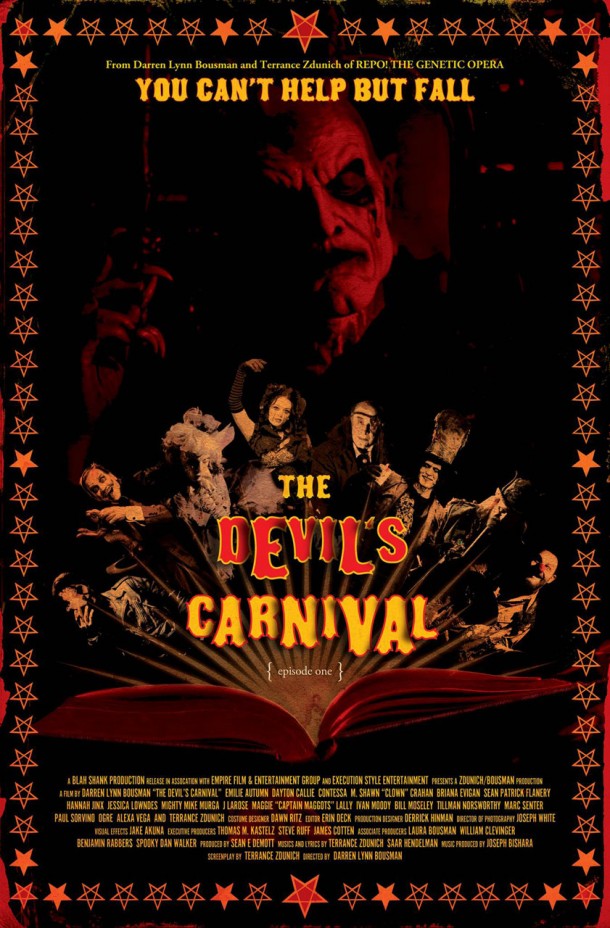
The Devil's Carnival
First things first; I'm going to shake up the format of this particular blog entry. Instead of my trusty "PROS/CONS/VERDICT" standby, I'm just going to lay out what the experience of attending The Devil's Carnival was like as best I can and let you draw your own conclusions. This is partially because my usual model isn't quite suited to conveying what The Devil's Carnival is totally like, and partially for the sake of keeping things fresh.
But first, a brief preface for those of you who don't know what The Devil's Carnival is:
I really can't say it better than creators Darren Lynn Bousman (director of Saw II-IV, Repo! The Genetic Opera, and a few lesser-known miscellaneous horror movies) and Terrance Zdunich (co-creator of Repo! in addition to portraying Lucifer in The Devil's Carnival and The Graverobber in Repo!) did in a previous interview, The Devil's Carnival is "a cross between Tales from the Crypt and the anti-f*cking Glee." Well said, gents! When the two collaborated on one of my personal favorites, the post-apocalyptic goth opera Repo! The Genetic Opera a few years ago, distributing studio Lionsgate didn't feel the piece was up to a wide release and gave it a very limited engagement; something like 6 or 7 screens nationwide. Instead of whining about "the Man," Terrance and Darren took it upon themselves to promote the film with a nationwide road tour; tagging in cast and crew members from the film to sign autographs and chat with fans along the way. The tour was a great success, and spawned two more. When the dynamic duo was unable to get Lionsgate (who now owns Repo!, unfortunately) to greenlight a sequel, they fell back to another project: The Devil's Carnival. Seeking to "create an experience you can't download" and bring back "what makes going to the movies fun," the two scraped and scrounged and put together the budget they needed to fund the project on their own. Bypassing the studio system completely, the two took The Devil's Carnival on the road - much like Repo! before it - with members of the cast and crew along for the ride.
I had the good fortune of grabbing tickets for a last-minute encore presentation in Los Angeles - a stop that coincided with my vacation in the Sunshine State nicely.
I went to The Devil's Carnival with my good buddy Andy, a fellow cinephile. He and I are something of a Mark-and-Jeremy from the British sitcom "Peep Show," with (hopefully) a bit less anti-social tendencies...and with American accents, sometimes.
We arrived early enough to be at basically the front of the line, while the next hour or so saw the gaggle of attendees stretch so far down the street behind us I couldn't exactly see where it ended. We were surrounded by a veritable treasure trove of "alternative lifestyle" folk; from post-ops (I think), pre-ops, (I'm sure), goths, attendees in costume as various Carnival characters, and then basically us: the two white guys in regular clothes at the front of the line. Some might have found the spread a bit too counter-culture, but personally I enjoy the company of those society labels 'freaks' or 'outcasts.' Their presence proves that not every subculture has been bastardized by hipsters and people obsessed with how meta everything is. Standing in line, there was no grand sense of pretense and for me personally, that put everything right on track for a great time.
I noticed Mika Boorem milling around the door, though I didn't remember her name at the time. I saw her for a moment and thought "That face looks like a 10 to 12-years-older version of a face in my memory" and after a couple of minutes sleuthing film credits on my phone pinned down her identity. For those who don't quite remember, she played the elder daughter in Mel Gibson's The Patriot and a young Charlize Theron in Mighty Joe Young - among other things...hence the gap in my memory as to what she looked like. Fairly inconsequential for the rest of the attendees, as I didn't notice anyone else noticing her. But for me it raised the bar a bit - seeing celebrities not directly attached to the project show up.
A little closer to the lifting of the curtain, Darren walked by, looking like the charming homeless version of J.J. Abrams that he does. Even with the anticipation mounting, you could sense that everyone there - from Darren himself to the gorgeous ticket-girl(s) - was on equal footing. We were all there to support an "underground" film, part of a dark little family stitched together for a few hours in North Hollywood; no one more important than the other.
Finally the line started slinking into the theater, and as Andy and I took our seats, I noticed Emilie Autumn immediately in the row in front of us - chatting with her Bloody Crumpet compadre Captain Maggot. Both of them Devil's Carnival cast members, they were just getting ready for the show and all that good stuff right in front of us - within arm's length. It took a few minutes for the rest of the attendees to file in and find seats, during which Andy and I joked back and forth about the implications of going to something called The Devil's Carnival on any given Sunday, and on Mother's Day no less.
The lights dimmed a bit and the focus was directed to the front of the theater, in which a brief "sideshow" was being performed. Namely, a woman was performing "The Human Blockhead" which involved her hammering and powertool-ing a nail and a screw into her head, respectively. Typical sideshow carnival stuff - accompanied by a girl in a creepy clown getup playing a gleeful carnie tune on a piano. The sideshow concluded, and a brief behind-the-scenes featurette of Repo! began, complete with sing-along! Being the pretentious film goer I am, I cursed the words for dancing at the bottom of the screen because I wanted to impress everyone within earshot with how well I knew the lyrics to this song. My gestures were futile, as I knew they would be, as the whole theater was singing along anyway, and I further cursed not having the opportunity to join the Repo! Road Tour back when it was making the rounds.
The Repo! featurette ended, and The Devil's Carnival began. It's technically a short film, clocking in at almost exactly 60 minutes. The movie follows 3 people down to Hell where they re-enact tableaus of Aesop's Fables - with the implication being that the lessons taught in the fable relate to the follies that led them to Hell in the first place. For example, a girl (Briana Evigan) who clearly spent her life in pursuit of jewelry and fineries finds herself playing the role of the dog in "The Dog and Her Reflection." True to the "anti-f*cking Glee" nature of the film, each tale is overlaid with a song or songs that further elucidate the moral of the story.
The music was LOUD. I mean...whew. It became genuinely difficult to enjoy the film (for me) with a deafening soundtrack, and I generally like deafening soundtracks. Carnie music isn't exactly my cup of tea though - a brisk staccato pace carried mostly by brass instruments and drums. Think Danny Elfman's music played twice as fast, twice as menacing, and competing with a jet engine for audibility. The lyrics (when I could catch them) were very well-crafted and poetic, and the music itself isn't entirely unsavory; but played at that level didn't wholly endear me to the genre.
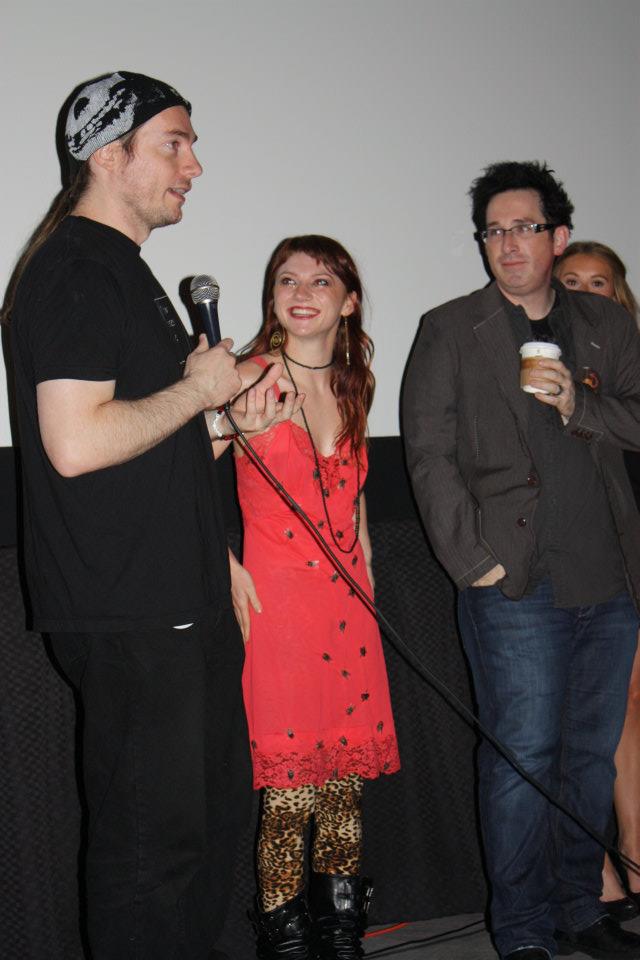
The film concluded, while not on a cliffhanger per se, but definitely with the implication that this is just the beginning. Actually, it was less an implication and more of a mantra. During the Q&A that followed (which was preceded by a brief costume contest) Terrance and Darren explained - among other things - that what they're trying to do with The Devil's Carnival is "build a brand." They've already written Episode 2 and essentially had it on hold pending how well the road tour did. All indications during the show were that the road tour has been successful enough to warrant production on the next installment and to hear the two of them talk about it - like the fanboys that they are - it sounds like that's on the top of their To-Do List.
The Q&A wrapped up and fans swarmed the gathering of cast and crew down at the front of the theater. Tactfully - I thought - I decided to hang back and hit them up on their way out of the theater and into the lobby, which is where I assumed they would take pictures, sign autographs, and generally schmooze. Ultimately, they kind of scattered on their own individually, but I did manage to shake hands with and chat briefly with Terrance. I can confirm for any fangirls reading this that he is absolutely as charming and down-to-earth as you'd expect. And that voice that had you all swooning in your black boots and corsets? It's totally how he talks in real life. I swooned a little bit. As I touched on briefly before, Terrance confirmed what I feared: there will be no Repo! sequel. Since Lionsgate owns Repo!, Terrance said that The Devil's Carnival "is our Repo! sequel." Admittedly, I was a little distraught. But the news is tempered by the fact that Terrance and Darren haven't come close to giving up what they do.
I also briefly managed to snag Alexa Vega before she was whisked away by one of the ticket girls. If you ever get a chance to chat with that young woman, I highly recommend you do so. Yes, she's attractive. But she's also as cool a chick as you're likely to meet - and very down-to-earth. Like "I-walked-up-just-to-say-I-had-a-great-time-and-she-asked-and-remembered-my-name" down-to-earth. And while I'm bragging on the internet, I also got a hug from her in parting; and not some half-ass side hug either.
As a whole, Terrance and Darren and their cohorts have done exactly what they set out to do: create an experience you can't download and more importantly, one you wouldn't want to even if you could. The Devil's Carnival was like a thin 3-hour slice of being at a film festival. The Q&A's, the presence of cast and crew, and just the sheer high of feeling as though you're on the creative cutting edge; it all adds up to a brilliantly unique experience. The film itself was not my favorite, in all honesty. It's not bad, it's just not my particular cup of tea, and had I just seen the film at home on my computer one afternoon I probably wouldn't have been all that jazzed about the project. But take the movie on the road, bring everyone you made it with along for the ride, and make a point to engage the fanbase at a grassroots level - I'm there. It's precisely the kind of "business model" that I think could make a drastic difference in the way films are made and shown. Terrance and Darren aren't sitting somewhere whining about piracy and how it's destroying their craft, and on the flipside they're not eating out of the corporate trough while damning The Man. Instead, they're getting out there and making sacrifices and doing what they love - without trying to make millions of dollars in the rat race of fame. And I was proud to be a part of that tour and supporting them in their efforts.
I'll be at one or more of the stops along the way when episode 2 comes down the pike, and I can't recommend more highly that you do the same. Even if a 60-minute musical about postmodern examples of Aesop's Fables isn't the kind of movie you normally go for, do it anyway. Go for the potential education on independent filmmaking. Go for the costumes. Go for the celebrity appearances. Go for the sheer non-mainstreamness of it all! It's wicked fun.
But first, a brief preface for those of you who don't know what The Devil's Carnival is:
I really can't say it better than creators Darren Lynn Bousman (director of Saw II-IV, Repo! The Genetic Opera, and a few lesser-known miscellaneous horror movies) and Terrance Zdunich (co-creator of Repo! in addition to portraying Lucifer in The Devil's Carnival and The Graverobber in Repo!) did in a previous interview, The Devil's Carnival is "a cross between Tales from the Crypt and the anti-f*cking Glee." Well said, gents! When the two collaborated on one of my personal favorites, the post-apocalyptic goth opera Repo! The Genetic Opera a few years ago, distributing studio Lionsgate didn't feel the piece was up to a wide release and gave it a very limited engagement; something like 6 or 7 screens nationwide. Instead of whining about "the Man," Terrance and Darren took it upon themselves to promote the film with a nationwide road tour; tagging in cast and crew members from the film to sign autographs and chat with fans along the way. The tour was a great success, and spawned two more. When the dynamic duo was unable to get Lionsgate (who now owns Repo!, unfortunately) to greenlight a sequel, they fell back to another project: The Devil's Carnival. Seeking to "create an experience you can't download" and bring back "what makes going to the movies fun," the two scraped and scrounged and put together the budget they needed to fund the project on their own. Bypassing the studio system completely, the two took The Devil's Carnival on the road - much like Repo! before it - with members of the cast and crew along for the ride.
I had the good fortune of grabbing tickets for a last-minute encore presentation in Los Angeles - a stop that coincided with my vacation in the Sunshine State nicely.
I went to The Devil's Carnival with my good buddy Andy, a fellow cinephile. He and I are something of a Mark-and-Jeremy from the British sitcom "Peep Show," with (hopefully) a bit less anti-social tendencies...and with American accents, sometimes.
We arrived early enough to be at basically the front of the line, while the next hour or so saw the gaggle of attendees stretch so far down the street behind us I couldn't exactly see where it ended. We were surrounded by a veritable treasure trove of "alternative lifestyle" folk; from post-ops (I think), pre-ops, (I'm sure), goths, attendees in costume as various Carnival characters, and then basically us: the two white guys in regular clothes at the front of the line. Some might have found the spread a bit too counter-culture, but personally I enjoy the company of those society labels 'freaks' or 'outcasts.' Their presence proves that not every subculture has been bastardized by hipsters and people obsessed with how meta everything is. Standing in line, there was no grand sense of pretense and for me personally, that put everything right on track for a great time.
I noticed Mika Boorem milling around the door, though I didn't remember her name at the time. I saw her for a moment and thought "That face looks like a 10 to 12-years-older version of a face in my memory" and after a couple of minutes sleuthing film credits on my phone pinned down her identity. For those who don't quite remember, she played the elder daughter in Mel Gibson's The Patriot and a young Charlize Theron in Mighty Joe Young - among other things...hence the gap in my memory as to what she looked like. Fairly inconsequential for the rest of the attendees, as I didn't notice anyone else noticing her. But for me it raised the bar a bit - seeing celebrities not directly attached to the project show up.
A little closer to the lifting of the curtain, Darren walked by, looking like the charming homeless version of J.J. Abrams that he does. Even with the anticipation mounting, you could sense that everyone there - from Darren himself to the gorgeous ticket-girl(s) - was on equal footing. We were all there to support an "underground" film, part of a dark little family stitched together for a few hours in North Hollywood; no one more important than the other.
Finally the line started slinking into the theater, and as Andy and I took our seats, I noticed Emilie Autumn immediately in the row in front of us - chatting with her Bloody Crumpet compadre Captain Maggot. Both of them Devil's Carnival cast members, they were just getting ready for the show and all that good stuff right in front of us - within arm's length. It took a few minutes for the rest of the attendees to file in and find seats, during which Andy and I joked back and forth about the implications of going to something called The Devil's Carnival on any given Sunday, and on Mother's Day no less.
The lights dimmed a bit and the focus was directed to the front of the theater, in which a brief "sideshow" was being performed. Namely, a woman was performing "The Human Blockhead" which involved her hammering and powertool-ing a nail and a screw into her head, respectively. Typical sideshow carnival stuff - accompanied by a girl in a creepy clown getup playing a gleeful carnie tune on a piano. The sideshow concluded, and a brief behind-the-scenes featurette of Repo! began, complete with sing-along! Being the pretentious film goer I am, I cursed the words for dancing at the bottom of the screen because I wanted to impress everyone within earshot with how well I knew the lyrics to this song. My gestures were futile, as I knew they would be, as the whole theater was singing along anyway, and I further cursed not having the opportunity to join the Repo! Road Tour back when it was making the rounds.
The Repo! featurette ended, and The Devil's Carnival began. It's technically a short film, clocking in at almost exactly 60 minutes. The movie follows 3 people down to Hell where they re-enact tableaus of Aesop's Fables - with the implication being that the lessons taught in the fable relate to the follies that led them to Hell in the first place. For example, a girl (Briana Evigan) who clearly spent her life in pursuit of jewelry and fineries finds herself playing the role of the dog in "The Dog and Her Reflection." True to the "anti-f*cking Glee" nature of the film, each tale is overlaid with a song or songs that further elucidate the moral of the story.
The music was LOUD. I mean...whew. It became genuinely difficult to enjoy the film (for me) with a deafening soundtrack, and I generally like deafening soundtracks. Carnie music isn't exactly my cup of tea though - a brisk staccato pace carried mostly by brass instruments and drums. Think Danny Elfman's music played twice as fast, twice as menacing, and competing with a jet engine for audibility. The lyrics (when I could catch them) were very well-crafted and poetic, and the music itself isn't entirely unsavory; but played at that level didn't wholly endear me to the genre.
The film concluded, while not on a cliffhanger per se, but definitely with the implication that this is just the beginning. Actually, it was less an implication and more of a mantra. During the Q&A that followed (which was preceded by a brief costume contest) Terrance and Darren explained - among other things - that what they're trying to do with The Devil's Carnival is "build a brand." They've already written Episode 2 and essentially had it on hold pending how well the road tour did. All indications during the show were that the road tour has been successful enough to warrant production on the next installment and to hear the two of them talk about it - like the fanboys that they are - it sounds like that's on the top of their To-Do List.The Q&A wrapped up and fans swarmed the gathering of cast and crew down at the front of the theater. Tactfully - I thought - I decided to hang back and hit them up on their way out of the theater and into the lobby, which is where I assumed they would take pictures, sign autographs, and generally schmooze. Ultimately, they kind of scattered on their own individually, but I did manage to shake hands with and chat briefly with Terrance. I can confirm for any fangirls reading this that he is absolutely as charming and down-to-earth as you'd expect. And that voice that had you all swooning in your black boots and corsets? It's totally how he talks in real life. I swooned a little bit. As I touched on briefly before, Terrance confirmed what I feared: there will be no Repo! sequel. Since Lionsgate owns Repo!, Terrance said that The Devil's Carnival "is our Repo! sequel." Admittedly, I was a little distraught. But the news is tempered by the fact that Terrance and Darren haven't come close to giving up what they do.
I also briefly managed to snag Alexa Vega before she was whisked away by one of the ticket girls. If you ever get a chance to chat with that young woman, I highly recommend you do so. Yes, she's attractive. But she's also as cool a chick as you're likely to meet - and very down-to-earth. Like "I-walked-up-just-to-say-I-had-a-great-time-and-she-asked-and-remembered-my-name" down-to-earth. And while I'm bragging on the internet, I also got a hug from her in parting; and not some half-ass side hug either.
As a whole, Terrance and Darren and their cohorts have done exactly what they set out to do: create an experience you can't download and more importantly, one you wouldn't want to even if you could. The Devil's Carnival was like a thin 3-hour slice of being at a film festival. The Q&A's, the presence of cast and crew, and just the sheer high of feeling as though you're on the creative cutting edge; it all adds up to a brilliantly unique experience. The film itself was not my favorite, in all honesty. It's not bad, it's just not my particular cup of tea, and had I just seen the film at home on my computer one afternoon I probably wouldn't have been all that jazzed about the project. But take the movie on the road, bring everyone you made it with along for the ride, and make a point to engage the fanbase at a grassroots level - I'm there. It's precisely the kind of "business model" that I think could make a drastic difference in the way films are made and shown. Terrance and Darren aren't sitting somewhere whining about piracy and how it's destroying their craft, and on the flipside they're not eating out of the corporate trough while damning The Man. Instead, they're getting out there and making sacrifices and doing what they love - without trying to make millions of dollars in the rat race of fame. And I was proud to be a part of that tour and supporting them in their efforts.I'll be at one or more of the stops along the way when episode 2 comes down the pike, and I can't recommend more highly that you do the same. Even if a 60-minute musical about postmodern examples of Aesop's Fables isn't the kind of movie you normally go for, do it anyway. Go for the potential education on independent filmmaking. Go for the costumes. Go for the celebrity appearances. Go for the sheer non-mainstreamness of it all! It's wicked fun.
Subscribe to:
Posts (Atom)