Monday, December 19, 2011

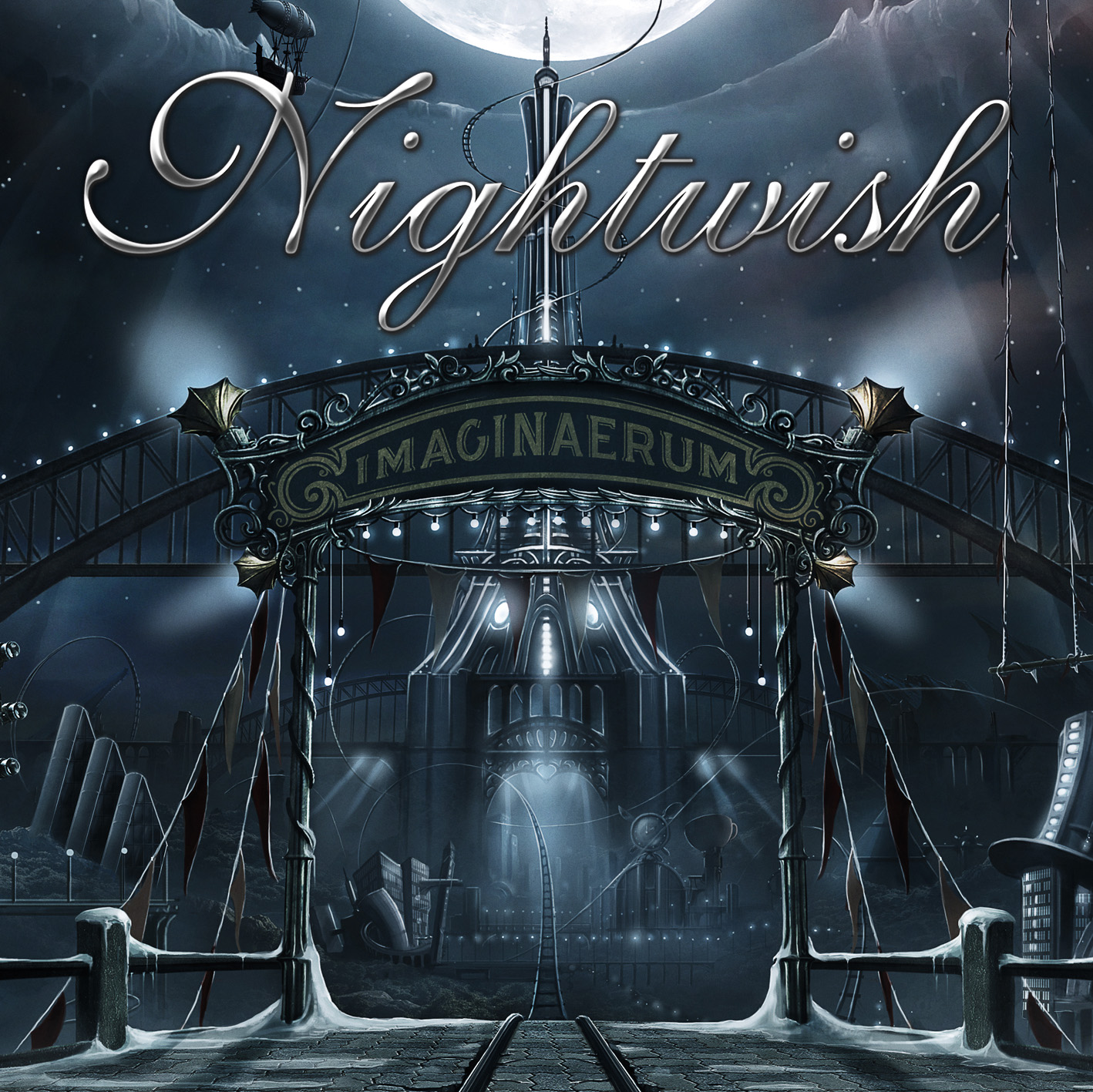
Nightwish - Imaginaerum


Symphonic power metal is like the hardcore rap of Scandinavia and Eastern Europe. Over there, bands of this particular strain routinely sell out amphitheaters and large-scale venues and comprise the majority of the auditory output of a given country. Among the demi-gods of this epic breed of heavy metal, a few artists do stand out. Chief among them is Finland's Nightwish - arguably one of the most influential symphonic power metal bands of all time. Since their inception in 1996, Nightwish has consistently released albums that beautifully marry the sophistication of orchestral arrangement with the high-energy chugging of power metal. Never a band to over-saturate, Nightwish usually leaves a few years interim between each new release - priming their fan bases' appetite for new material with increasingly satisfying releases. With Imaginaerum, the band's seventh full-length album, Nightwish continues pushing the boundaries of their own genre; blending ever-increasing levels of complexity and sophistication with the epic and sweeping sound they're known for. That's the synopsis; here are the details.

THE PROS:

"Imaginaerum" was billed as one of the band's most ambitious projects to date, and it most definitely pays off in that department. Each successive Nightwish release claims to be the biggest and baddest since the one before it, a formula that risks reaching critical mass and fizzling all-too-soon. But they've managed to keep things fresh and alive, and it's largely due to their willingness to risk and sample new genres and styles.

"Imaginaerum" features some of the most divergent and versatile musical influences of any Nightwish release I've had the pleasure of listening to. There is, of course, the tried-and-true formula of palm-muted riffs for each verse and soaring melodies in the chorus. It's a bit of an overused formula - and admittedly they don't explore too much new territory in that particular vein. But had Nightwish abandoned it altogether the album would have definitely faltered. But mixed in with the familiar are a few songs and moments unlike anything Nightwish has yet attempted. For example, "Slow, Love, Slow" evokes imagery and motifs of film noir. The orchestration is light - drummer Jukka Nevalainen gently swishing brushes back and forth on the snare, the piano moody but restrained, echoes of wanton brass instruments in the distance - but the effect is profound. It's a definite departure from Nightwish's typical modus operandi, calling to mind pictures of lead vocalist Anette Olzon crooning into the microphone of a dimly-lit jazz club - tendrils of cigarette smoke curling up from the tables. It almost doesn't work, but the band jumps into the motifs so whole-heartedly and paints a musical image so vivid that it's impossible to deny the song's utter confidence and strength.

Elsewhere, "Scaretale" begins with decidedly familiar Nightwish motifs. The guitar cuts a dark and aggressive path through a song that vaguely calls to mind previous Nightwish excursions "Planet Hell" and "Master Passion Greed." The song is downright scary...and then halfway through yields to a completely different musical influence: Danny Elfman. Again I found myself bewildered at the dramatic shift into a darkly whimsical staccato accented by circus-music themes. And just as I begin to acclimate to recollections of The Nightmare Before Christmas and Beetlejuice in the middle of a Nightwish album, the themes transition back into the familiar territory the song opened with. It's a unique evolution - and one I wasn't entirely sure of at first. But again, the influences are so profoundly concrete and confident - leaving no room for the hedging of bets - that the song really does grow on you.

Likewise "Turn Loose the Mermaids" - this album's answer to "The Islander" from Dark Passion Play - reaches out to whistling and brass arrangement a la Ennio Morricone's work. I never would have considered the two genres compatible - acoustic Celtic music and strains of Sergio Leone - but somehow Nightwish manages to pull it off.

As for the less experimental songs, the lead single from the album - "Storytime" - is a perfect example of what to expect on this album as well. Too much experimentation probably would have killed Imaginaerum; but the lion's share of musical influence is most decidedly in familiar Nightwish territory. My favorite track is "I Want My Tears Back." It's a high-energy tune that's more anthemic than overly aggressive, and the addition of bagpipes on this particular track is an added bonus. The title track is enjoyable as well, something of an overture that reiterates all the major themes - almost as though credits are rolling up an invisible screen.

THE CONS:

Upon the first listen-through of Imaginaerum, some of the more experimental moments on this album might throw you off. They certainly did me. Had I known they were coming I might not have been so initially put off by their presence, but giving them more than just a first impression definitely softened my opinion.

The longest track on the album (clocking in at just over 13 minutes), "Song of Myself," not only references Walt Whitman's poem of the same name but actually features a complete recitation of the poem as well. Now, I'm not one to deny Whitman's importance in American literature, and I've always thought he was an incredibly talented poet - but I've never particularly cared for the content of his work; it's just not my thing, for the most part. So while this is just a personal beef of mine, being subjected to an entire Whitman poem in the middle of an album I was already having to listen through a couple of times was a bit of a challenge. Some of the imagery in the poem is also somewhat explicit, and I didn't feel that it fit the themes of fantasy and child-like awe the rest of the album sought to evoke.

THE VERDICT:

Imaginaerum is quite unlike any previous Nightwish album to date. Fortunately, in most ways that is a very good thing. Their expansion into new musical territory came as a bit of a shock at first, but their confidence and precision-handling of said experimentation ultimately won the day over my misgivings.

As a band, they've truly evolved. Anette Olzon's vocals are much stronger here than on Dark Passion Play, where they were already pretty solid. The same is true of Marco Hietala's vocals; he pulls off high-octave vibrato with the best of them, evoking Rob Halford or Bruce Dickinson in the process. And as always, Nightwish continues to prove that they're without peer when it comes to a perfect harmony between orchestral arrangement and power metal. With a film being produced alongside it, Imaginaerum is definitely an ambitious work. But there's no denying the rich and visual quality this album possesses; even without the context of the film. In the end this CD, fortunately, was very much worth waiting for.

Thursday, December 15, 2011

The Muppets


By now, they're a cultural milestone. Beginning in the 70s and remaining - to a lesser extent at times than others - an earmark of American television and film, the Muppets were among the first to pioneer entertainment with both children and adults in mind. I've been a die-hard Muppet fan for as long as I can remember, and when Jason Segel announced he was working on a new Muppet movie (shortly after such things were hinted at in Forgetting Sarah Marshall) I was thrilled. Has the wait been worth it? Are the Muppets back to stay?

THE PROS:

Up to this point in time, the last good Muppet movie was Muppets from Space which hit theaters in 1999. In between that time and The Muppets there were two feature-length Muppet movies (A Very Merry Muppet Christmas Movie, and The Muppet Wizard of Oz); both of which were adaptations/spoofs - It's a Wonderful Life and The Wizard of Oz - and both of which were just awful. That's to say nothing about the handful of straight-to-DVD or Disney channel "specials" that came out during that time, most of which were mediocre at best. So putting it mildly, The Muppets had quite a hill to climb, and thankfully achieves this feat brilliantly. The first step to doing so is with the story. Part of what made the Muppets so great to watch was a kind of self-consciousness and reflexivity that manifested itself in both pop culture references and a good deal of meta-jokes. But these alone can't make a Muppet movie good (see the last two Muppet movies for agonizing proof), the story itself also needs to be compelling. And The Muppets is most definitely compelling.


Chronicling the story of a boy named Walter (the newest member of the Muppet cast) who grew up as the Muppets biggest fan, the movie takes the familiar jump from coming-of-age to road-movie to show-within-a-show as Walter travels around the country reuniting the Muppets for one last show to save their theater from the greedy oil tycoon Tex Richman (Chris Cooper). Along for the ride is his brother Gary (Jason Segel) and Gary's girlfriend Mary (Amy Adams). It's no spoiler to say that Segel and Adams look like they're having the time of their lives and jump into the corny humor with more than adequate ease. And with the human members of the cast allowing the audience an appropriate anchor, the Muppets themselves are free to be exactly what they've been all along: just pure fun.

Another big step in making a home-run Muppet movie is, of course, the music. It's not enough just to have song-and-dance routines, they need to be catchy and well-written. And thankfully, again, The Muppets scores big time in the music department. If you don't find yourself tapping your toes or bobbing your head then you're probably in the wrong movie. But in addition to being well-written and catchy, the songs aren't complicated; quite the contrary they're wonderfully accessible. So singing right along with much of the music can happen right on your first viewing. DOUBLE POINTS.


Finally, The Muppets manages to walk that hair-thin line of not taking itself too seriously, while taking itself just seriously enough. There is an appropriate amount of meta-humor and 4th wall bending, but it never derails into "groaner" jokes or condescension. Even the truly corny jokes (courtesy of Fozzie and of course Statler and Waldorf) are still genuinely funny because of the context. Hell, they even manage to sneak in some fart humor without making it feel like a gimmick. I've always been a bit of a sucker for fart-related humor (the "film" critic in me just choked on his Earl Grey - but that's what he gets for holding his little pinky out right?) but even I can be turned off by gags and gimmicks when they're used to low-ball the audience. But fortunately, nothing about this movie low balls the audience, or talks down to us, or puts anything too on-the-nose.

THE CONS:

There is truly precious little to be said negatively about this movie. The villain is your typical stock character oil tycoon (Tex Richman? Well at least they're not perpetuating any state-related stereotypes...) but even he fits into the overall "cliche" that the movie isn't afraid to tackle. And seeing Chris Cooper rap - and I mean REALLY rap - is too much of a treat to bear any grudge whatsoever against this movie, despite what Fox News had to say about it.

The other somewhat minor drawback to the movie is an almost complete lack of Rizzo. I almost didn't even realize it until it was pointed out to me by a friend at the end of the movie. Every other Muppet got some decent screen time, even Beauregard. But Rizzo is painfully absent from this flick. It's a little thing, to be sure, but it bears mentioning.

THE VERDICT

The Muppets are back, officially. They've been taken off the list of "indie cred" items and I think it's high time that was the case. Going almost 11 years without a decent credit to their name was really a shame - but in retrospect, The Muppets has made that 12 years completely worth the wait. And the film does a brilliant job of referencing that very fact - that the Muppets have been "gone" and now they're "back" - so watching the movie quite literally feels like being a personal part of the Muppet journey.

This movie has EVERYTHING we've come to love about the Muppets, right down to some hilarious cameos (Dave Grohl as Animal's replacement in the "off-brand" Muppet band would have been enough on its own, but there's plenty of Mickey Rooney, Jack Black, Alan Arkin, Emily Blunt, Kristin Schaal, and more to go around!) and a few vintage Muppet songs. This is the movie old Muppet fans have been waiting for, and by the look of the critical and audience response it's getting - it's what'll probably be the start of a whole new generation of Muppet fans.

Kermit, Miss Piggy, Fozzie, Gonzo, all of you, welcome back; you've been sorely missed.

Friday, November 11, 2011

Animals As Leaders - "Weightless"


The great thing about metal as a genre is that it's one of the few left wherein such a high percentage of its population has obtained virtuoso or near-virtuoso levels of musical proficiency. When was the last time you heard of a "classically-trained" rap artist? Or a "virtuoso" country music star? Some may exist, but they're not par for the course. Because of their very nature, most subgenres within heavy metal have a built-in "height-requirement"...you must but *this* tall to play "Raining Blood"...you must be *this* much of a perfectionist to learn "Master of Puppets."...etc.

But even amongst this veritable smorgasbord of skill and technicial proficiency, one band stands out. To paraphrase Gandalf here in description: "A demon of the ancient world. This (band) is beyond any of you...(MOSH)!"

I'm talking, of course, about Animals As Leaders. The trio is widely known as one of the most - if not THE most - musically skilled band in the technical/progressive metal breed. And as an instrumental band, their appeal manages to cross the boundaries of heavy metal to reach those listeners who "Don't like screaming music." Their full-length self-titled debut set them apart. What's to be said of their follow-up album, Weightless?

THE PROS:

Much like my As I Lay Dying review, I feel the first major perk about this CD is...NEW ANIMALS AS LEADERS. I was still enjoying discovering new layers of genius from their self-titled debut, so it's certainly not like I was going through withdrawals. But it was exciting news all the same when they announced this album and for a quick summary (spoiler alert): it doesn't disappoint. At all.

It's hard to imagine that lead guitarist Tosin Abasi could get any better after listening through their debut. But Weightless makes it clear he's not done polishing a level of proficiency that borders on super human. And before it sounds like I'm being hyperbolic, go look up any video of him playing live...his fingers literally become a blur. And his bandmates, guitarist Javier Reyes and drummer Navene Koperweis, are only a fraction of a step behind him in their own proficiency.

But attainment of virtuoso status alone isn't enough to make the music worth listening to. As a comparison, Joe Satriani is an amazing guitarist with comparable musical skill. But what Satriani often does is simply play random strings of notes and tunes purely to showcase his prowess. So while the skill displayed is phenomenal, it's often implemented without regard to the structure of the song. That's what separates Animals As Leaders from musicians like Satriani; regardless of the flurry of notes or lightning speed of time and chord change, there's always an inherent logic to the music they play. Weightless is no exception.

Already exploring genre fringes, Weightless pushes the band even slightly further into new musical territory. There are some vague hints at deathcore in the album's title track and "An Infinite Regression." "Earth Departure" opens with some powerful tapping/slapping effects, launching forward into a frenetic display of musical ferocity. The album's single, "Isolated Incidents" is a fantastic example of how much territory the band can explore with one song. Starting out with a lonely little melody, the song gradually builds on itself, growing stronger and stronger, while never fully reaching a true crescendo. It slowly finds its way back to the original guitar melody, making it feel like a perfectly symmetrical journey.

It's hard to truly convey the album in words. Most instrumental music has a distinct visual component; when listening I'm always put in mind of this person, or that vignette. Their debut album had that quality for me, but there's something about Weightless that escapes any kind of visual ascription. Maybe it's just because the music is so nuanced and layered my brain has yet to fully digest this album. But it's also likely due to the fact that the band's increased musical prowess has catapulted them beyond the usual rules of instrumental experience.

THE CONS:

The presence of electronic effects is a bit more prominent on this album. It's perhaps a little nit-picky for me to point that out as a shortcoming, but personally I enjoyed the somewhat organic overall feel of their self-titled album. It's certainly not intensely distracting - Weightless isn't exclusively defined by an electronic sound. But there are definitely a lot more glitches and tweets sprinkled into the mix this go 'round.

Weightless is also ever-so slightly shorter than their first. There are no 6-minute-plus tracks on this CD, though one or two stray beyond 5 minutes. It's not the worst that could be said, but it makes for a slightly less epic experience overall.

THE VERDICT

Despite it's minor flaws, Weightless has been well worth the buy. Tosin's MAD skills as a virtuoso metal-head are as impressive as they've ever been, and not a single track on this album feels forced or gimmicky.

I miss the more organic approach that characterized their first album, but the larger presence of electronic elements doesn't weigh down (pun intended) this CD in the slightest. It was hard for me to imagine that these three musical masters could get any better, but they managed to pull it off and the result is immensely satisfying. If you enjoyed their self-titled debut, you owe it to yourself and to this band to buy Weightless.

Some albums are good enough to justify a download. Others are worth picking out a few tracks of importance on iTunes or Zune or what have you. And a select few have earned the right to be physically purchased at your local Best Buy, WalMart, Barnes and Noble, etc.

Weightless
is one of those albums.

Thursday, November 10, 2011

As I Lay Dying - "Decas"


It's been ten years. Ten years since The Fellowship of the Ring released in theaters, kicking off the greatest cinematic trilogy of all time. (screw you Wikipedia! Citation NOT needed!) Ten years since Halo forever changed the landscape of video gaming and catapulted the Xbox into the forefront of adolescent preoccupation. Ten years...since As I Lay Dying officially began their journey as band - practically inventing metalcore and then keeping the bar set almost unattainably high. And to commemorate those ten face-melting years, As I Lay Dying released "Decas" - a retrospective/compilation/cover/remix/EP/full-length CD.

THE PROS:

As a huge As I Lay Dying fan, the first pro I feel I have to mention is...NEW AS I LAY DYING. The wait from "An Ocean Between Us" (2007) to "The Powerless Rise" (2010) was almost too long, so to only have to wait a little over a year for new tunes from America's #1 metalcore band was merciful news. But "Decas" isn't exactly a "new" CD. The album features 3 brand new tracks, one re-recorded medley, 4 remixes, and 4 covers. It's a grab bag, no doubt about it. But fortunately it's a good one overall.

The 3 new tracks in question kick off the album with "Paralyzed." The song is about as As I Lay Dying as any you've heard, showcasing the band's already spit-polished musicianship and fine-tuned mixing and mastering skills. It's not anything you haven't heard before, and as much can be said of the next two tracks - "From Shapeless to Breakable" and "Moving Forward." If you like As I Lay Dying, you'll like these songs. If you're completely new to metalcore, these songs are as good as any to give you an idea of what to expect from the genre.

The covers on this album are the tracks that really shine though. As I Lay Dying brings their signature ferocity to Slayer's "War Ensemble" and the less serious "Coffee Mug," originally by Descendents. No holds barred, just shred-tastic thrash and sledgehammer-to-the-face hardcore, respectively. Sandwiched between those two gems is a little Priest. Judas Priest, to be exact. They certainly aren't the first to cover "Electric Eye" (or to thankfully tag on its intro, "The Hellion") but they do it justice and frankly, As I Lay Dying covering Judas Priest is about as METAL as things come.

THE CONS:

The remixes. Just about any gripe or shortcoming this album can be accused of is thanks to those damn remixes. As I Lay Dying isn't a band that really *needs* to be remixed anyway, and making metalcore songs into dubstep abominations is about as bad as any remix of any kind can get. Their only saving grace is that they don't take up the majority of the CD. And to give credit where credit is due, Kelly "Carnage" Cairns remix of "Confined" actually does the song justice, mainly by leaving it largely intact and just changing up some of the instrumentalization. And to avoid sounding like a total cynic, Big Chocolate's (who you hopefully recognize from either Disfiguring the Goddess or Commissioner or both) remix of Elegy is pretty good, too. It's a remix, so there's only so much "good" to go around for it. But if you like Commissioner's sound and have always wanted to hear what that formula would sound like applied to As I Lay Dying's music, "Decas" has your golden ticket.

THE VERDICT

"Decas" can best be described as somewhere between a retrospective album, a best-of CD, and a compilation project. New songs, old songs, red songs, blue songs; if you like As I Lay Dying then you should definitely pick this one up because they're a band worth supporting.


If you only want to snag a few songs from this CD via iTunes or what have you, I'd recommend the new tracks and the covers. And their "Beneath the Encasing Ashes" re-recording medley, of course. Personally, one of the biggest drawbacks to their debut album was the low production value, so hearing a few of the great moments from that album rolled into one and mixed professionally was a real treat. But the remixes really aren't anything to write home about...unless your favorite things in life involve good music being run through a "wub wub" machine and coming out full of glitches and tweets.

It's not a new full-length album, but for my money it's worth having a little memento of As I Lay Dying's ten years as a band. And word has it this album's release is kicking off their "Decade of Destruction" tour with iwrestledabearonce, The Ghost Inside, Of Mice and Men, and Sylosis. So I'll take the good with the bad.

Monday, October 31, 2011

Puss In Boots


Sequels and spin-offs are the dual gift-and-curse of the fact that the film industry is a business. If it can make just enough money to justify its existence, Hollywood will damn near make a sequel or a spin-off out of just about anything - and they have no shame when it comes to dead horses and how mercilessly they're beaten....lest we forget Land Before Time 13.

So when Dreamworks announced that they'd be producing a spin-off of the also-sequel-laden Shrek franchise focused on the character of Puss In Boots, I was neither surprised nor impressed. I figured it would probably not do very well at the box office and would be a critical flop. Then the reviews started coming in, and it seemed that the general consensus was that Puss in Boots far exceeded everyone's expectations. So, I decided to play the role of "white-guy-in-slasher-flick" and grabbed my proverbial flashlight to go investigate.

The movie plays out like something of an origin story for the character, taking place before the events of the Shrek movies. Orphaned from an early age, Puss (Antonio Banderas) is taken in by a kindly woman who ran in orphanage in San Ricardo. There, he befriends Humpty Dumpty (voiced by Zach Galifianakis) and the two become partners in crime. Puss soon grows out of his penchant for petty thievery, and instead tries to devote his life to a more respectable path. But Humpty isn't so easily swayed and through some underhanded scheming, frames Puss for a crime he didn't commit. Branded an outlaw, Puss goes from tavern to tavern...just searching for his next shot of leche. But upon meeting the beautiful thief Kitty Soft-Paws (Salma Hayek) and learning that she is in cahoots with Humpty, the trio set off to retrieve the fabled magic beans from Jack and Jill (Billy-Bob Thornton and Amy Sedaris).

THE PROS:

To their credit, the folks at Dreamworks know how to cast voice-actors. Antonio Banderas reprises his roll as Puss flawlessly, and the joy he brings to the job is palpable. It's little secret that Puss is a take-off of Banderas' other famous silver-screen persona: Zorro. So it's always a joy to see the ways in which he and the filmmakers send up the very persona that made him famous in the first place. Salma Hayek appears as the femme-fatale/love interest, and cliched though it might be (it's not like the two co-starred in Desperado or anything) it's a dynamic that works, so "if it ain't broke, don't fix it." Galifianakis is another pitch-perfect voice, and his characterization of Humpty as a schemer, if still a vaguely tragic hero, is a real delight.

It's no secret that Dreamworks Animation Studio isn't on par with Pixar (frankly, no one is) but to their credit, their animation style has definitely come into its own. In addition, their writing certainly seems to have recovered. And I say "recovered" because, let's face it, with Shrek 4Ever After they were using the old "What if none of this had even happened?" a la It's a Wonderful Life. And any book or seminar on screenwriting will tell you that trope is one of the last things to be scraped from the bottom of the barrel. So it was surprisingly refreshing to see that Puss in Boots, its status as spin-off notwithstanding, actually explored some new narrative territory. There's a near half-hour flashback in the first 20 minutes of the movie and it manages somehow to not stop the narrative momentum of the film. And they thankfully resisted the urge to work in other characters from the Shrek franchise - opting instead to present us with a whole new array of faces, besides Puss of course.

THE CONS:

Puss in Boots occasionally has to go for gimmicks and gags to grab another laugh or two. I love the whole "chipmunk voice" thing, but when it shows up in this movie (the characters are in the clouds, where the air is thinner) it definitely feels like the audience being tossed a bone. Especially considering their voices change back immediately once they enter the castle from the Jack and the Beanstalk legend. Kitty asks why they're voices are back to normal. Humpty explains the castle air is pressurized. Ok, that technically closes any loopholes. But the exchange feels forced, the chipmunk voices themselves even more so.

The movie is achingly predictable. Yes, it's a kids movie. But the Shrek films - at least the first two - were all about shaking up old fairy tale cliches. As a result, there was something fresh and unexpected about them. Maybe my expectations were too high, but Puss in Boots seems to sail straightforward in one direction the whole time. It works just fine as a kids movie, but again some of the fun of the Shrek films is that there was material for young and old audiences both to enjoy.

The other thing that seems to be missing from this outing is the overall lack of pop culture references. That was where a good deal of the humor and charm stemmed from in the original Shrek movies. Puss in Boots, being a send up of the whole Zorro franchise, acts like one big pop culture reference in itself and skimps on the rest. That's not to say there are no pop culture references, just not quite enough in my estimation.

THE VERDICT

Maybe my expectations were just in the wrong place. Dreamworks definitely seemed to make a concerted effort to distance Puss in Boots from the rest of the franchise and had I known that going in, perhaps I wouldn't have come out so disappointed. I really really wanted to like this movie. I really did. Puss was always my favorite character from the Shrek movies and when the movie started garnering a lot of critical praise I was pretty excited to see it. But at the end of the whole affair, I didn't feel like my $11 for a 3D matinee was completely justified.

Having said all of that though, I'm positive that the younger audiences will eat this movie up. And maybe that's where my expectations were misplaced; I was expecting something that had more cross-audience appeal and Puss in Boots is most decidedly a kids movie. As a kids movie, it's a solid home run. There's precious little bathroom humor and there's no denying the inherent charm of the characters.

If you, like me, go into this movie expecting some of the more mature humor and snarky writing of the Shrek movies - you'll probably wind up - like me - generally disappointed. But take the kids to see it, and if you don't enjoy it, I'll put money on the fact that it will at least be worth the value of enjoying it with them, because they'll love Puss in Boots.

Monday, October 17, 2011

The Thing


Quick! What's the scariest movie you can think of? No! Not...*sigh*...not "Paranormal Activity." Sure the movie was pretty awesome but that's the wrong...that's the wrong answer. No, technically this question doesn't have an empirically defined right answ- ya know what? Let's just do this. Let's pretend you said John Carpenter's 1982 horror classic, The Thing. Ok? *Ding Ding Ding* That's right! To this day, The Thing remains one of the most disturbing, most disgusting horror movies of American cinema. Even when it came out - knowing full well the movie was supposed to be a horror flick - critics derided it for being too gruesome. In the years since its release, however, The Thing has enjoyed a gradual lessening of the negative critical reaction that characterized its initial release. Going on to become something of a cult-horror-classic - The Thing spawned a prequel. So what's up with this Thing?

First, allow me to give a brief synopsis of the first film. The film opens with a dog running across the Antarctic wilderness, pursued by two men in a helicopter who are desperately trying to kill it. The dog reaches an American outpost and seems to find refuge in the company of the Americans, as the Norwegians in pursuit are killed when the helicopter crashes. The American team goes to investigate the Norwegian camp several miles north of their position, only to find that everything has been destroyed. The only thing left seems to be some half-melted...um...thing, that looks like two men melted together; somewhere between a Salvador Dali painting and...something else utterly horrifying and revolting. They take the specimen back to their camp, examine it, (along with videos and documents from the Norwegian camp) and come to find out that this thing is actually a (*sigh* I'm sorry I have to keep doing this) thing that somehow imitates the cells of its prey and then manages to become a completely indistinguishable copy of it. The dog also turns out to be a similar thing and before you know it, the characters are all turning against each other for fear that their compadres might be, ya know, *things* themselves. It's a great premise - Ten Little Indians plus massive amounts of gore and viscera.

So, with all that context, The Thing (the 2011 prequel in question) seeks to tell the story of what exactly happened at the Norwegian camp in the days and moments leading up to the beginning of the original.

THE PROS:

This 2011 prequel really feels more like a remake than anything else. That's primarily due to the fact that both films share essentially the exact same plot, and consequently feature many of the same plot devices. There are only so many ways to nuance the "stuck-in-the-Antarctic-with-a-group-of-people-you-can't-trust" structure and to its credit, The Thing doesn't try too hard to break that mold. It's a good - if not great - hook and allows for some exploration of sci-fi, horror, and psychological thriller simultaneously and the movie does a good job of weaving all those elements together. A handful of cast look-a-likes also give The Thing (2011) a feeling of Déjà vu.

Mary Elizabeth Winstead (who plays the lead, paleontologist Kate Lloyd) does an admirable job of providing an emotional foundation for the audience. She (fortunately) shies away from her previous reputation as "scream queen" and delivers a much stronger performance, without veering into the even more tired "kick-ass-gunslinger-girl" cliche. Think Eleanor Ripley...before that whole franchise got out of hand, anyway.

Other commendations are to be given out as well to the rest of the cast, who play the movie with an appropriately straight face. It's also balanced and refreshing to have a female join the cast, as a remake/prequel featuring a bunch of dudes - again - might have felt unbearably familiar. Marco Beltrami's score, much like the Thing itself, imitates Ennio Morricone's original music perfectly; occasionally weaving in that ominous synthesizer that characterized the original film's score.

And true to form, the movie manages to resist the temptation to fully show just exactly what the Thing looks like in its native form. Much of the suspense and tension of the original came from the fact that we never fully get a look at the Thing; the most we get is a gander at some half-mutated, not-fully-formed version of whatever it was trying to imitate. I went into this version half-expecting the film makers to use that as a hook: we finally get to see what this thing actually looks like! Fortunately, while we do see a little bit more of the creature, the majority of this alien life-form remains - as it should - in the shadows. In trade for not actually getting to see the creature, we are treated to an inside look at its space ship; buried deep beneath the ice. For me, it's an appropriate trade.


THE CONS:

Personally, I couldn't find *too* much to gripe about. The movie falters a bit in its opening moments, unsure of how to depict certain characters. Some of the acting doesn't really flourish until about 15 minutes into the movie, but if you can sit tight and wait for the film to really get going it's not all that great a deterrent.

Another drawback is a pretty moderate dose of predictability. It doesn't take too long to figure out who's real and who's not - or who is going to make it to the end alive. (A black guy in a horror movie? So much for that...) If you've seen the original, you can practically match each character to their counterpart to figure out who is going end up where.

My biggest problem with the movie was actually the sound. The old addage "Sound is half of what the audience sees" was apparently not part of this movie's mantra. In an attempt to wring every bit of shock out of the film, The Thing opts to be an incredibly "loud" movie. Rather than simply allowing for occasional stings in the score or the soundtrack, The Thing practically blasts the audience with a sound bomb every time something "scary" is going on. It was literally so loud it sounded like the speakers were peaking. In the theater. So you definitely get a jolt of adrenaline, but it's a lot less because the film is genuinely scary and more because you fear for your own hearing. That's not to say The Thing is without a proper set of horror-movie moments; it made me jump once or twice in my seat. But ultimately the blaring of score and sound effects became so distracting it was hard to just enjoy the movie without plugging my ears.

THE VERDICT:

Horror movies aren't as scary as they once were, and it's largely due to advances in CGI. While CG makes things look more realistic, or allows for filmmakers to achieve spectacles never before possible - there is just something about the way old-timey puppets and animatronics moved. It was precisely because they didn't imitate reality exactly that they were so scary; for me it was an uncanny valley situation. That's what made the 1982 version so terrifying. When that one guys' head drops off his body and sprouts legs and eyes and starts crawling away...it's movement was so unnatural it made the images infinitely more terrifying. When the Thing grabbed that one guy (I'm purposefully being vague so as not to give away anything to those who've yet to see either film) by the head and started shaking him around, it was obvious that puppets were employed for both bodies. And witnessing the otherworldly appearance, slightly disproportionate, of the mutated head shaking around a mannequin whose limbs kept bending at weird angles...I could barely look at the screen when it was happening. And fake blood from the 80s always seemed too red, and congealed in weird ways...adding another layer of "something's just off" to movies like The Thing. As much as the atmosphere and psychological tension of the original contributed to its achievement as horror milestone, so did the technology available at the time.


On the flip-side of that coin, The Thing (2011) uses much more realistic and up-to-date technology, but at the cost of what truly - in my opinion - made the original so downright revolting. It's not "un-scary" - but it's far from the visceral monument of its predecessor.

To its credit, the filmmakers behind this film put a lot of diligence in "reverse engineering" the look of the destroyed Norwegian base from what was shown in the original. For example, the axe lodged in the wall - covered in blood - that Kurt Russell finds in the original; we get to see what happened that led to that axe being put, and ultimately left, in the wall. It's a minor detail, but it makes for a good wink at the knowing members in the audience. Though unfortunately, we don't exactly find out why that one guy ends up slashing his wrist and throat, leaving all his blood frozen in mid-spill. We do see that he happens to be there by the end of the movie, but I suspect a deleted scene or two could have been left in the theatrical cut just for good measure.

As a mild fan of the original (it's not my favorite movie, but I enjoyed it) I found this prequel/remake to be quite adequate. It updated what needed to be updated and left the same what should have been left the same. It's by no means perfect, but it's sufficient. You'll probably get more out of seeing it if you've seen the original at least once, but familiarity with the 1982 version is not a prerequisite. I wouldn't recommend watching either of the movies on a full stomach, though.

Sunday, October 9, 2011

50/50


Bertolt Brecht was an influential scholar of theater during the 20th century. Brecht's thoughts and theories centered around a philosophy in which the theater was meant to be a representation of reality - rather than reality itself. Brecht's plays made deliberate attempts to alienate the audience from the emotional occurrences on the stage - he wanted people to evaluate the messages on stage critically, and felt that if attempts at "realism" came into play, the audience risked complacency.

Fast forward several decades and many of his ideas still have a very firm root in both theater and film. With movies, audiences deliberately suspend disbelief (sometimes more so with certain movies than others) in order to be entertained. Even in movies with realistic premises and characters, a certain measure of "staging," if you will, goes into their production and as such we as the audience are often ever-mindful of that age-old phrase: "It's only a movie."

What does all that have to do with the movie 50/50? Well, it has nothing to do with it - and that's what it has to do with it. No, you didn't read that wrong - just keep going.

50/50 is a very straightforward film: Adam Lerner (Joseph Gordon-Levitt) is diagnosed with cancer - the film follows the ways in which his life changes and the reactions of those around him. Sounds fairly dry - but the result is anything but.

THE PROS:

Many dramas (and even comedies for that matter) attempt to address real-life situations such as drug problems, loss of loved ones, or terminal illness. And while many a film has climbed to the top of the Oscar ladder squeezing every drop out of narrative and pathos possible, each one of them in retrospect featured a good deal of "staging," like I mentioned before. It's not a flaw per se, but most of the movies coming to mind (A Beautiful Mind, Philadelphia, Brian's Song - those are just the first three that came to mind as I typed) were carefully crafted to be achievements of film. Not that they weren't honest or powerful, quite the opposite - at least in the case of those I've mentioned. But what I'm getting at is 50/50's crowning achievement is its ability to truly depict "life" without making it feel like a movie. There's emotional music, there's great cinematography, there's fantastic editing - all of the factors that go into making a good movie are prominently on display here. But 50/50 somehow manages to transcend its own medium and become more than just a movie.


As I watch the film, I am consciously aware that writers wrote each line of dialogue. I'm aware that likely many takes went into a given scene, and that everything that normally has to happen to make a movie also happened - just like it would have with any other movie. But somewhere amongst an honest script, a veritable gourmet of fine acting, and even a stray cliche or two - 50/50 managed to become more than the substantial sum of its parts. I've never been in the situation presented to the principle characters of the film - but watching each of their reactions I can't help but believe that thousands of people have lived these very circumstances and reacted the exact same way. Seth Rogen (who plays Kyle, Adam's well-intentioned but slightly obtuse best friend) is an actor I don't particularly enjoy watching very much. But his awkwardness and occasional bafoonery bears a strong sense of sincerity here. For all his baby-facedness, Joseph Gordon-Levitt exudes the kind of emotional upheaval one would expect from someone in his circumstances. We watch him run through the entire "5 Stages of Grief" like a textbook demonstration - but he manages to imbue every moment of his time on screen with a kind of earnest distress that goes beyond just another gut-wrenching performance. Anna Kendrick, who plays a doctoral psychology candidate assigned to aid Adam with his therapy, is just as charming as she is reservedly confident of her credentials.


Bryce Dallas Howard is another solid home-run from a casting and acting perspective. I'm not used to seeing her portray a character as vapid and naive as she does in 50/50, but her turn as Adam's wayward girlfriend continues to solidify this film's already-in-the-bag status as perfect blend of comedy and drama.

As part of growing cinematic tradition towards more personal and "realistic" pieces, 50/50 also features a soundtrack that's reflective of a growing mainstream trend towards non-mainstream trends. And as much as I hate the whole hipster subculture and their obsession with obscure artists, 50/50 balances old-school tunes with new-school indie music to pitch perfection. Pearl Jam shows up, as do the Bee Gees - right next to Cut Copy, Edward Sharpe and the Magnetic Zeros and of course Michael Giacchino's delicate original score as well. It's an emotional blend, no doubt about it - but it never strays too far into the realm of sappy or overly sentimental.

THE CONS:

Profanity has never bothered me. And as an extension of this, I personally believe that people live in a much more PG-13 to R-rated world than they often profess. So for me, the level of profanity (which is pretty high) and innuendo in this film only serves to further it as a movie that is genuine and unabashedly sincere. Having said that, I know plenty of people who will find 50/50 to be too crass, crude, or what have you. That really shouldn't come as a surprise though, given Seth Rogen's presence as both co-star and co-writer. So do with that what you will.

Same goes for the drug/alcohol content in the film. It's not something that I found distracting or offensive but it will likely deter more sensitive viewers.

THE VERDICT:

See this movie, as soon as possible. Seriously. There's a reason it has a 90-something on Rotten Tomatoes. If you're thinking this is another Seth Rogen/Judd Apatow type outing where raunchy comedy and "realistic" drama collide you'd be wrong. 50/50 does blend comedy and drama to perfection - but this is not Knocked Up or Superbad or Funny People. This movie is truly genuine, truly sincere, truly honest in a way that I can't come up with a comparable title at the moment.

50/50 prides itself from not shying away from the "ickier" elements of terminal illness - from Adam's debilitating chemo side-effects, to the gradual alienation that occurs as Adam slips into depression, right up to the tear-jerking goodbye moments right before Adam goes into a last-ditch surgery. I won't tell you how the film ends, because take my word here - you owe it to yourself to find out by seeing this movie.


I know it all sounds like another Hollywood Heart-Job that requires a 3-sniffle minimum - but somehow it manages to not be. This is partially aided by some tactfully placed handheld camerawork (no J.J. Abrams crap though, thankfully) - the rest of exactly how this movie manages to be so non-cliched is honestly a mystery to me. It goes straight for powerful and moving and completely bypasses the whole "sad-music-and-slow-motion" tropes I was expecting.

50/50
is another indication of how much cinema has evolved in a very short time - a good deal of which is simply the reflection of shifting cultural norms. But it's also a monumental cinematic achievement in that it's not your typical monumental cinematic achievement. It's just honest and genuine - without being what "honest and genuine" usually means in a film review; there's not a modicum of self-importance in this piece.

So in summary, to use a tired cliche with a truly non-tired cliched intent: I laughed, I cried, it moved me. And it did. It really, really did.