Tuesday, October 4, 2011

Oh Sleeper - "Children of Fire"


Metalcore is getting kinda long in the tooth. Even amongst metalheads, the term "metalcore" has come to have something of a stigma attached to it. It almost implies that whichever band you're talking about isn't really all that heavy, or hardcore, or truly-madly-deeply metal. In the case of some bands, it's a label appropriately applied when done with a bit of disdain; hundreds of metalcore bands litter the scene that all sound more or less exactly like each other. Even to a diehard metalhead like myself, metalcore has really lost its sheen and brilliance.

ENTER: Oh, Sleeper.

THE PROS:

I'm gonna take a cue from Julie Andrews on this one and start at the very beginning...of the album anyway. The first track, "Endseekers," was the first track I heard back when the band was releasing a few preview clips of the new album a couple of months ago. The song turned out to be one of the few tracks I've ever heard that had me hooked from literally the second it started. It's got a kind of groove/borderline djent riff to it for about 15 seconds, and then lead vocalist Micah Kinard comes in with the lyrics "Pry your eyes and behold our captain (Rally 'round his feet!) As He controls His captive! (Bring him to his knees!)" and I literally got goosebumps. It's one of the most solid openings to any album I've ever heard, and leaves you with such a glow that you might not even notice if the rest of the album is any good.

Fortunately, it is - literally from start to finish. There's barely a wasted second - not a song on here feels like a filler track - and the album is just as heavy as any of their previous material.

The song "Hush Yael" revisits the Nahariya attack; an attempted kidnapping and subsequent murder of an Israeli family carried out by Samir Kuntar in 1979. The song starts out rather quiet and mournful, Kinard singing in a subdued dirge. At :27 the song literally explodes onto the listeners ears with another perfectly thunderous musical assault as Micah shouts "Wet your jaws for the world! We're going back to the darkest hours!" The song goes on to chronicle the brutal killings perpetrated at Kuntar's hand, and exhorts the listeners to "Rise and make these victims our martyrs." It's a song that gives me goosebumps every time I listen to it, and even typing these words out I'm getting chills down my spine. It's that powerful. The song descends further and further into fury until its last few moments: while a dark and brooding breakdown thunders away, Micah cries "End him slow." It's 'revenge-metal' at its finest and one of those songs that'll give you a second wind during a workout.

The title track and final song on the album is also another solid home run for Oh, Sleeper. Hell, the whole album is. But I'm going to try to keep it limited to my personal favorites - difficult as they are to pick out. I love that this album starts and ends on two songs that are just amazing. The chorus of "We are the children of fire, we are the lions, we stand when all else deserted, because we were born to fight and fight and fight!" is enough to get your blood pumping just reading it. But lay that over a melodic breakdown complete with a lead melody as intricate and forceful as anything that Oh, Sleeper has recorded and you essentially have an album that would have been worth the money just for this single. Or just for "Hush Yael." Or "Endseekers."


Whether your personal religious beliefs run in course with or afoul of Oh, Sleeper's - I think you'll still find it hard to resist how infectious their conviction is. The band doesn't make any bones about their faith as Christians - but this album still manages to be the kind that can resonate with those who don't believe as they do. For my part, Children of Fire is the kind of album that has really sparked a renewed desire to pursue my faith.

THE CONS:

I honestly can't really say much in the way of negatives about this album - melodramatic though that may seem. Occasionally Oh, Sleeper likes to play with rhyme schemes that don't *exactly* match (rhyming "...in my name" with "...that he made" for example) and as a fan of lyrical gymnastics I occasionally find those stretches a bit much. And you've heard this complaint from me before, but the album is just too short. That's not to say it's a true fault, but when I get through 36-some odd minutes of just pure musical bliss and there's no more...that makes me a sad panda.

THE VERDICT:

I'm going to say it: Children of Fire may be the best metal album of the year. With 3 months left to go and promises of new releases from many of my favorite bands, I'm still fairly confident that this piece will rank among the finest of 2011. It's arguably the best metalcore album of the year, and if you feel that metalcore has already run its course - this album will change your mind.

Oh, Sleeper deftly handles transitions between heavy and acoustic tracks (two whole songs with no screaming on them and little more than an acoustic melody feature prominently on this CD, and they somehow fit right in amidst the chaos) while still managing to somehow bring the heat throughout the entire album's length. Children of Fire is dark, ominous, brooding, aggressive, powerful, inspiring, profound, and beautiful. For me, it's the best Oh, Sleeper album to date and proof that dedication and commitment can still mine gems from the decaying ruins of metalcore.

Now I really regret not being able to make it to this album's release party.

Monday, October 3, 2011

Maylene and the Sons of Disaster - IV


Rock 'n' roll ain't what it used to be. For better or worse I don't think anyone would argue that what we call rock these days is a far cry from what was called rock even 20 or 30 years ago. With that in mind, it's always fun to see a band that revisits the roots of the genre with that special rock 'n' roll swagger. Maylene and the Sons of Disaster is a band that has had made a career of doing that very thing - writing and playing heavy metal with an emphasis on a return to a southern rock 'n' roll feeling. So with their fourth album, conveniently titled IV (preceded by III, which in turn was preceded by II, which in turn was preceded by a self-titled debut - hey at least they're consistent right?) does Maylene proudly carry on the gritty "cock rock" tradition they began 3 albums ago? Wish I could say it did...but we'll get to that.

THE PROS:

I've always been one to give the benefit of the doubt wherever necessary. With that in mind, IV definitely has the best production value of any Maylene album to date. It's clear from the moment that the first double-time riff starts off that the band spent a good deal of time perfecting and fine-tuning the engineering of this album.

And before it sounds like my review of this album is meant to be largely negative, that's not my intent. We'll get to why my praise for this album is a bit hesitant in the next section, but for the moment let me say that the music itself is really solid. Maylene's signature sound is still there, more or less, and they've managed to refine it even more.

Lead vocalist Dallas Taylor is a big part of why this band's sound is so unique. Having formerly fronted metalcore outfit Underoath, Dallas was originally known for the squealing, vaguely emo-tinged vocalizations that characterized much of "mainstream" metalcore in the early 2000's. The idea of Dallas going from Underoath (a strictly metalcore band) to founding Maylene and the Sons of Disaster (a band all about Southern machismo and old school rock-metal) seemed like a longshot. But he managed to find his true calling with Maylene, and adjusted both his singing and screaming to evoke more "Southern" motifs. He's only perfected with each new album, and IV is no exception.

A few stand out tracks are the opener, "In Dead We Dream" - which features just about the most aggressive riffs on the album (the other primary contender being "Never Enough", or maybe "Cat's Walk"). It's a pretty solid barn burner type of song, and just as much fun as any previous Maylene material. "Taking On Water" and "Come For You" feature chord progressions and lyrics more in-line with traditional rock - and for all their bark-instead-of-bite, they're actually really good songs.

THE CONS:

If you've heard the album, you probably know what comes next: this album is not classic Maylene. I'm not attacking the quality of the music or even the band itself, I'm really not. This is not the old "the band sold out" routine. But I don't think even the band would argue that IV sounds pretty markedly different from their other material. Is it bad for a band to explore new subgenres? Of course not. But I went into this album expecting some more fire-and-brimstone Maylene, more middle-finger-to-the-mainstream Maylene, more work-out-and-then-go-shoot-my-shotgun Maylene. So when what I got instead was..."radio-friendly" Maylene, needless to say I was a bit disappointed. And from the fan-reaction to the album it seems I'm in pretty good company. I'm not negating their right as a band to write and record whatever the hell they want. But as a fan of a very specific thing from Maylene and the Sons of Disaster, getting the exact opposite...yeah, I'm disappointed with this album.

To be specific...IV can most readily be described as a sound you're probably intimately familiar with. Think Theory of a Deadman, plus a dash of Nickelback, a few Creed-like moments, and one or two half-nods to their previous material and you have IV. It's not just the fact that Dallas doesn't scream hardly at all on the album; the riffs themselves and the music overall has been mixed to greatly reduce the full force of the electric guitar. The music feels...kinda, declawed is the only way I can describe it. And while that's not a bad thing in and of itself, it's not what I've come to expect from Maylene and the Sons of Disaster.

Another signature Maylene and the Sons of Disaster motif is to have the last track kinda stand out from the rest of the album as well. It's usually more instrumental, occasionally featuring some spoken word. Well, "Off to the Laughing Place," the last track from IV definitely keeps that tradition alive, but not in a good way. The track would be an experimental outing for a band like Dream Theater - it's just plain weird, and it feels like an after thought more than anything else. Even trying to give Maylene the benefit of the doubt, that song just had me scratching my head.

THE VERDICT

Again, let me reiterate I'm not saying I think the band sold out at all. The fact that they deliberately moved away from the sound they were known for is a pretty ballsy move such as it is. So I'm not of the opinion that Maylene is now trying to eat out of corporate trough. But you'd have to be in pretty solid denial to say that IV is not the least aggressive Maylene outing to date.

If you take Maylene's 4-album career and look at their progression, it still seems fairly logical. Their self-titled debut had a very "dirty" feel to the recording, and the riffs were gritty and unrefined. II scaled that back a bit and III continued to take Maylene to a slightly less overt sound. It wasn't a bad thing, II and III are my favorite Maylene albums. So it doesn't come as a complete surprise to see them scaled back even further. But it is, as I've said before, a bit disappointing.


I'll say it again: I don't think the band sold out. Hell, I'm sitting here with "Taking On Water" and "Come for You" on repeat, I really like these tracks. But their sound is more radio-friendly, less aggressive, and overall more mainstream. Those things aren't necessarily bad things in and of themselves - I'm not trying to demonize a mainstream sound. But it's flat-out not what I've come to expect from Maylene and as a result I'll probably wait for a few other reviews to come out before I run out and buy their next album. If you didn't like Maylene because their sound was a little too metal for ya, there's never been a better time to become their next biggest fan. You can have my seat - to hear Dallas tell it via their Facebook page, it seems I'm not wanted in these ranks anyway. Oh well, it was fun while it lasted.

Straw Dogs


Sam Peckinpah was a pretty controversial Hollywood figure during his prime in the 60s and 70s. His movies often featured disturbing content, not-very-likeable anti-heroes, graphic violence, and quite often a scene (or scenes) of rape. The guy really had some demons to sort out, and he most often did it on the big screen. Some of his more prominent works include The Wild Bunch and Pat Garrent and Billy the Kid - but one he's just as vilified for is Straw Dogs. Originally released in 1971 with Dustin Hoffman in the lead - Straw Dogs remains just about as controversial as the day it was released. Exactly 40 years later, Straw Dogs hit theaters again as a remake. So how does it stack up to the original?

THE PROS:

The story is fairly simple. Husband and wife David (James Marsden) and Amy Sumner (Kate Bosworth) move back to Amy's home town of Blackwater, Mississippi to tend to her recently deceased father's affairs. David, a screenwriter, also hopes to use the time in the countryside as an opportunity to get some writing done and Amy seems eager to reconnect with her roots. At first, all seems fairly well - if quaint, and for the most part the citizens of the small town are largely friendly to the two "city folks." But Amy's previous relationship with Charlie (Alexander Skarsgard) seems to generate tension in their marriage. And while I hate to use such vulgar shorthand here, the only thing to say at that point is "things just go downhill from there."

On the plus side - both films explore the same themes thoroughly. The old argument of "violence never solves anything" is the most obvious lesson on the menu, with various "sub-themes" occasionally explored - things like the balance and flow of power in the Sumner marriage, definitions of masculinity as embodied through violence, etc. The film expresses its message in a fairly transparent way - and simple devices like intercutting between concurrent events to juxtapose them against each other are used appropriately.


For the most part each performance is adequate, though this movie does make the mistake of assuming that all Southern accents are largely the same - so even though the film takes place in Mississippi, one hears Texas accents, Floridian accents, etc. It's not overly long, in fact it clocks in at almost the exact length of the original. The pacing of the film is fairly even, and the flow of events is organized in a logical way. This is not a hard movie to follow in the first place, but it's worth noting as a positive at any rate.

THE CONS:

As far as the negative side goes, there's not a whole lot to be said about the film that hasn't already been hashed and rehashed about the original. It's a dark movie, and it's got its fair share of disturbing content.

One drawback that I personally found a bit distracting was James Marsden's physique. He's playing a bookish, pacifist, "mousy" sort of fellow who eventually gets pushed to a breaking point. (Think Dustin Hoffman circa 1971 - ...oh wait...) But Marsden has both the classic movie-star good looks and bulk of someone who could probably hold his own in a fight anyway. So when the inevitable siege of their farm house begins and David "snaps," it doesn't seem to stand in stark contrast to anything but his demeanor before. That's not to say Marsden's performance is inadequate, but he was cast against type and the brunt of the film's message is lost over that.

The other thing about the film that didn't quite live up to my expectations was how "on-the-nose" the whole thing was. In an interview about the film, James Woods (who plays the short-tempered Coach Heddon) remarked "We're painting in broad strokes with this film. And that's the fun of it: it's not a subtle movie." Eh...yes and no. While the topics explored warrant a certain measure of "broad strokes," there's still something to be said about the ways in which Peckinpah managed to nuance the violence in his original with more than just pure catharsis. There are hints early in both films that indicate that David is the kind to eventually snap, but Peckinpah's film managed to obscure some of those hints a little better. The 2011 remake lays everything right out in the open, and even movie-goers with no "formal education" in film analysis will pick up on what's being communicated.

THE VERDICT:

Straw Dogs isn't a total strikeout, but it's not exactly a home run. It succeeds in being a strong remake - in taking the prescient elements of the original, updating them a bit, and remolding them adequately, but the original is still better. That's by far more often the rule rather than the exception, regardless.

The other thing that struck me about the film was how...not unsettling it was. Now, this may have more to do with my own desensitization to violence than with the content of the movie itself. I found the rape scene just as unsavory as the original - if not more so - which was a good gut check for my sense of propriety. But when the big siege of the Sumner home begins, all I could do was root for David and revel in the glory of his retribution. Again, maybe that's just me. But I think a lot of it had to do with the way the film was framed - where lines of black and white were more starkly drawn than the original...again kinda going back to the whole broad strokes thing. If the purpose of the movie is to enjoy the catharsis of watching David finally fight back and give those racist backwards rednecks what they deserved, then the film succeeds. But if we're to take writer/director Rod Lurie at his word (and by extension, Peckinpah as well) then the point was to emphasize David's descent into unforgivable savagery. The film ultimately fails if that is its goal, and instead glorifies the violent climax. I've always enjoyed a good retribution flick, so I don't personally have a problem with that glorification of violence and the much-needed catharsis at the end (especially after the rape scene). But maybe that's my problem.


Ultimately, Straw Dogs is one you can afford to miss. You probably won't regret seeing it, if you know what you're going into. But if you don't get around to seeing the remake, the original still packs a better punch anyway.

Tuesday, September 6, 2011

iwrestledabearonce - "Ruining It For Everybody"


I've had a strange relationship with iwrestledabearonce.

From the get-go, they established themselves as a band defined by the marriage of blistering intensity and bizarre musical exploration. Not content to simply play "progressive metal," the band commenced their musical career with an approach to music in which pretty much anything goes...from random horse-neighing sound effects, to carhorns that blare the first few notes of "Dixie" á la Dukes of Hazzard, to off-tempo breakdowns, to atonal vocalizations - both screaming and singing.

When I first listened through their full-length debut, "It's All Happening," I found myself alternately banging my head away then debating if I even liked this band at all. Another catchy hook would sway my vote back to approval only to be followed a minute or so later by music or sound effects so out-of-left-field I almost threw the CD out the window. It was a true love/hate relationship and it was a roller-coaster I wasn't emotionally prepared to undergo. So I had the DTR-talk with iwrestledabearonce and kept the relationship professional.

Two years after the difficult decision to just agree-to-disagree, the band asked me out so we could talk about "us" by releasing their latest album: "Ruining It For Everybody." I was hesitant, at first, fearing the difficulty of having to shoot them down once more. Their persistence was admirable, but I just didn't think there was anything more to say about our relationship.

But I was wrong, so terribly wrong. Because iwrestledabearonce is back with another full-length-forget-about-everything-you-know-where-we're-going-we-don't-need-roads exercise in musical mayhem. The twist, this time, is it's just better.

THE PROS

The band has a lot to overcome for me personally because I just don't like female screamers that much. Before iwrestledabearonce I had two exceptions: Arch Enemy's Angela Gossow and Flyleaf's Lacey Sturm - and that was it. (I love your band, Maria Brink, but your screaming just doesn't cut the mustard) Part of what initially kept me from embracing iwrestledabearonce was the fact that I didn't think I could get passed lead vocalist Krysta Cameron's vocal abilities. Besides, I was happy with just Angela and Lacey; I didn't know my wolf-pack could grow by one. But when I listened to "Ruining it For Everybody" I thought: "Wait a second, could it be?" And now I know for sure: I just added one more female screamer to my wolf-pack.


Krysta's vocals on "Ruining it For Everybody" are vastly improved. Whenever she wasn't screaming on "It's All Happening," Krysta seemed to make a concerted effort to pitch her singing either too flat or too sharp. Granted it was part of the whole avant-garde, Dadaist schtick that iwrestledabearonce was known for - but for me personally it was too distracting and made it difficult for me to enjoy the music itself. On "Ruining..." however, Krysta's vocals gel with the rest of the music much, much better. She still favors non-traditional approaches to vocal progression, but there's a certain structure to the dissonance and insanity that makes it paradoxically more potent and more palatable.

And that's just her singing!

Her screaming is actually a lot stronger as well. Her highs are higher, her lows are lower and she does a fantastic job of pitching each scream/growl/pig-squeal to ear-splitting perfection. Any would-be-chick-metal-future-hopefuls would do well to take notes from this album. I can only liken the effect to tuning a guitar; "It's All Happening" exists in that 'inter-note' range where things are just barely out of tune - and "Ruining..." is that quarter-twist on the machine head of that one string that brings everything into harmony with each other.

Now, don't let that little guitar metaphor fool you. iwrestledabearonce is a band that thrives on musical chaos and savagery and "Ruining..." proudly continues that tradition. But where "It's All Happening" preferred a jolting, stop-start approach to those transitions - "Ruining..." smooths out some of the wrinkles. So when the Gospel choir comes in at the end of "Deodorant Can't Fix Ugly," it feels less like arbitrary schizophrenia and more like organized insanity. When a breezy surf-rock interlude (complete with sea gull sound effects and an effected Elvis vocalization) drops by during "You Know That Ain't Them Dogs Real Voices," the effect is closer to a mischievous sense of madness than a sadistic attempt to hijack and subvert the listener's expectations.

Another little delight that iwrestledabearonce continues to embrace (comparatively insignificant though it may be) are their song titles. The above-referenced titles aren't the half of it. My personal favorite is "Karate Nipples," and not just because I like boobs. The Tropic Thunder-referencing "This Head Music Makes My Eyes Rain" also comes in slightly ahead of the others and "It Is 'Bro,' Isn't It?" sounds like an inside-joke I wish I was a part of.

THE CONS

Fans of iwrestledabearonce's moments of cleaner singing and less manic moments don't make up the majority of their following. Since "Ruining..." features more clean vocals and a slightly more structured musical methodology than "...Happening" I suspect this album might not endear them as wholly to their existing fan base. The album still packs the punch of a shotgun filled with thumbtacks, but so many metal-heads these days get their bollocks in a twist at the slightest hint of a future "selling-out." This sophomore album isn't anywhere near the mainstream crossover, but it's possible that the extra bit of logic characterizing their new music might scare off the "purists."

Psh, whatever. Their loss.

The other major shortcoming this album features is its length; or in this case lack thereof. I personally love a really long album. I don't dislike an album simply because it's a bit short, but in the case of "Ruining..." there feels like a lot of territory left unexplored. Like when you're in the middle of an RPG and you've collected all those half-finished side-quests. But instead of following them up and grabbing that extra bit of XP, you just charge on through to the finish for the big climax and cutscene. The album kinda feels like that. No, it's not technically wrong for the album to be short or for you to leave all that fresh XP just lying around - but it would have been that much better had the extra time been spent exploring; musically or otherwise...whichever example you're still following.

THE VERDICT

"Ruining It For Everybody" makes me feel like Simba in The Lion King, finally realizing that Nala is more than just a friend with whom I argue and sing Elton John tunes. Or Ben (coincidentally enough) in "How To Lose a Guy in 10 Days": a relationship founded upon dislike and objectification gives way to ultimate bliss.

I used to believe that iwrestledabearonce was that kinda cute girl in high school that acted out for attention while hiding a crippling sense of insecurity and self-doubt. I've come to realize that they're really the manic-pixie-dream-girl of my musical exploration.

"Ruining It For Everybody" is certainly not for everyone. It's loud, grating, insane, obnoxious, abstract, and downright bizarre. But that commitment to unhindered aggression and nontraditional musicality is what made hardcore so much fun to listen to in the first place. And stacking it up to their previous releases showcases how much more mature it is than the rest of their discography - brief though it may be. As a result, this album looks like, to quote the great Humphrey Bogart: "...the beginning of a beautiful friendship."

Thursday, September 1, 2011

Imperial Bedrooms


Bret Easton Ellis is an acquired taste. He's a unique author with a unique perspective and manages to be one of those particularly unique people who has greatly influenced popular culture in without being a household name. Amongst my generation, his books are something of a novelty; an artifact from a decade or era that we either weren't quite old enough to fully "get," or weren't born into in the first place. It all started, of course, with his breakout novel Less Than Zero. More than two decades - and several books - later, Ellis released Imperial Bedrooms, the sequel to that wildly popular debut.

Imperial Bedrooms follows Clay from Less Than Zero; now in his mid-forties and returning to Hollywood to continue a career as a screenwriter. The book opens with a brief mention of the Less Than Zero movie, setting Imperial Bedrooms in the "real world," albeit a very meta-real world. The novel continues Bret's tradition of narrating in the first person; that minimalist, detached voice he's so famous for. Unlike Less Than Zero, Imperial is not simply an observation on the vapid lives of rich people in California - though it is that, as well. Imperial is most decidedly a mystery-thriller - with the Bret Easton Ellis brand of delivery - and as such plays out like a neo-noir of sorts. Without spoiling any details, I'll just say that the cover to this book very accurately summarizes what the book is about: the story of how the man unleashed the inner monster.

THE PROS:

If you're already a fan of Bret's material, then you'll definitely "get" Imperial Bedrooms. Bret proved long ago that even when confined to limited vocabulary and simple diction, he can effectively paint vivid word-pictures and Imperial is no exception. Also in keeping with Bret's commitment to coherence, familiar motifs and devices - like a certain measure of surrealism and ambiguity - color this book with masterful craftsmanship. Dreams, deception, and drugs lay the foundation for what turns out to be something of a cat-and-mouse story. Bret does a fantastic job of sustaining an atmosphere of growing paranoia and unease as the book slowly follows its protagonist down yet another dark path of self-destruction. It's hard to go into more detail about the pros on Imperial, because one of its greatest strengths is how "Bret Easton Ellis" it is. So if you're a fan of Bret's books, this one will likely satisfy your need for another fix - like it did for me. As it's the latest book he's released so far, it also currently acts as a bookend to his entire bibliography. I'm certainly not saying that I hope he stops writing novels. But there is a certain symmetry to the way in which Less Than Zero and its sequel Imperial Bedrooms are his first and last books, respectively.

THE CONS:

Being a huge Bret fan, I had to admit I was a little disappointed in the potential this book failed to live up to. By that, I mean that Bret's work is testament to how well he can see through the surface of popular culture to what lies beneath; be it benevolent or malevolent. His early books can generally be described as reshaping the appearance of modern life to reveal how vapid and empty it is underneath. Having made a tradition of "calling out" the 80s and 90s, I expected to see him really tear into social networking websites and the whole framework of trolling and narcissism in our post-Y2K world. Imperial definitely makes use of modern-day technology to accurately place it in time - and Bret does a great job of exposing the extent to which cell phones have reformed our lives. But only a handful of times is the internet mentioned, and the only social networking stabs occur in a single reference to MySpace. Now, being in his mid-forties and not "in the trenches" when it comes to Facebook and Twitter and all that, it's understandable that it didn't really occur to him to put that in his book because that's not really where he is personally. So, had Imperial come out maybe 8-10 years ago, it would have been a much more quickening social commentary. But Bret missed the boat by just enough to take a good deal of the sting out of his message.


Imperial is also a look at the "dark side" of Hollywood, and for all its honesty - it also comes a bit too late. Shows like the E! True Hollywood Story and a slew of entertainment news outlets have largely desensitized America to the depravity at the heart of Hollywood and the film industry at large. So to read about characters caught up in the "seedy underbelly" of the area wasn't nearly as shocking as Bret probably intended it to be. Again, had this book come out a few years earlier, it likely wouldn't have made so small a splash in terms of shock value.

THE VERDICT:

Imperial Bedrooms is classic Bret Easton Ellis. But classic Bret already made his mark on previous decades and here, he feels a bit rehashed. The mechanics of the book work to perfection. Bret is an expert at fine tuning the gradual rise in panic that characterizes much of the narration. And he's still masterfully skilled at giving his characters unique voices. But without really "updating" his arsenal, he loses a good deal of his relevance.

It's hard for me to admit this, being as big a fan of Bret and his works as I am. But if Imperial Bedrooms is an indication of what's to come - it may be that Bret is largely passed his prime. I sincerely hope I'm wrong, and this certainly doesn't mean I won't buy his next book the day it comes out - whenever that may eventually be. But if Bret doesn't dig deep into the muck of popular culture and find something new in himself and/or the world around him, it looks like we've seen the best Bret has left to offer.

That may sound harsh. But given the breadth and depth of Bret's career over the past two decades, that's still allowing for the fact that his books are - and will likely remain - in a league entirely of their own.


Wednesday, August 31, 2011

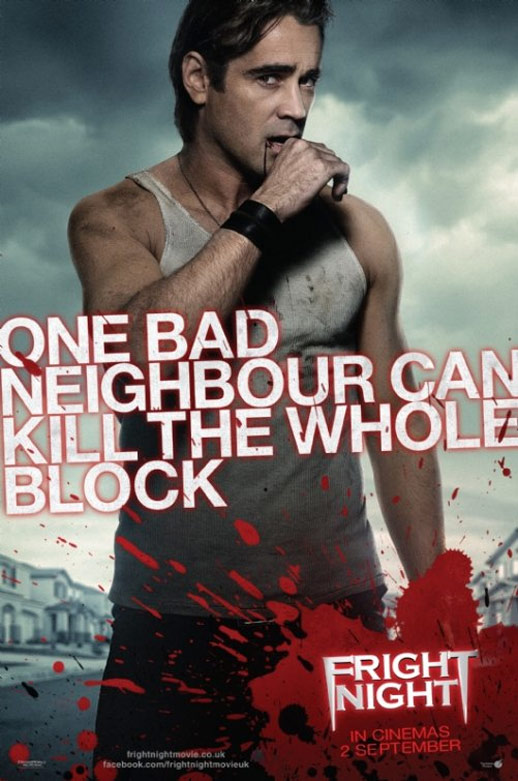
Fright Night


I promise this review will contain no ranting about the Twilight movies. In fact, from this point forward, Twilight will only be mentioned a total of three (3) times - including that previous one. Ok, glad that's out of the way.

The original Fright Night came out in 1985 and was a surprise box office hit - given horror movies don't frequently have a reputation as blockbusters. While its sequel, Fright Night 2, was far less well-received (its subsequent achievement of cult-film status notwithstanding) the real gem of the Fright Night movies turns out - oddly enough - to be this summer's remake.

The plot is pretty simple, and even borders on derivative. If you've seen the trailers it's no spoiler to say that the story revolves around a high-school teen (played surprisingly well by Anton Yelchin) who lives in a remote suburb near Las Vegas. His new neighbor Jerry (Hollywood bad boy Colin Farrell) seems a little strange. And as with all cases of strange neighbors, he turns out to be a vampire; don'tcha just hate it when that happens? From there, the movie gleefully - if somewhat predictably - makes its way through a veritable treasure trove of laughs and scares to a satisfying conclusion.

THE PROS:

Again, it's a pretty basic premise - even if the movie hadn't been a remake. And with the resurgence of vampires in popular culture via True Blood, The Vampire Diaries, and Twilight (reference #2), Fright Night stood an awfully good chance of getting lost in the white noise of pop culture.

What facilitated the exact opposite is definitely rooted in the film's performances. Yelchin is a bit of a step away from the traditional "jock" type leads that often populate movies of this breed. He's also not fully on track with the emergence of the more nerdy, awkward characters that have become a staple of the last 5 years or so - lookin' at you two, Michael Cera and Jesse Eisenberg! Yelchin falls somewhere in the middle, and consequently portrays a character who has an awkward streak but is confident enough to carry the film forward with a straight face. And while realism isn't the name of the game in a movie like this, Yelchin's portrayal is a more accurate representation of the high school every-guy and I think this leads to him being both more likeable and more relate-able.


Playing the menacing vampire neighbor to perfection, Colin Farrell is both sufficiently intimidating and seductive. It's really hard not to like him, even as he's gruesomely picking off characters left and right. Along with Yelchin and generally the rest of the cast, Farrell also brilliantly manages to play his character with just enough camp to make the movie as much fun as it is frightening.

David Tennant, who plays the "vampire" "slayer" (break in quotations intentional) Peter Vincent, provides the majority of the comic relief in the movie and is yet another solid score for the casting director. Tennant's presence and comedic abilities could have very easily derailed the movie and turned it into a wacky, one-liner exercise in silliness. But his performance adds just enough humor to give Fright Night a very well-rounded feel.

As evidenced through the casting and direction, Fright Night is a movie that walks a thin line between excess goofiness and excess gore. Several opportunities arose during the course of the film where you could almost feel the movie just about to lose its balance between the two. But it never does, and the result is a movie that doesn't take itself too seriously, while taking itself just seriously enough.

Ramin Djawadi's score is pitch perfect, utilizing the back-and-forth string motifs that characterize most horror films and evoke classics like Jaws. The occasional presence of an organ also harkens back to earlier horror film scores while blending with elements of more modern orchestral arrangement. Like the film itself, the score confidently samples elements of different periods and genres and the resulting music is as finely tuned and balanced as the movie.

THE CONS:

I saw the film in 2D, and I'll confess that had I known what I was going in for I would have paid the extra for the 3D. A handful of gags and moments bend the fourth wall (without completely breaking it) in favor of exploiting the 3D technology and without the 3D experience they feel just a bit out of place. The least subtle of these examples occurs during a chase scene in which the camera remains in a car with the movie's protagonists as Jerry attempts to run them off the road in his truck. As the camera pans around and the collision of vehicles sprays glass at the screen, I felt for a brief moment as if I were on a 3D ride at Disney World or Universal Studios. In 3D, the experience might have been a bit more thrilling and a bit less distracting - but such as it was the scene still didn't fully halt the film's momentum.

Toni Collette's performance as Yelchin's Mom just barely misses the mark, and in just a handful of scenes it almost feels like she's flirting with him. It's not distracting enough to ruin the movie at all, but whenever she's not screaming and fleeing in terror she has a strange grin on her face that just won't...can't...won't go away.

THE VERDICT:

Fright Night plays out like a walk across a very high tight rope. And when the movie finally makes it to the other side without any slips or falls, the result is a very satisfying movie-going experience. I've never had so much plain ol' fun in a horror movie, as usually I enjoy horror movies purely as visceral thrills. Fright Night will probably draw its fair share of comparisons to Zombieland, insomuch that both films blended horror and comedy elements for a memorable movie-going experience. Fright Night resides a bit more on the horror end of the spectrum than Z-Land but for the effects it was trying to achieve that works to its advantage.


My personal feelings towards the recent vampire trends aside, Fright Night does a good deal to bring vampire movies "back." As Christopher Mintz-Plasse (who plays Yelchin's former best friend Eddie) states early in the film "He's a real monster and he's not brooding or lovesick or noble. He's the f***ing shark from Jaws!" As such, he obviously doesn't sparkle (we'll call that reference #3, shall we?), and not that I expected him to - but it was definitely fun to see a vampire that didn't show up in mirrors or on video cameras and couldn't come inside unless he was invited.

The movie also scores MAJOR points as a horror movie on account of the fact that the main characters don't end up doing the stupid things that lead to most horror movie deaths. I hesitate to use the word "realistic" but it's very refreshing to watch a set of characters NOT forget to pick up those weapons and NOT always "go investigate" every suspicious noise. (Even whey they do, they're relatively smart about the way they go about that, as well!)

Fright Night is everything a solid remake should be, referencing just enough of the original (Chris Sarandon, who played the villain in the original, makes a brief appearance) while exploring new territory of its own as well. Moreover it's a solid horror movie and a solid comedy, in its own way. I'll definitely be getting this when it comes out on DVD. Scratch that, BluRay. And I'll probably go see it again in 3D, because I don't remember having that much fun sitting by myself in a movie theater in a long time.

Tuesday, August 30, 2011

Born of Osiris - "The Discovery"


Born of Osiris is a band that has wholly accomplished one of the greatest challenges in the market today: individuality. To be sure, their brand of progressive deathcore isn't without its fair share of "comparables" - but Born of Osiris as a band has managed to hollow out a distinct territory for themselves and create a sound that is uniquely theirs. It's difficult to mistake a Born of Osiris album or song for something from, say, label-mates Veil of Maya or After the Burial. The journey to that achievement spanned 2 albums and their first EP released in 2007 under the name Born of Osiris (previously known by the moniker Rosecrance). But their latest release, The Discovery, is the piece that solidifies their accomplishment.

THE PROS:

Just about everything. Yeah, it sounds like a cop out but from the moment lead vocalist Ronnie Canizaro growls "Follow the signs!" and the band comes in full on the opening track called, well, "Follow The Signs" - it's clear this album is going to (for lack of a less cliched phrase) BRING IT.

The increasingly intricate and flawless musicianship from previous releases is back with a vengeance. Albums like this are the ones you can push in the face of people who don't believe metal is actual music because it's impossible to deny, whether you like the music or not, that this album is filled to the brim with near-virtuoso levels of musical mastery. Born of Osiris makes extensive use of their keyboardist, Joe Buras; a decision that only adds to the greatness of their music and to this album specifically. Whole instrumental tracks/interludes are dedicated to a keys-only approach. This is in keeping with subtle musical "hints" on previous albums The New Reign and A Higher Place, with each giving more room, respectively, to the dominance of the keyboard. On A Higher Place, this was best showcased during the outro to the fourth track "Now Arise" in which an almost hip-hop beat was overlaid with eerie and ethereal choir and bell effects while Canizaro screamed the song to conclusion. Another similar moment (incidentally also on the fourth track) appears on The Discovery; "Devastate" concludes with a bassline and drum loop that sounds like something off of some gangster rap album. But the accompanying keyboard effects and musicality evoke something more akin to the soundtrack for a Tim Burton film. It's one of the most fun moments on the album.

The other great strength of the album is how it was mixed and mastered. Where The New Reign used a kind of raw approach to mixing for effect and A Higher Place favored less bass-oriented mixing for a leaner sound - The Discovery finds a perfect harmony between the two. Combining a slick and professional mixing job with the thunderous force of (what must be) every instrument turned up to 11, The Discovery feels like Born of Osiris has arrived at a complete and confident balance.


A few tracks of note are the previously mentioned opener, "Follow The Signs." Amidst the crashing of cymbals and the collision of double-bass and palm-muted guitars, the melody is still clear and discernible. "Devastate" is my personal favorite from the album, as it showcases all the best bits of Born of Osiris in a single track. I live for musical moments like those in the midst of "Devastate," where a doom-like melody and choral effect backs up the phrase "System Failure" screeched at the top of both Canizaro and Buras' lungs while the accompanying breakdown literally sounds like the walls of a skyscraper collapsing down upon the listener's ears. In keeping with Born of Osiris' experimental spirit, one of the instrumental interludes ("The Omniscient") sounds like something from an Enigma album...or ambient spa music...or a porno from the 90s. Either way, it's something markedly different for the band overall; but coupled with the band's musical confidence and presence, the track still doesn't feel out of place and only contributes to the achievement of the album as a whole.

THE CONS:

There really aren't any, and I'm not being hyperbolic. The Discovery has a run-time that's just a couple of minutes shy of being as long as their previous two releases combined; but when the music is this satisfying, that's a very good thing. There are a handful of spots that bring the word "repetitive" to mind, but they're few and far between enough to be easily ignored. Apart from that, there's precious little I can think of on the negative side - and I've listened through the entire album several times. The flip-side of such an accomplishment, though, is that the next release has that much more of a hurdle to overcome.

THE VERDICT:

The Discovery is the best Born of Osiris release to date. The album very much feels like a culmination of efforts for the band. As such, it may be difficult for the band to top this release without straying too far from their sound. But even if this is as good an album as Born of Osiris ever releases, it will still remain to prove that Born of Osiris is one of the greatest bands on the scene today. And in a scene that's inexplicably sprinting towards higher levels of mediocrity and bafoonery - that's not only an accomplishment, it's a borderline miracle.